Saturday Oct 17, 2026
Saturday Oct 17, 2026
Tuesday, 1 September 2026 03:50 - - {{hitsCtrl.values.hits}}
Nine years ago, a small guesthouse in Negombo began hosting guests the way almost no Sri Lankan property had before: entirely in sign language. That guesthouse, Lilly Palace Villa, has since welcomed more than 1,000 travellers from over 15 countries and holds a 4.8-star rating, and it is now the foundation of what its founders hope will become one of the island’s newer tourism export categories.
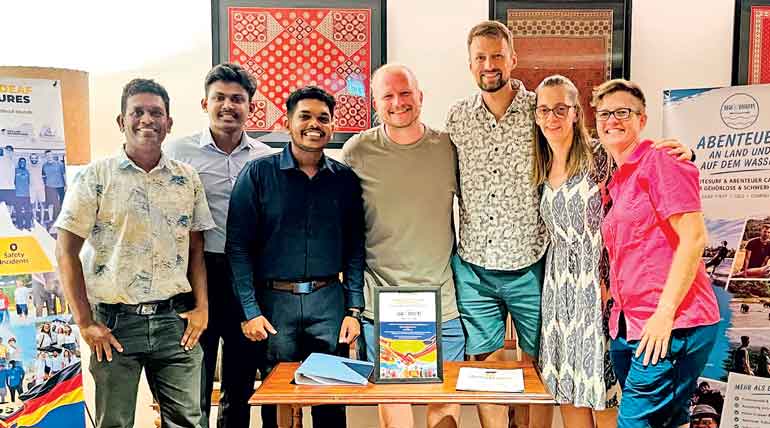
Ceylon Deaf Adventures (CDA), the Negombo-based inclusive travel enterprise that grew out of that homestay, has signed a Memorandum of Understanding with DeafVentures of Germany. Announced on August 20, the agreement is understood to be the first cross-border Deaf tourism partnership formalised by a Sri Lankan operator, and it converts an already-working relationship into a structured, ongoing one.
The two companies had already run a joint inbound tour before the MOU was signed , a fully accessible itinerary for confirmed German Deaf travellers, guided in sign language from the moment they landed to the moment they left. The agreement now gives that collaboration a framework to continue: CDA and DeafVentures will jointly develop, market and operate Deaf tourism packages connecting the two countries.
Deaf and hard-of-hearing travellers make up a sizeable, and largely unaddressed, segment of global tourism demand. The gap has rarely been about attitude, it is infrastructure: few destinations have guides, operators or accommodation providers who work natively in sign language rather than treating accessibility as an afterthought. By CDA’s own reading of the global Deaf travel landscape, no other dedicated inbound Deaf tourism operator exists anywhere in South Asia, leaving the field largely open.
That matters commercially because Sri Lankan tourism competes on relatively thin margins against every other sun-and-culture destination. A niche with almost no direct regional competition, unusually high traveller loyalty, and a tightly networked international community , the kind that produces referrals rather than one-off bookings, is a different kind of proposition. Germany already anchors CDA’s inbound numbers, and DeafVentures supplies the source-market credibility and distribution needed to turn that into a recurring, packaged pipeline rather than occasional group visits.
Behind the partnership is a personal story. Founder and CEO Praveen Waas is a CODA - a Child of Deaf Adults raised moving between the Deaf and hearing worlds, and fluent in Sinhala, Tamil, English and sign language. Lilly Palace Villa, run by his family since 2017, was Sri Lanka’s first Deaf-friendly homestay; CDA, formally launched in November 2025, was built to carry that same model sign-language guiding paired with accessible logistics and Deaf-owned hospitality , beyond a single guesthouse. It has since hosted several Deaf tourist groups, and the DeafVentures MOU marks the first time that model has been extended into a formal international partnership.
It is precisely this combination a commercially defensible niche, a first-mover position, and a measurable inclusion outcome that tends to catch the attention of development partners, impact investors and SDG-aligned funders.
“This MOU is bigger than two companies. It’s the first bridge between Sri Lanka and the global Deaf community, built in our own language. We’re proving that accessibility isn’t a cost it’s a market, and it’s one Sri Lanka can lead,” said Praveen Waas.




