Thursday Mar 12, 2026
Thursday Mar 12, 2026
Wednesday, 11 February 2026 00:18 - - {{hitsCtrl.values.hits}}
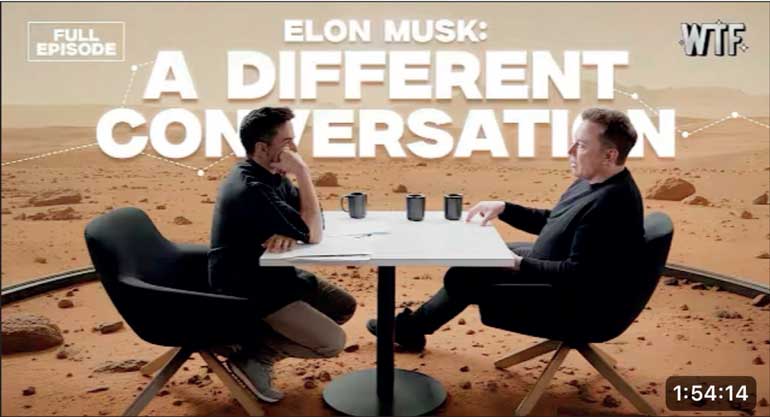
Elon Musk on the future of skills and technology
 Recently, a post went viral quoting Elon Musk from a podcast, suggesting that AI could make learning skills “unnecessary.” A closer reading shows his remarks were predictive, not definitive: some hard skills may be overtaken by AI, but learning itself will not become irrelevant. While this thought unsettles many, the reality is clear. Hard skills can be automated; soft, human-centred skills cannot. I am often asked, as AI advances across boardrooms, classrooms, and workplaces: if machines can think and create, do human skills still matter? The answer is unequivocal—AI will not make learning unnecessary; it will make it indispensable, and human-centred soft skills cannot be fully replaced.
Skills matter
AI and Tech is not eliminating the need for skills—it is redefining which skills matter. For much of the last century, education and professional development focused on acquiring a fixed body of knowledge and applying it repeatedly over a career. That model is becoming obsolete. AI systems can process vast amounts of information, draft reports, run analyses, and automate routine decision-making far faster than humans. Skills based purely on repetition or recall are increasingly being augmented—or replaced—by machines. Yet this does not diminish the role of people. On the contrary, it elevates it. In an AI-enabled world, uniquely human capabilities—judgment, ethical reasoning, contextual understanding, relationships and accountability—become more valuable, not less. AI can generate options, but humans must decide which path to take and bear responsibility for the consequences. This is particularly true at leadership and board levels, where decisions carry strategic, social, and reputational weight that no machine can fully comprehend. Moreover, as automation and AI take over routine tasks, uniquely human capabilities—soft skills—become more important, not less. Employers want people who can think critically, build relationships, show resilience, solve problems, engage effectively, and exercise judgment in complex situations. Soft skills, therefore, cannot be replaced by AI. Hard skills, on the other hand, can increasingly be automated.
The real shift
The real shift is from learning fixed skills to learning how to learn. As technology advances at unprecedented speed, the shelf life of technical skills is shrinking. Directors, executives, and professionals can no longer rely solely on qualifications earned decades ago. Continuous learning, adaptability, resilience, the ability to question meaningfully, and intellectual curiosity are becoming core competencies. As Musk points out in the podcast , college or university may no longer be required solely to acquire specific skills, but higher education still holds value for social development, career opportunities, building resilience, networking and broad intellectual exposure. Professional qualifications such as CIMA, ACCA, CIM or CFA that develop critical technical skills and problem-solving abilities will integrate most effectively with technology and AI.
Conclusion
AI is redefining what it means to be skilled. The ability to ask the right questions of AI systems, critically interpret their outputs, and recognise their limitations is now essential. Digital literacy is no longer just about coding; it is about understanding how technology shapes decisions, incentives, and outcomes, and knowing when to rely on machines versus human judgment. Equally important are skills AI cannot replicate: leadership, empathy, negotiation, resilience , relationships, creativity, and the ability to align diverse stakeholders behind a shared purpose. In times of disruption—economic, technological, or geopolitical—organisations do not turn to machines for moral guidance or strategic reassurance. Countries turn to people. For boards and institutions, this shift carries a clear implication: investment in human capital must not slow because of AI; it must accelerate and evolve. Certainly, some job-specific skills may become redundant as AI takes over routine tasks. But AI will not replace skilled people—it will replace people and organisations that stop learning. In the years ahead, learning and CPD will no longer be a phase of a professional career. It will be the career itself. In the final analysis, blind trust in algorithms can be as dangerous as ignoring them altogether. Human skills will therefore remain relevant—and essential.
References




