Friday Oct 09, 2026
Friday Oct 09, 2026
Tuesday, 10 February 2026 03:51 - - {{hitsCtrl.values.hits}}
By Amira Cader
Cambridge University Press & Assessment formally introduced Linguaskill to Sri Lanka yesterday at the Courtyard by Marriott, Colombo, with a strong focus on the role of English in workforce readiness—particularly as Sri Lanka positions itself for a tourism-led economic recovery.
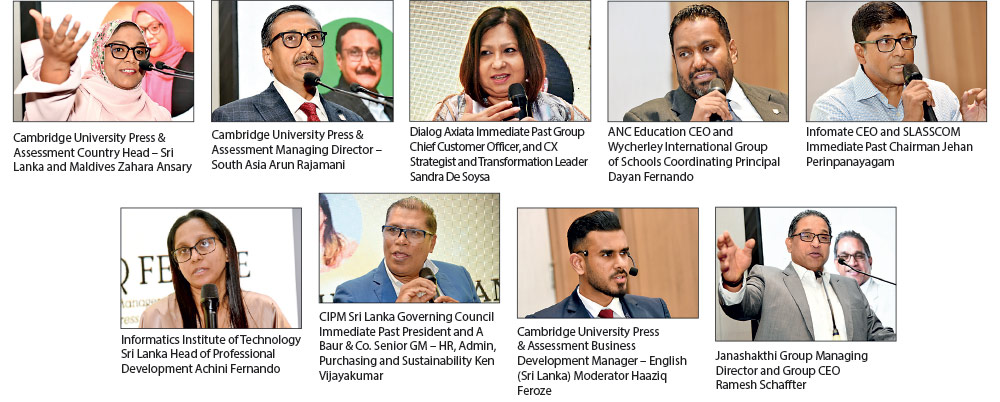
Delivering the keynote address, Cambridge University Press and Assessment Managing Director - South Asia Arun Rajamani said Linguaskill was designed to meet real-world needs.
“Employers and institutions require fast, accurate and internationally benchmarked evidence of English ability. Linguaskill delivers that, while supporting learners to meet global expectations,” he noted.
Cambridge University Press and Assessment Country Head - Sri Lanka and the Maldives Zahara Ansary said: “Linguaskill responds to a growing need in Sri Lanka for an accurate, reliable and internationally benchmarked English assessment. It enables institutions and employers to measure real-world communication skills while supporting learners and professionals to meet global standards.”
Linguaskill is a certificated English proficiency exam that delivers fair, accurate and reliable results, giving employers and recognising bodies confidence in an individual’s language ability. The assessment is offered in two formats — Linguaskill Academic and Linguaskill Business — tailored to higher education and workplace contexts respectively.
Candidates receive a certificate featuring in-depth reporting on each module completed, along with an overall average score. The assessment incorporates advanced built-in security technology and is aligned to the highest levels of the Common European Framework of Reference (CEFR).
Delivering the inspirational address, Janashakthi Group Managing Director and Group CEO Ramesh Schaffter underscored the pivotal role of English as Sri Lanka seeks deeper integration with the global economy.
“English serves as a vital link connecting the country to international markets, knowledge systems and opportunities and it should not be viewed merely as a link language,” he added.
Schaffter also pointed out that much of the world’s academic and professional knowledge base is available primarily in English. As a result, many Sri Lankans who are technically skilled and capable often find themselves disadvantaged due to language barriers, limiting their ability to progress, innovate and compete globally.
A high-level panel discussion, “Unlocking World-Class English,” brought together corporate, education and skills leaders to examine how gaps in English proficiency continue to limit employability and service quality, despite growing demand from global markets.
The session was moderated by Cambridge University Press and Assessment Business Development Manager – English (Sri Lanka) Haaziq Feroze who noted that the discussion reflected a shared urgency across sectors to address language gaps with credible assessment and targeted upskilling.
Speaking during the discussion, Dialog Axiata PLC Immediate Past Group CCO CX Strategist and Transformation Leader Sandra De Zoysa said English proficiency has moved beyond being a “nice-to-have” skill. “In sectors like tourism, BPOs and professional services, English directly impacts customer experience, confidence and credibility. When language fails, opportunity fails,” she noted.
Infomate CEO Jehan Perinpanayagam pointed out that while Sri Lanka has strong technical talent, language remains a bottleneck.
“We see capable professionals struggle to progress simply because they cannot communicate effectively in global business settings. Addressing English proficiency is essential if Sri Lanka is to remain competitive,” he said.
A. Baur and Co. Senior General Manager – HR, Admin, Purchasing and Sustainability Ken Vijayakumar stressed the importance of objective assessment.
“Employers need reliable tools to measure real workplace English, not just academic knowledge. Standardised assessment helps us recruit, train and promote with confidence,” he said.
Highlighting the education sector’s role, ANC Education CEO and Wycherley Group of Schools Coordinating Principal Dayan Fernando said early and accurate benchmarking was critical.
“If we align learning outcomes with global standards from school to workplace, we can close the gap between education and employability,” he said.
Informatics Institute of Technology (IIT) Professional Development Unit Head Achini Fernando added that tourism and services growth would place new pressure on communication skills.
“As Sri Lanka boosts itself as a tourism destination, frontline workers need confidence in practical English. Language should not be a barrier to opportunity,” she said.
Linguaskill, Cambridge’s online, certificated English proficiency exam, is trusted by over 1,400 organisations worldwide, including international corporations such as Air France and higher education institutions such as RMIT University.
The launch event underscored a shared view among stakeholders that improving English proficiency is central to boosting employability, service excellence and Sri Lanka’s global competitiveness—particularly as tourism and export-oriented services continue to expand.




