Wednesday Sep 23, 2026
Wednesday Sep 23, 2026
Wednesday, 23 September 2026 04:40 - - {{hitsCtrl.values.hits}}
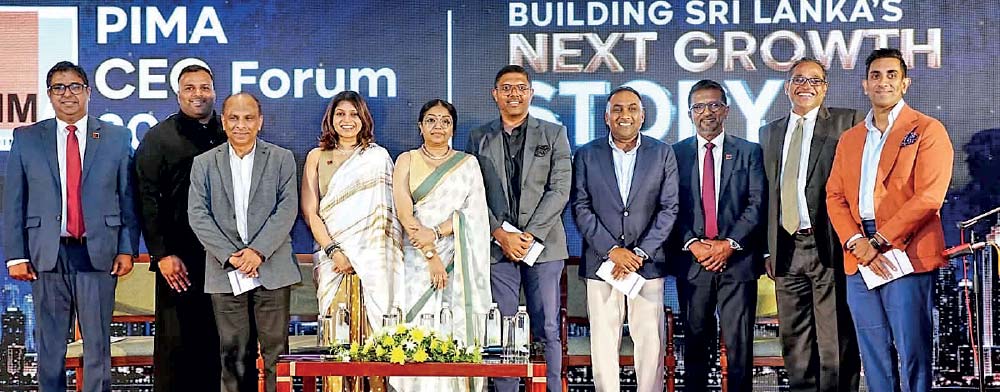
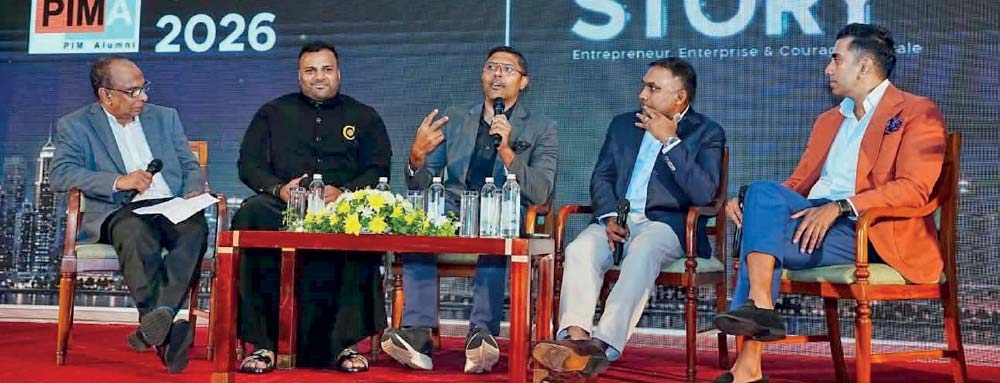
From left: Postgraduate Institute of Management Director and Moderator Dr. Asanga Ranasinghe, Celeste Founder and Managing Director Janik Jayasuriya, PickMe Founder and CEO Jiffry Zulfer, Global Sports Icon, Entrepreneur and Strategic Adviser Mahela Jayawardene and Spa Ceylon Co-Founder and Group Director Shalin Balasuriya
 We don’t ask how much growth we can achieve. We ask what value we bring to the table - Janashakthi Group Managing Director and Group CEO Ramesh Schaffter
By Safna Malik
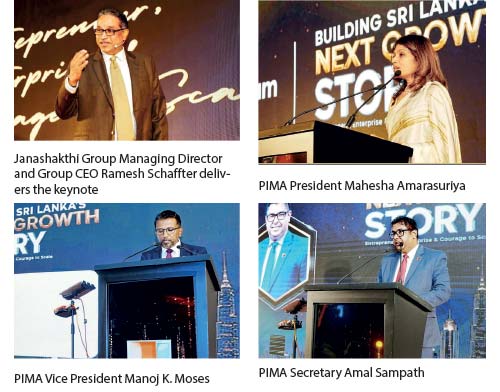 Sri Lanka’s economic opportunities and challenges came into focus as business leaders and entrepreneurs shared insights on driving growth, fostering entrepreneurship, encouraging innovation and attracting investment at the PIMA CEO Forum 2026, organised by the PIM Alumni Association (PIMA).
Speaking at the event, PIMA President Mahesha Amarasuriya said the future was not something to inherit or wait for, but was built through decisions made today, risks taken, innovations pursued and courage shown during uncertain times.
She said sustainable growth required bold ideas, resilient enterprises and visionary leaders willing to think bigger, move faster and scale beyond their comfort zones. Sri Lanka had repeatedly shown remarkable resilience by recovering and reinventing itself through continuous challenges. True growth, she added, came from turning ideas into impactful enterprises and dialogue into action that contributed to the nation’s socio-economic development.
“We don’t ask how much growth we can achieve. We ask what value we bring to the table,” Janashakthi Group Managing Director and Group CEO Ramesh Schaffter said, outlining the disciplined approach to mergers and acquisitions (M&A) that has supported the Group’s expansion from 32 employees in 1992 to a financial conglomerate with around 2,000 employees.
Delivering the keynote, he reflected on his family legacy and personal experience, recalling how early entrepreneurial courage laid the foundation for Janashakthi Group. Now rebranded as JXG, identifies potential deals that bring unique value through technology, distribution, industry insight or talent. Without a clear value proposition, he said, acquisitions become costly exercises in scale rather than synergy.
He also stressed the importance of integrating existing employees into the organisation’s culture, assuring job security while upholding five core principles: integrity, collaboration, respect, performance and innovation.
JXG has developed solutions that had previously not existed in the market, including lifelong medical cover that helped reshape expectations in the insurance sector. The focus, he noted, was on creating new opportunities rather than securing its position in existing markets. Schaffter also highlighted three central concepts: driving meaningful impact for society and the world, operating with clear purpose and consistently adding value.
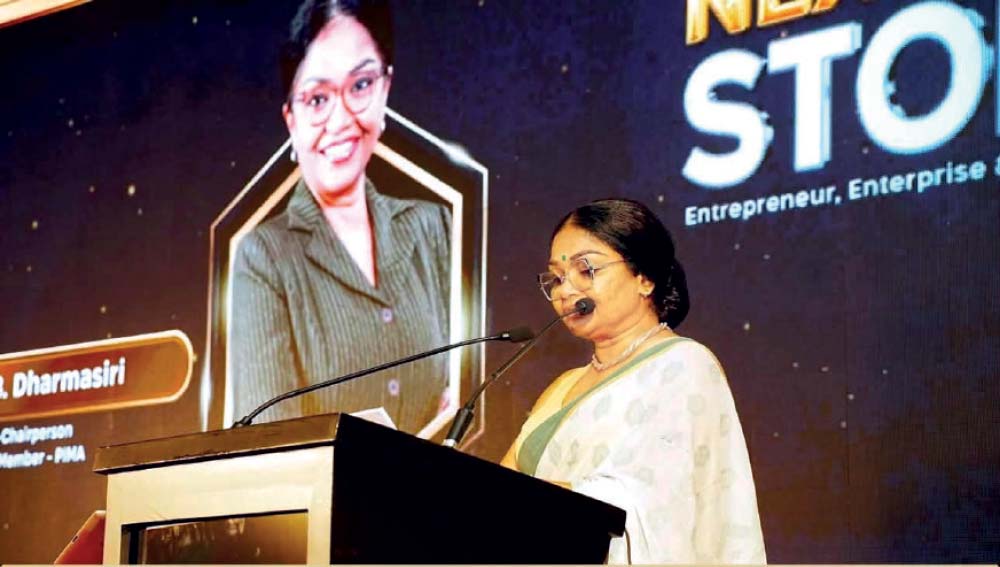
Independent Consultant Marketing and Brand Specialist; PIMA Committee Member Nadi B. Dharmasiri
Just having that courage to explore and do something different - Global Sports Icon, Entrepreneur and Strategic Adviser Mahela Jayawardene
Looking ahead, he said JXG was assessing several acquisition opportunities while exploring regional expansion. However, the Group would enter new markets only where its operational expertise, brand strength or sector knowledge could create measurable value for the businesses acquired and its shareholders.
“Sri Lanka is a beautiful country with massive potential,” he said, pointing to sectors such as tourism and regional trade while calling for clear, execution-driven national planning to support long-term economic stability.
Technology and AI will redefine every industry. You must adapt to new tools - PickMe Founder and CEO Jiffry Zulfer
The panel discussion featured prominent personalities from different sectors, including Global Sports Icon, Entrepreneur and Strategic Adviser Mahela Jayawardene, PickMe Founder and CEO Jiffry Zulfer, Spa Ceylon Co-Founder and Group Director Shalin Balasuriya; and Celeste Founder and Managing Director Janik Jayasuriya. The discussion was moderated by Postgraduate Institute of Management Director Dr. Asanga Ranasinghe.
Jayawardene spoke about his leadership experience, from international sport to entrepreneurship and venture building. Noting that playing in a national team environment taught him how to handle both victory and defeat, strengthening the importance of ethics, integrity and resilience.
He shared that his extensive background in team sports made managing diverse personalities natural, emphasising that effective leadership begins with active listening and understanding people on a personal level. Jayawardene explained that these insights helped him build strong organisational cultures across his business ventures.
He also shared the story behind his investment in Ministry of Crab (MOC), noting that it began simply from a shared passion for food with Kumar Sangakkara and ultimately evolved into a successful 15-year venture through a willingness to take risks and explore new ideas.
Zulfer, meanwhile, spoke about the story behind launching PickMe and the challenges he faced. He recalled that when PickMe was founded, many were sceptical, saying Uber would soon enter Colombo and the company would not survive.
He said even potential investors refused to back the business because Uber was expected to enter the market and offer deep discounts. For him, this was part of what entrepreneurship was like taking risks to prove that the idea could work.
The only way you are going to get noticed is if you’re different and authentic. Pay attention to speed and be willing to evolve- Spa Ceylon Co-Founder and Group Director Shalin Balasuriya
Despite raising only $ 5 million compared with the much larger capital available to its competitor, PickMe was able to compete by understanding local problems, Sri Lankan consumer behaviour and the local market dynamics. He said being agile and staying close to the local market helped the company compete with multinational players.
Zulfer said businesses needed to keep up with the rapid changes brought by technology and AI. He noted that traditional roles and business practices, including retail and software engineering, were changing quickly. PickMe, he said, also recognised that its technology could become outdated within a few years if it failed to adapt.
Reflecting on his role on the GovTech board, he urged entrepreneurs and the country to embrace AI and new tools. He said technology had made it easier for more people to write code and develop software.
He encouraged business leaders and aspiring entrepreneurs to overcome the fear of taking risks, assess where technology can add value to their operations, and take the lead in staying relevant in the future.
Balasuriya shared his perspective on brand building, drawing on his experience of scaling a Sri Lankan enterprise internationally across more than 25 countries, including the United States, and a journey shaped by courage and value creation.
Reflecting on the heavy scepticism they faced when starting out, he noted that many criticised their attempt to sell a premium wellness and luxury cosmetics product from a small, largely unknown developing island. He explained that when they attended global industry fairs, people had no idea where Sri Lanka was, often failing to connect Ceylon Tea with the country itself.
Despite these challenges, Spa Ceylon 17 years later, had become the world’s largest luxury Ayurveda brand and was working towards becoming a global leader in natural cosmetics and wellness. He emphasised factors that hold them back, such as traditional Ayurveda and their local island origin, became their biggest unique selling propositions (USPs).
Our goal is to become the “McDonald’s of grocery”, focusing on process efficiency, speed and rapid order fulfilment - Celeste Founder and Managing Director Janik Jayasuriya
Every aspect of the brand, from the ingredients, science and packaging design to the store aromas and background music, is deeply rooted in Sri Lanka. He said in a globalised marketplace, success requires standing out through genuine differentiation and authenticity, proving that taking the initial step to put their Sri Lankan identity at the forefront ultimately paid off.
Balasuriya outlined three crucial actions businesses must take to build and thrive in a changing global environment: willingness to evolve and adapt, capitalising on speed, and mentoring and coaching the next generation.
Jayasuriya discussed the rise of quick commerce and how digital transformation, human-centric strategies and risk-taking are reshaping retail. Addressing the common industry perception that quick commerce is not profitable, he shared the challenges behind building Celeste and what led him to enter the high-risk sector.
Jayasuriya explained how the pandemic disrupted his hospitality business, leading him into fresh produce distribution and a partnership with PickMe for last-mile delivery. As restrictions eased, he realised that moving consumers from supermarkets to online grocery shopping required a completely new approach. He said this led him to aim to become the “McDonald’s of grocery”, focusing on process efficiency, speed and rapid order fulfilment.
He added that seeing PickMe and Spa Ceylon grow from Sri Lankan roots gave him the confidence to challenge traditional retail models despite the steep operational risks involved.
The panel noted that the discussions came at an important time for Sri Lanka as the country seeks to strengthen its economic recovery and build a more sustainable foundation for future growth.




