Monday Sep 28, 2026
Monday Sep 28, 2026
Tuesday, 11 August 2026 01:32 - - {{hitsCtrl.values.hits}}
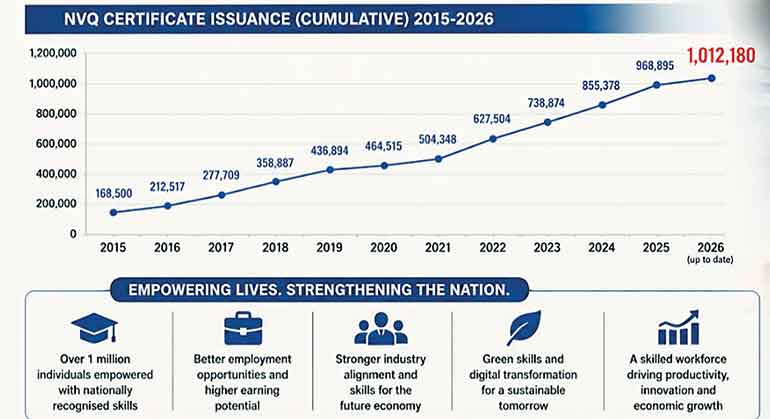
 On 12 August 2026, Sri Lanka will celebrate a landmark achievement as the nation marks the awarding of One Million National Vocational Qualification (NVQ) Certificates at the Bandaranaike Memorial International Conference Hall (BMICH).
The ceremony, to be graced by Prime Minister Dr. Harini Amarasuriya and Education and Higher Education Deputy Minister
Dr. Nalin Hewage, is far more than a ceremonial event. It celebrates one of Sri Lanka’s greatest investments in human capital and reaffirms the country’s commitment to building a skilled workforce for sustainable economic growth.
Introduced in 2005, the National Vocational Qualification (NVQ) Framework has become Sri Lanka’s national benchmark for quality-assured technical and vocational education and training (TVET). It provides nationally recognised, competency-based qualifications that are increasingly accepted by industry both locally and internationally.
Collective efforts
This remarkable achievement has been made possible through the collective efforts of the Education, Higher Education and Vocational Education Ministry, and Vocational Education, the Tertiary and Vocational Education Commission (TVEC), VTA, NAITA, DTET, NYSC, Ocean University, NIFNE, University Colleges, private training providers and thousands of trainers, assessors and employers working together under a single national qualification framework.
The progress achieved during the past five years has been exceptional. Despite the COVID-19 pandemic and the economic crisis, the TVET sector remained resilient, awarding more than 500,000 NVQ Certificates during this period alone. Annual certification has now consistently exceeded 100,000 qualifications, reflecting growing confidence among young people, employers and training providers in the NVQ system.
However, the true significance of this milestone lies beyond the numbers. One million NVQ Certificates represent one million individuals equipped with recognised skills, improved employability and better opportunities for productive employment and entrepreneurship. A skilled workforce is the foundation of a competitive economy, and every NVQ graduate contributes directly to national productivity and economic development.
The celebration of One Million NVQ Certificates is therefore not simply a recognition of past achievements. It marks the beginning of a new era in which skills, innovation and lifelong learning will become central pillars of Sri Lanka’s economic transformation. As the country aspires to become a competitive, knowledge-based economy, investment in vocational education and skills development will remain one of its most valuable national assets
Sri Lanka’s TVET sector
Sri Lanka’s TVET sector has also undergone significant transformation in recent years. Digitalisation has improved quality, transparency and efficiency through online accreditation, digital certificate verification, online assessment question banks and modern learner services. The CareerOne platform, developed with the support of KOICA and UBION, has further strengthened career guidance by connecting learners, training providers and employers through an integrated digital platform.
Recognising the demands of the future economy, Sri Lanka has also embraced Green TVET, integrating green competencies into National Competency Standards and curricula while developing a National Green TVET Policy. At the same time, stronger industry partnerships have ensured that training programs remain aligned with labour market needs through employer participation in curriculum development, apprenticeships, Recognition of Prior Learning (RPL) and competency-based assessments.
Looking ahead, the Government has placed skills development at the centre of its education and economic reform agenda. Increased investment in the TVET sector and forthcoming education reforms will introduce vocational subjects as a dedicated stream at the G.C.E. Advanced Level while integrating vocational learning into the G.C.E. Ordinary Level curriculum. Students will have the opportunity to obtain NVQ Levels 3 and 4 while still in school, creating seamless pathways between general education, vocational education and higher education.
Rationalisation of the TVET sector
In parallel, the Government is implementing a comprehensive rationalisation of the TVET sector through a modern institutional framework that will strengthen district training centres, establish specialised NVQ Level 5 and 6 institutions, and further develop TVET universities. These reforms will optimise public resources, improve quality, strengthen centres of excellence and enhance industry collaboration, creating a more efficient, flexible and future-ready skills development system.
The celebration of One Million NVQ Certificates is therefore not simply a recognition of past achievements. It marks the beginning of a new era in which skills, innovation and lifelong learning will become central pillars of Sri Lanka’s economic transformation. As the country aspires to become a competitive, knowledge-based economy, investment in vocational education and skills development will remain one of its most valuable national assets.
The journey to one million is a remarkable national achievement. The journey beyond one million will define Sri Lanka’s future.
(The author is the Director General/CEO of the Tertiary and Vocational Education Commission (TVEC), Education, Higher Education and Vocational Education Ministry, Sri Lanka)




