Thursday Oct 15, 2026
Thursday Oct 15, 2026
Thursday, 15 October 2026 00:39 - - {{hitsCtrl.values.hits}}
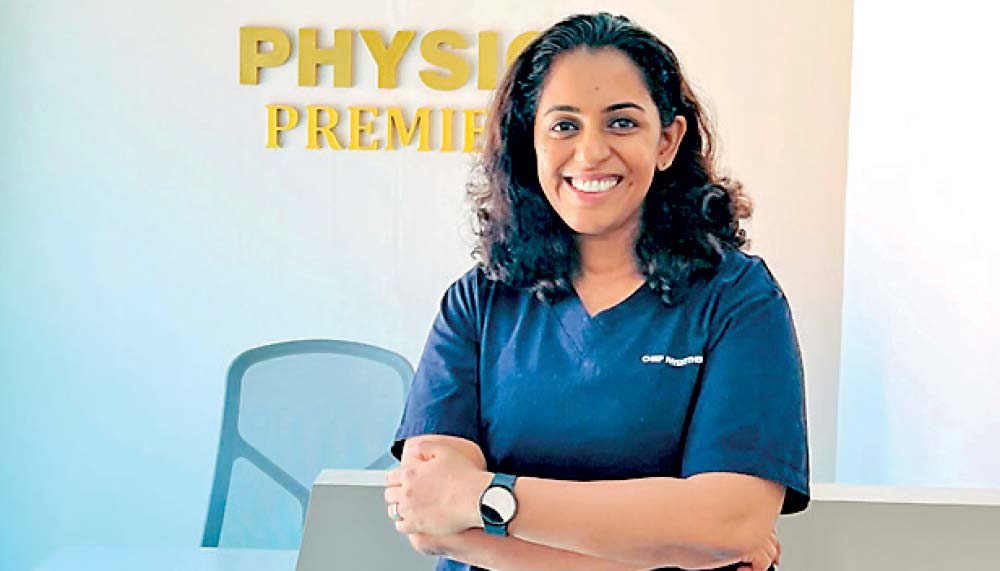
Nilakshi Kasilingam
The corporate ladder is enticing and promises much success, but too much time at the desk can quietly render you sedentary, diminishing one’s ability to indulge in the fruits of that labour. People are often unaware of how easily this could happen, and it often happens as a result of people making their lives a bit too easy, warns Nilakshi Kasilingam, Chief Physiotherapist at Physio Medicare.
“Sometimes people don’t even realise they are adapting their lifestyle around reduced mobility. They may start choosing slip-on shoes, for example, because bending down has gradually become uncomfortable. In Sri Lanka, many people decide to come in, for physiotherapy or a visit to the doctor, when they are at an extreme stage of discomfort. Then it’s not going to be that easy or comfortable. Physiotherapy, or simply looking after yourself, is not an expensive habit. It’s just that people don’t see the real value behind it,” Nilakshi avers.
A former Guest Lecturer at the Universities of Colombo and Peradeniya, Nilakshi says many people are unaware of the importance of constant movement.
“In my observations during corporate sessions, a surprisingly large proportion of participants struggle with at least one of the basic movements I ask them to perform.”
In many instances, when discomfort persists, people focus on managing the pain without necessarily addressing the movement or functional issue behind it. For many movement related musculoskeletal problems, physiotherapy can play an important role in addressing the underlying functional issue rather than focusing only on temporary symptom relief.
The problem, Nilakshi says, is that people don’t see the value of being active or mobile until a very late stage. We like to ‘take it as it comes’.
“We have to get moving at least once every hour. We always think at the end of the day, we’ll do an hour of exercise, but it doesn’t work like that for our body. Exercise is important, but movement shouldn’t be an appointment we keep for one hour a day. It should be built into our day.
“The body likes progression. Going from zero to a hundred overnight isn’t training, building capacity gradually is. Movement doesn’t always mean exercise. Small amounts of movement accumulated throughout the day matter too,” she said.
If people still can’t do enough and be mobile and end up with aches, pains and stiffness, Nilakshi hopes they would learn to recognise physiotherapy as an important part of managing movement-related issues. Physiotherapy is not just about pain management and mobility; it adds to the broader quality of life both at work and home over the longer term.
She gave examples where patients had undergone MRI scans and multiple investigations while trying to understand relatively common movement-related complaints.
“Not every musculoskeletal complaint requires imaging. A good clinical assessment can often help determine whether further investigation or referral is actually required,” Nilakshi said.
Nilakshi says she has addressed a number of corporate trainings and programs on the importance of mobility and physiotherapy, and whilst interest is on the rise, the commitment can wane with time.
“You would be surprised how weak some clients who come in are, and they are also very scared. Sometimes people become extremely anxious about symptoms before they have had an appropriate clinical assessment. The first step should be understanding the symptom properly and then deciding whether rehabilitation, medical referral or further investigation is required.
“The awareness of physiotherapy is growing, but the real understanding of its value is still missing from people’s minds. I would like that part to come out. If a movement-related problem persists, keeps returning or starts limiting what you can do, don’t simply learn to live around it. Get it assessed. People can save a lot of time and pain.”
Nilakshi adds that access to physiotherapy, specialised rehabilitation and public awareness is still uneven across Sri Lanka, particularly outside the main urban centres. Markets such as India have moved faster in adopting rehabilitation technology, specialised services and physiotherapy as part of mainstream healthcare.
“I don’t see that gap only as a weakness. I see it as an opportunity for Sri Lanka to build a much stronger rehabilitation and movement-health sector,” she said.




