Monday Sep 21, 2026
Monday Sep 21, 2026
Monday, 1 June 2026 00:00 - - {{hitsCtrl.values.hits}}
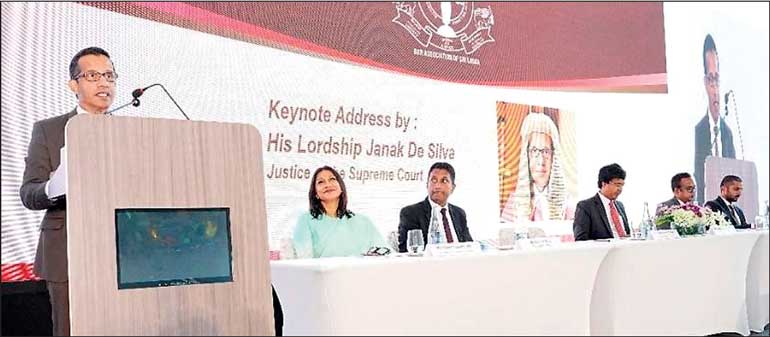
Supreme Court Judge Janak De Silva delivering the keynote address
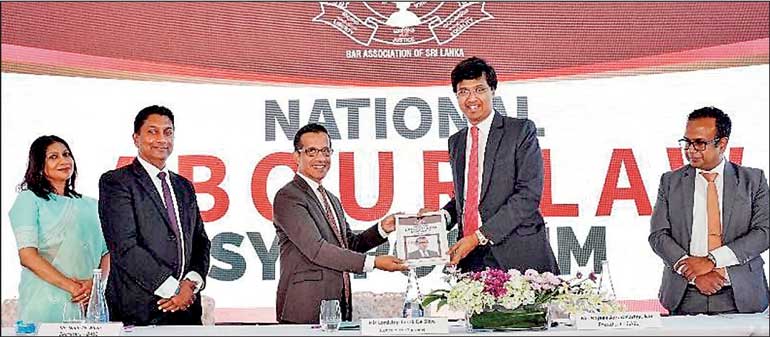
BASL President Rajeev Amarasuriya (right) presenting a token of appreciation to Justice Janak De Silva
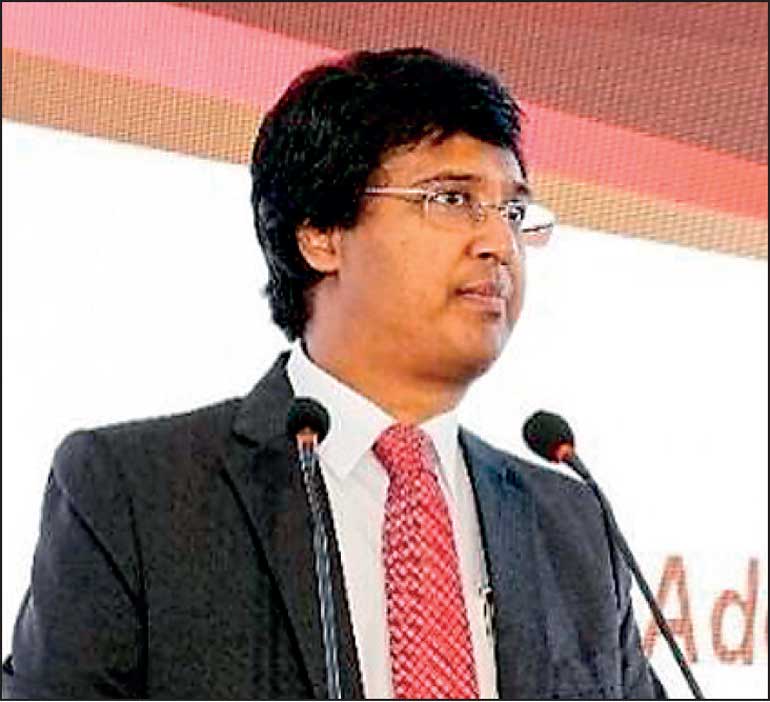
BASL President Rajeev Amarasuriya delivering the introductory address

The Bar Association of Sri Lanka (BASL) successfully concluded the ‘National Labour Law Symposium’ on 19 May 2026, bringing together the nation’s leading legal minds, policymakers, and industry leaders under the theme ‘Industrial Law in Transition: Evolving Laws for an Evolving Workplace’.
The landmark event, held after four-years, issued a powerful collective call for modernising Sri Lanka’s labour framework to meet the challenges of the digital age, the gig economy, and a new generation of workers.
The symposium, which saw a full house of legal professionals, addressed pressing issues from remote work and artificial intelligence (AI) to platform-based employment and sexual harassment. The event featured an extensive panel of resource persons, including Supreme Court Judge Justice Janak De Silva, senior counsel, labour administration officials, academics, and industry leaders.
Symposium Organising Committee Chairperson Manoli Jinadasa, welcomed the participants and outlined the importance of this symposium. She said “[A]s Gen Z increasingly becomes the backbone of the future workforce, a sound understanding of their perspectives and expectations will be critical in promoting harmonious industrial relations and sustainable organisational growth”. She further stated “today’s discussions will allow us to explore how legislation, judicial interpretation, and workplace practices are adapting to these rapid changes”.
From tradition to transformation: The need for change to meet the present realities
BASL President Rajeev Amarasuriya in his address emphasised that labour law must evolve with modern work realities and that the current labour law framework was designed for traditional workplaces and was no longer fully suited for the modern digital economy. He said “[A] legal framework designed for the factory floor of the 20th century cannot fully regulate the digital workplace of the 21th century”, and identified key emerging work trends such as remote and hybrid work, AI-assisted employment, freelance and platform-based work, cross-border digital services and flexible contracts and working hours as areas which need reform.
Amarasuriya also stressed the importance of protecting workers while also maintaining investor confidence and economic adaptability and said the challenge before us is how do we protect worker dignity while also ensuring economic adaptability and investor confidence. The possibility of mediation and alternative dispute resolution mechanisms for labour matters was encouraged.
He said that changing employment structures such as gig economy workers, freelancers and app-based workers, required change in existing legal categories that were included in the current laws. He highlighted the need for legal reform on remote and hybrid work on issues such as work-from-home reimbursement, digital supervision and monitoring, flexible working hours and the right to disconnect.
Amarasuriya also observed that Sri Lanka’s labour law framework consists of numerous overlapping statutes, making compliance difficult for both employers and employees and referred to the Shop and Office Employees Act; the Industrial Disputes Act; Wages Boards Ordinance; EPF and ETF laws; Maternity Benefits Ordinance; TEWA and the Factories Ordinance as some examples which may need simplification.
Speaking on AI and the future of work he acknowledged the rapid development of AI and emphasised that “[A]rtificial intelligence must be used to supplement and enhance human productivity, ensuring that human dignity is not eroded.”
He concluded that the symposium was described as a forum not only for academic discussion but also for generating practical reform proposals to be presented to policymakers and stakeholders.
A legal framework for the 21st century
Justice Janak De Silva, delivering the keynote address on the theme ‘Reforming Industrial Law for Tomorrow’s Workforce’ remarked that labour law remains one of the few areas of law where statutes, economics, politics, and human emotion all collide at once. He said “the challenge before us is therefore not merely legal reform. It is legal adaptation”. He added that “labour law is never merely about contracts. Labour law is about people.”
He warned that much of the country’s labour architecture belongs to ‘another century’ citing the rise of hybrid work, AI, and platform economies as urgent drivers for change.
He opined that “[W]e stand at a moment of profound transition. Our economy is changing, technology is changing, our workplace is changing and our workers are changing faster than statutes”, and with automation, he further added that “[H]ybrid work, platform work, outsourcing, freelancing, AI-assisted services, remote employment, and digitally managed labour” will be the norm.
Justice De Silva outlined five key principles for future reform: ‘Dignity’; ‘Flexibility’; ‘Fairness’; ‘Simplicity’; and ‘Adaptability’.
Technical sessions
The 6 technical sessions were conducted by eminent panelists from the legal fraternity, the corporate sector and the Government sector, addressing current issues related to the labour law framework in Sri Lanka. Panelists across multiple sessions grappled with the challenge of defining employment in a world of Uber drivers, freelance coders and AI-assisted management. The symposium explored how traditional “control” and “integration” tests are becoming obsolete.
Geoffrey Alagaratnam President’s Counsel commenced the first technical session with comments on the existing legal landscape which he said is outdated and hindered by political ideologies. He explained that labour legislation has been “in the pipeline” for seven years without any progress and the need to focus on prevention (mediation, skilled HR, ombudsmen) rather than cure (litigation). He added that women are underrepresented; and need part-time work options, night work safeguards (particularly in the BPO sector), and parity benefits. He observed that traditional tests to determine employment (such as the control and integration tests) are obsolete for modern IT and cross-border work. He also observed that the Termination of Employment of Workmen Act (TEWA) was a temporary measure that had lasted for too long; and concluded that the state needs an alternative social safety net.
Dynamics in the contract of employment
Panel Discussion 1 was on the ‘Dynamics in the Contract of Employment’ with BASL Treasurer Pasindu Silva moderating the session. President’s Counsel Geoffrey Alagaratnam, warned that outdated legal tests are hindering economic progress, adding that “[C]ontract labour is something that has come to stay, and that we must keep abreast with commercial developments. There can be ‘sui generis’ contracts — neither a ‘contract for service’ nor a ‘contract of service’, but with ingredients of both. We need new thinking, and most of all, a balanced vision to take our economy forward”.
Employers Federation of Ceylon CEO Vajira Ellepola, discussed the practical difficulties businesses face under Sri Lanka’s current labour law framework regarding leave, overtime, holidays, and working hours. He explained that the existence of numerous wage boards and different statutory systems creates confusion, inconsistency, and administrative burdens for employers.
He pointed out that different industries follow different leave calculations; overtime rules vary across wage boards, and the legal framework is highly fragmented and difficult for investors to navigate. Therefore, he advocated for a more uniform labour law system, simplified leave and overtime rules, and reforms that would make Sri Lanka more attractive for investment while still protecting employee rights.
Prof. A. Sarveswaran confirmed that Sri Lankan labour laws (as lex fori) apply to foreign ventures in Sri Lanka. However, he said exemptions may be possible for Port City investments and suggested bilateral treaties for cross-border enforcement of judgments.
Prasad De Silva, speaking on the rights of probationary employees explained that probation periods are intended to assess an employee’s skills, competence, and suitability for employment. He stated that although employers are generally considered the primary judges of probationary performance, terminations must be carried out in good faith and not maliciously.
Rohan Dunawila discussed transfers and said that employers can transfer if the contract allows it and it is done in “good faith” (not as a demotion or punishment). He introduced the concept of “employer of record” for future global HR platforms.
Employment in the digital world
Session 2 was on the theme ‘Employment in the Digital World’.
With the introduction of Sri Lanka’s Personal Data Protection Act (PDPA) and the rise of AI in HR, the symposium dedicated a full session to the digital world. Experts cautioned that AI-driven hiring and monitoring could introduce new forms of bias.
Former SLCERT Chairman Jayantha Fernando elaborated on the PDPA which he said is very much a law in the making and eventually the other sections and parts and the dates of operation of those provisions will be announced very soon. He spoke more specifically on the scope of personal data.
Attorney at Law Shanaka Gunasekara spoke on the labour law principles related to the process of using AI agents for the purpose of recruiting and analysing employee performances. He also stated “[I]f there is historical bias in the data, AI will not only perpetuate it but magnify it. Fairness by design is essential. AI alone cannot meet the ‘just and equitable’ principle for performance monitoring or termination”.
Deputy Solicitor General Kanishka De Silva Balapatabendi enlightened the audience on documenting digital data and corresponding legal obligations, and elaborated on the Evidence Special Provisions Act and the Electronics Transactions Act.
Rakitha Abegunawardhana discussed social media misconduct. An employer needs a clear policy. Private posts are only a concern if «directly harmful» to the company›s business or reputation. He said that a preliminary inquiry is required before termination.
Reshaping statutory obligations via digitalisation
Commissioner General of Labour Nadika Waththuhewa, presented her observations on ‘Reshaping Statutory Obligations via Digitalisation’.
She emphasised on the need to digitalise the labour law regime considering that the Department of Labour is overwhelmed (18K+ disputes in 2025 and 24K+ pending court cases) with only 469 inspectors and 9 legal officers. A key solution now in place is via the ‘Labour Community Platform’ (a single window for EPF/Central Bank and ETF claims). She also said that labour law reforms are focusing on 4 areas, namely, labour standards, occupational and safety hazards, industrial relations and trade unions.
Reshaping statutory obligations and social welfare
Panel Discussion 3 was on ‘Reshaping Statutory Obligations and Social Welfare’ moderated by Shamali Jayawardena.
President’s Counsel Chamantha Unambuwa spoke on how most gig and digital platform workers are currently unprotected in relation to EPF/ETF and gratuity payments and stressed that the law must evolve to prevent a generation of “working poor”.
Theja Tillekeratne discussing maternity benefits said that the private sector bears the cost of 84 days of leave. The informal sector is unprotected. She argued that removing the financial burden alone will not fix the hiring bias and spoke of the need to introduce childcare infrastructure and flexible hours.
Jeevan Gunatileke touched on the health benefits aspect and said that the current law only provides seven days of casual leave (including sick leave). Multinational companies offer additional benefits such as bereavement leave, sabbatical and attractive insurance policies to attract talent. He added that the law is outdated regarding work-from-home and hybrid models.
Isuru Lakpura spoke on the Workmen’s Compensation Act and said the 2022 amendment expanded occupational diseases (lead, arsenic poisoning), shifting a difficult “negative burden” to employers adding that compensation maybe claimed up to a maximum of Rs. 2 million, but reputational risk from compliance issues is high.
Panel Discussion 4 on ‘From Courts to Consensus the new Age of Dispute Resolution’ was moderated by Rakitha Jayatunga
President’s Counsel Uditha Egalahewa traced the history of trade unions commencing from the time of A.E. Gunasingha, who formed the first trade union in Sri Lanka and traced the developments up to date and said that trade unions must move from “destruction” to collaboration. Employers must negotiate with unions representing >40% of the workforce. He was against tripartite models as being prone to political interference.
Shenali Chang spoke on the topic of investigations and said that employers fail due to defective charge sheets and cited them as being vague, with no date/time, lack of preliminary investigations, predetermined outcomes, and disproportionate punishment and the need to address these issues when conducting investigations.
Court of Appeal Registrar Sanjeeva Fernando, commented that Labour Tribunals have fulfilled their mandate of accessible justice, but that delays are a problem and suggested UK-style panels where medical/technical experts sit with the judge for complex modern disputes.
Pradeep De Silva spoke on the Termination of Employment of Workers Act which was a ‘draconian’ law which prevented mass retrenchments in the 1970s, and now it needs reform. For example, he suggested the removal of the mandatory consent requirement and replacement of the same with a compulsory compensation formula. He further suggested that the Rs. 2.5M cap for high earners be removed.
Shanaka Amarasinghe speaking on appeals said they require depositing cash security. He said the new rules (post-Duropipe case) must be strictly enforced and warned that appealing an adverse order is expensive and risks higher costs if the employee wins.
Sexual harassment: Zero tolerance and cultural shift
A powerful final panel addressed sexual harassment in employment, revealing alarming statistics and calling for a shift from policy to practice.
President’s Counsel Mohamed Adamaly cited recent surveys indicating that 61% of women in Sri Lanka have experienced workplace harassment. He stressed that organisations must back zero-tolerance policies with rigourous action.
Shyamala Gomez spoke on the need for gender-sensitive, independent committees (with external members) and stressed that inquiries must be confidential, trauma-informed and held in neutral locations (e.g., hotel conference rooms, and not glass offices).
Attorney at Law Yasho Ravi Bakmiwewa highlighted Sri Lanka’s ratification of the ILO Convention C-190 on violence and harassment, calling for a dedicated law that extends beyond traditional employment to include gig workers, interns, and volunteers. She called for “a cultural shift which will provide dignity and respect at work as a necessity”.
Looking ahead
The symposium concluded with a clear consensus that Sri Lanka’s labour laws are at a historic crossroads. With the government currently reviewing labour reforms, the legal fraternity pledged to play a proactive role.
BASL Treasurer Pasindu Silva, delivered the closing remarks, acknowledging the hard work of the organising committee and the enthusiastic participation of all delegates.
The Bar Association of Sri Lanka confirmed that outcomes and proposals from the symposium will be formally presented to relevant policymakers and stakeholders to help shape the future of work.
The initiative was organised under the leadership of the BASL Labour Law Symposium Committee.




