Wednesday Sep 30, 2026
Wednesday Sep 30, 2026
Monday, 20 July 2026 04:02 - - {{hitsCtrl.values.hits}}
 Sri Lanka continues to experience an outflow of skilled professionals, although the trend has improved significantly. LinkedIn data showed that talent outflow declined by 45%, with professionals leaving the country falling from 55,358 in 2023 to 24,887 in 2026. Over 590,000 Sri Lankan professionals are active on LinkedIn, representing a 188% year-on-year increase, while time spent on the platform has doubled, highlighting growing engagement in professional networking and career development
By Amira Cader
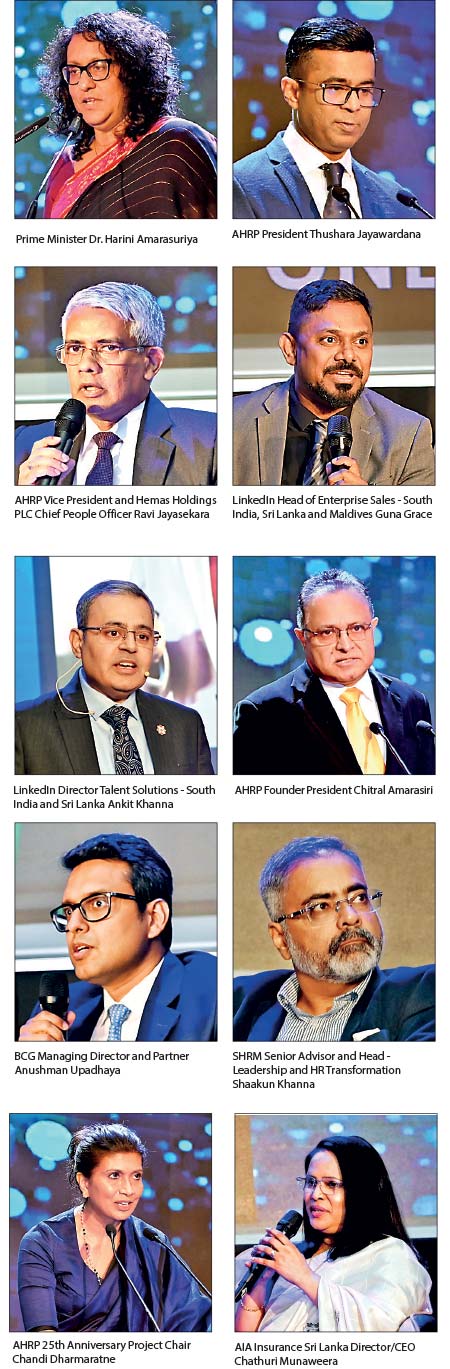 The Association of Human Resource Professionals (AHRP) Sri Lanka celebrated its Silver Jubilee with a landmark conference that looked beyond its first 25 years to the future of work, bringing together policymakers, business leaders, HR professionals and global experts to examine how artificial intelligence (AI), digital transformation and skills-based talent strategies are reshaping organisations.
Held at Cinnamon Life yesterday, the conference was graced by Prime Minister Dr. Harini Amarasuriya as Chief Guest, highlighting the growing importance of human capital in driving Sri Lanka's economic transformation and future competitiveness.
Congratulating AHRP on its Silver Jubilee, she said HR professionals play a critical role in building organisational cultures that promote learning, innovation and leadership while helping organisations navigate technological transformation.
She also called for stronger collaboration between Government, industry and educational institutions to develop a future-ready workforce.
"The greatest competitive advantage of any nation is its human capital – the knowledge, skills, creativity and resilience of its people," she said.
Welcoming participants, Association of Human Resource Professionals Sri Lanka President Thushara Jayawardana reflected on AHRP's remarkable journey over the past 25 years and its contribution to advancing the HR profession in Sri Lanka.
He said the association has consistently championed professional excellence, ethical leadership and innovation in human resource management while helping organisations navigate an increasingly dynamic business environment.
Jayawardana noted that as organisations enter an era shaped by AI and rapid technological disruption, HR professionals have an even greater responsibility to build resilient, future-ready workplaces through continuous learning, people development and organisational transformation.
"Our greatest achievement is not the first 25 years we celebrate today, but the foundation we have laid for the next 25," he said, reaffirming AHRP's commitment to shaping the future of work through leadership, innovation and professional excellence.
As part of its Silver Jubilee celebrations, AHRP also commemorated the milestone with a ceremonial market-opening bell-ringing at the Colombo Stock Exchange (CSE). Led by President Thushara Jayawardana together with the Executive Committee and CSE officials, the event symbolised the association's contribution to advancing Sri Lanka's HR profession over the past 25 years while marking the beginning of its next chapter.
Reflecting on the association's beginnings, AHRP Founder President Chitral Amarasiri recalled the vision that inspired its establishment 25 years ago.
He said AHRP was founded with the objective of elevating human resource management into a recognised strategic profession capable of contributing directly to organisational success and national development.
Looking back on the association's achievements, Amarasiri commended the generations of HR professionals who have helped build AHRP into one of Sri Lanka's leading professional bodies while continuing to uphold excellence, integrity and lifelong learning.
Established in 2000, the Association of Human Resource Professionals (AHRP) Sri Lanka is the country's leading professional body for HR practitioners. For 25 years, it has championed professional excellence, leadership development and innovation in human resource management while supporting organisations in building resilient and future-ready workforces.
LinkedIn insights
The conference featured a keynote presentation titled "Redefining the Future of Work," delivered by LinkedIn Director – Sales, Talent and Learning Solutions for South India and Sri Lanka Ankit Khanna, who explored the transformative impact of artificial intelligence, skills-based hiring and changing workforce dynamics.
Drawing on LinkedIn's global workforce insights, Khanna revealed that 60% of professionals globally are expected to seek new employment opportunities in 2026, while the figure rises to 68% in Sri Lanka, reflecting increasing workforce mobility.
He also noted that AI is rapidly reshaping Sri Lanka's skills landscape, with six of the country's ten fastest-growing skills now linked to artificial intelligence and technology infrastructure.
Khanna revealed that over 590,000 Sri Lankan professionals are active on LinkedIn, representing a 188% year-on-year increase, while time spent on the platform has doubled, highlighting growing engagement in professional networking and career development.
Addressing talent migration, he observed that Sri Lanka continues to experience an outflow of skilled professionals, although the trend has improved significantly. LinkedIn data showed that talent outflow declined by 45%, with professionals leaving the country falling from 55,358 in 2023 to 24,887 in 2026.
He emphasised that the future of work presents both unprecedented opportunities and significant challenges, urging organisations to embrace adaptability while placing people at the centre of transformation.
Building on the keynote, the conference featured a panel discussion titled "Shaping the Future of Work and Organisations," moderated by AHRP Vice President and Hemas Holdings PLC Chief People Officer Ravi Jayasekara.
Shaping the future of work and organisations
The panel brought together SHRM Senior Advisor and Head - Leadership and HR Transformation Shaakun Khanna, LinkedIn Head of Enterprise Sales – South India, Sri Lanka and Maldives Guna Grace, BCG Managing Director and Partner Anushman Upadhaya and AIA Insurance Sri Lanka Director/CEO Chathuri Munaweera.
Speaking during the discussion, LinkedIn Head of Enterprise Sales – South India, Sri Lanka and Maldives Guna Grace described the current workplace transformation as the "Great Skills Reset."
He noted that while only 25% of job skills changed between 2015 and 2025, nearly 70% are expected to change by 2030, signalling an unprecedented shift in workforce requirements.
Grace warned that organisations face an "invisible crisis," with 86% of companies yet to fully prepare for the rapidly changing skills landscape.
He argued that tomorrow's opportunities cannot be secured using today's capabilities, stressing that workforce upskilling should become a business growth strategy rather than simply another learning and development budget item.
According to Grace, the traditional talent equation based on experience, qualifications and existing skills is rapidly becoming obsolete.
Instead, he said, future success will depend on the combination of AI capability, human capability and adaptability.
He explained that AI capability refers to an individual's ability to effectively work alongside artificial intelligence, while human capability includes uniquely human strengths such as creativity, empathy, critical thinking, judgement and leadership. Adaptability, he added, is the willingness to continuously learn, unlearn and relearn as technology evolves.
Grace also observed that employers are increasingly assessing candidates based on their learning agility, problem-solving ability and capacity to embrace change rather than relying solely on past experience and academic qualifications.
BCG Managing Director and Partner Anushman Upadhaya said organisations must move beyond simply digitising existing processes and instead redesign their operating models to become AI-first enterprises.
He explained that many companies mistakenly equate digital transformation with adding technology to existing workflows, resulting in only incremental efficiency gains.
In contrast, AI-first organisations fundamentally redesign processes by enabling artificial intelligence to perform routine execution tasks while employees focus on higher-value responsibilities requiring judgement, innovation and oversight.
Using the example of a bank processing personal loans, Upadhyaya illustrated how AI can streamline operations by analysing existing customer information and completing credit assessments automatically, enabling faster and more personalised customer service.
He said organisations embracing AI-first operating models have the potential to achieve productivity improvements of up to 34 times, but stressed that such transformation depends as much on people as technology.
He noted technology accounts for only 30% of successful AI transformation, while the remaining 70% depends on leadership, organisational culture and governance and employee adoption.
Responding to concerns over employee resistance, he said successful AI transformation requires involving employees in redesigning workflows and assuring them that AI is intended to augment rather than replace their roles.
Drawing on a banking transformation project, he explained that productivity gains enabled employees to process significantly more work, allowing the organisation to increase business targets rather than reduce headcount.
"The most successful AI transformations are those where people are genuinely involved in shaping new ways of working," he said.
SHRM Senior Advisor and Head - Leadership and HR Transformation Shaakun Khanna emphasised that while AI is transforming organisations, the greatest challenge lies not in technology but in people.
He said AI has democratised access to advanced technologies, making powerful tools available to organisations of every size. However, successful transformation depends on leaders redesigning organisational structures, investing in workforce upskilling, fostering an AI-enabled culture and establishing strong governance frameworks.
Khanna stressed that organisations would fail to realise returns on AI investments if employees do not fully adopt new technologies.
He also urged organisations to move beyond competency-based talent models towards skills-based organisations, where recruitment, learning, career progression, performance management and rewards are centred on skills rather than qualifications alone.
Noting that 81% of organisations recognise the need for this transition, he said only a small proportion have successfully implemented it because it requires redesigning the entire employee lifecycle rather than simply introducing new policies.
AIA Insurance Sri Lanka Director/CEO Chathuri Munaweera said organisations of the future will be defined not by their size but by their ability to foster continuous learning, adaptability and innovation.
Drawing on AIA's AI transformation journey, she said Sri Lanka's competitive advantage lies in its resilient and agile workforce, adding that organisations should leverage these strengths while embracing artificial intelligence.
Munaweera acknowledged that one of the biggest challenges is overcoming employees' fear that AI will replace their jobs. "AI will not replace employees, but employees who are good at AI will replace those who are not," she said, stressing the importance of reskilling employees and building confidence throughout the transformation journey.
She also highlighted the need for strong digital foundations—including robust systems, reliable data and well-designed processes—before organisations can successfully implement AI.
Describing AI transformation as fundamentally a leadership challenge, Munaweera said HR plays a pivotal role in redesigning organisations, supporting leaders and guiding employees through change.
Reflecting on AIA's own experience, she acknowledged that while AI transformation is essential, "it is easier said than done."
Concluding the discussion, AHRP Vice President Hemas Holdings PLC Chief People Officer Ravi Jayasekara said the future of work will not be defined by artificial intelligence alone but by how effectively organisations design collaboration between people and technology.
He said organisations that deliberately create environments where humans and AI complement one another will enjoy a lasting competitive advantage, with HR professionals uniquely positioned to lead this transformation through future-ready operating models centred on people, culture and technology.
Reflecting on AHRP's Silver Jubilee, Jayasekera said the anniversary was not merely a celebration of the association's achievements over the past 25 years but the beginning of its next chapter.
"The future of work is about humans working with AI and AI working with humans. How deliberately we design that relationship will set organisations apart," he said.
He said the decisions organisations make today will determine how successfully Sri Lanka's workforce adapts to the future, reaffirming AHRP's commitment to supporting HR professionals and business leaders in building resilient, innovative and future-ready organisations.
- Pix by Upul Abayasekara



