Wednesday Nov 04, 2026
Wednesday Nov 04, 2026
Wednesday, 4 November 2026 00:00 - - {{hitsCtrl.values.hits}}
By Dilrukshi Fernando
Diabetes claimed an estimated 3.4 million lives worldwide in 2024, equivalent to one death every nine seconds, according to the International Diabetes Federation’s (IDF) Diabetes Atlas. In Sri Lanka, an estimated 1.6 million adults aged 20–79 are living with the condition. However, 37.7% of them, or approximately 600,000 people, remain undiagnosed and unaware that they have diabetes. The scale of the challenge is further reflected in World Health Organisation (WHO) data for 2023, which ranks diabetes as the third leading cause of death in Sri Lanka among both men and women.
The numbers above highlight a significant gap in early detection and the need to make screening and healthcare advice more accessible to communities. Particularly to make people understand their health risks, encouraging timely diagnosis before complications arise.
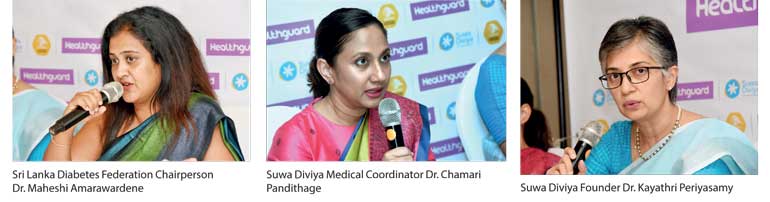
“According to the International Diabetes Federation’s 2026 data, the global prevalence of diabetes stands at 11.1%, meaning that 1 in 9 adults suffers from diabetes. In Sri Lanka, a more recent study conducted by Prof. Prasad Katulanda from a population cohort in the Western Province found that 27% had diabetes, while a further 35% had prediabetes. Diabetes remains one of the biggest health burdens in the world, as well as in our country, and is one of the commonest non-communicable diseases,” said Sri Lanka Diabetes Federation Chairperson and Consultant Endocrinologist Dr. Maheshi Amarawardena, emphasising the urgent need to strengthen awareness, screening and early intervention to address the growing burden of diabetes.
Against this backdrop, Sunshine Holdings PLC, through its community health arm, Sunshine Foundation for Good, will conduct a five-day diabetes screening and awareness program across nine selected Healthguard outlets from 9th to 13th November 2026. The initiative was officially launched at a media roundtable in Colombo recently, ahead of the World Diabetes Day 2026.
Early detection is vital for control and remission
The rise of diabetes across Sri Lanka in recent decades has ranked the country with the third highest number of adults (ages 20 to 79 years)< living with diabetes in the IDF South-East Asia Region, according to the Diabetes Country Report IDF 2000 - 2050.
“The problem we mainly face in Sri Lanka is the denial of the disease. Patients don’t like to understand that they have diabetes,” said Dr. Maheshi Amarawardena. Doing so, the individual loses out on the ‘golden years’ of time and opportunity to take control of the diabetes, to live a good and near-normal life.
Dr. Amarawardena emphasised that the early management of diabetes can have a lasting influence on a person's long-term health outcomes, a concept known as ‘glycaemic memory’. Drawing on evidence from earlier studies, she explained that how blood glucose is controlled during the initial months and years following diagnosis can have a lasting impact on the development of complications. “How you treat the condition in the early months or years gets stored in your brain, and has a legacy effect which controls the outcomes,” she noted.
Early diagnosis and effective blood glucose management can help reduce the risk of complications affecting the body's small and large blood vessels. These include microvascular complications involving the nerves, eyes and kidneys; macrovascular conditions such as heart attacks and strokes; and peripheral vascular disease, which can restrict blood flow to the limbs and, in severe cases, lead to amputation. Dr. Amarawardena stressed the importance of educating communities with accurate information, and encouraging people to screen for diabetes early, to avoid life altering changes such as blindness, limb loss or long-term insulin usage.
Another important consideration in early diabetes management is limiting glucotoxicity, the harmful effects of prolonged high blood glucose levels on the body's insulin-producing cells in the pancreas. Preserving their function is important in maintaining the body's ability to regulate blood glucose.
Dr. Amarawardena also highlighted the possibility of Type 2 diabetes remission when the condition is addressed early. The concept, which has gained increasing attention in recent years, refers to maintaining blood glucose levels below the diabetes range for at least three months without glucose-lowering medication. She identified sustained lifestyle changes, appropriate medical treatment and weight reduction, with losses of up to 15% of initial body weight in some cases, as factors that can contribute to remission.
“Even if you label a patient as being in diabetes remission, we have to regularly follow up with them because it can relapse at any given time, due to weight gain or other complications”, she further said.
The journey to diabetes remission is a three-modular lifestyle approach of diet, exercise and medication. including a low-carb diet, and at least 30 minutes of exercise five times a week, while medication and frequent blood glucose monitoring needs to be advised by a medical professional.
“There is nothing called diabetes cure, it’s control and remission”, said Dr. Amarawardena.
Reducing the National Burden of Diabetes Through Early Action
“It’s a silent disease. Just because you don’t have symptoms doesn’t mean you don’t have the disease. Because it’s so common, anyone over the age of 30 should be checking your blood sugar, so you can bring it down to a controllable level with early detection”, said Consultant Physician Dr. Kayathri Periasamy, who has been working continuously with the Suwa Diviya initiative of Sunshine Foundation for Good, which focuses on diabetes prevention, early diagnosis, adequate control and the prevention of complications, conducting awareness activities across workplaces, factories and community settings.
“Diabetes is not only a burden for the person, it’s a huge burden for the country. With this level of statistics and prevalence of Diabetes the Ministry of Health is spending a huge amount on medication and caring for people with diabetes in hospitals and communities”, said Dr. Periyasamy, pointing out that in 2024, the Ministry of Health, Sri Lanka had reported an expenditure of almost LKR 7.3 billion for out-patient healthcare budget on medication (drugs) and insulin alone. The supply chain for medication also faces considerable pressure with 1 in 4 adult Sri Lankans being diabetic, Dr. Periyasamy further noted.
“When talking about the prevention of diabetes, it is definitely cheaper for the person, the country, and the Ministry of Health to do activities that prevent the disease than to manage their diabetes and complications lifelong”, said Dr. Periyasamy, detailing ways of encouraging communities to get free walk-in diabetes screenings, and health advice to ensure the continuity of the endeavour.
“Enough data is there to show that lifestyle changes, changes in your diet, healthy living, proper exercise can actually reduce diabetes by almost 60%. So it is a worthwhile thing to educate people on how to overcome this challenge”, Dr. Periasamy noted.
Suwa Diviya taking early action on diabetes into communities
Well aligned with the World Diabetes Day 2026 theme, ‘Early action on diabetes’, Sunshine Foundation for Good, through ‘Suwa Diviya’, the Foundation’s diabetes awareness and management initiative, will conduct a five-day series of diabetes screening and awareness sessions for people to better understand the importance of preventive healthcare.
All screening tests offered through the program will be free of charge. The activities will cover outlets in Nugegoda, Kohuwala, Hill Street, Pitakotte, Malabe, Thalawathugoda, Ethulkotte, Dharmapala Mawatha and Kirula, providing opportunities for the public to access screening and professional guidance. Activities will run from 8.30 a.m. to 12.30 p.m. at the first eight locations, with an extended session at Kirula from 8.30 a.m. to 4.30 p.m.
Sunshine Holdings Group CEO, Shyam Sathasivam, said: "Last year's response showed us that people value having a convenient place to ask questions and understand their health risks. This year, we want to build on that by giving communities more opportunities to take action early. Diabetes awareness should not be limited to a single day. Through Suwa Diviya, our focus is on helping people make informed choices about their health and encouraging habits that can make a difference over time."
This year’s program builds on the 2025 “Unmask Diabetes” initiative which reached more than 600 people across 10 Healthguard outlets in two days. The 2026 program, which spans across five days, will also seek to bring together organisations from the healthcare, nutrition, lifestyle, corporate wellness and fitness sectors, connecting diabetes awareness with broader health and lifestyle considerations.




