Wednesday Sep 16, 2026
Wednesday Sep 16, 2026
Wednesday, 8 July 2026 00:00 - - {{hitsCtrl.values.hits}}
 By Amira Cader
Sri Lanka has emerged as a global leader in hypertension research, with locally generated clinical evidence reshaping international treatment guidelines, securing US Food and Drug Administration (USFDA) approval and earning a novel blood pressure therapy a place on the World Health Organisation’s (WHO) Model List of Essential Medicines.
This achievement took centre stage at a high-level scientific forum organised by the University of Kelaniya recently, where clinicians, researchers, policymakers, regulators, and patient representatives explored how the country’s landmark research can now be translated into better health outcomes for Sri Lankans while strengthening the nation’s reputation as an international clinical research destination.
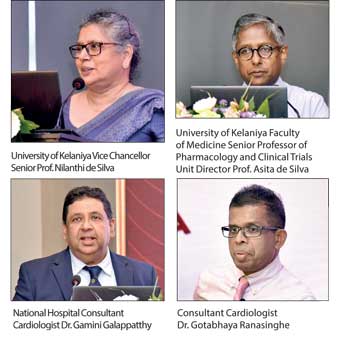
University of Kelaniya Vice Chancellor Senior Prof. Nilanthi de Silva underscored the importance of translating scientific evidence into national health benefits through collaboration among academia, healthcare professionals, and policymakers.
University of Kelaniya Faculty of Medicine Senior Professor of Pharmacology and Clinical Trials Unit (CTU) Director Prof. Asita de Silva outlined the scientific evidence behind the landmark research.
He noted that hypertension remains the world’s leading cause of preventable death despite the availability of effective and affordable treatments, making improved blood pressure control a global public health priority.
Prof. de Silva said the CTU focuses on developing innovative, cost-effective, and scalable healthcare solutions to address major public health challenges through well-designed interventional and epidemiological studies conducted in collaboration with internationally recognised centres of excellence.
He outlined how researchers at the University of Kelaniya, working alongside Sri Lankan specialists and experts from The George Institute for Global Health, developed a fixed low-dose triple combination antihypertensive therapy designed to improve blood pressure control.
“More than 50% of the scientific data underpinning the internationally recognised research originated from Sri Lanka, demonstrating the country’s capacity to conduct rigorous clinical trials with global impact,” he said.
Drawing on evidence from multi-country studies, Prof. de Silva explained that cardiovascular disease continues to disproportionately affect low- and middle-income countries, with South Asians experiencing acute myocardial infarctions approximately six years earlier than their European counterparts.
One of the landmark studies discussed was the TRIUMPH clinical trial, conducted between 2016 and 2018, which investigated whether initiating treatment with a low-dose triple-pill combination was more effective than conventional care for patients with mild to moderate hypertension. The study demonstrated significantly better blood pressure control with the combination therapy than with standard treatment.
Consultant Cardiologist Dr. Gamini Galappaththi said hypertension affects approximately 35% of Sri Lankan adults, underscoring the need for early intervention and low-dose combination therapy to improve blood pressure control and reduce cardiovascular risk.
Consultant Neurologist Dr. Bimsara Senanayake presented the neurological perspective, highlighting the critical role of effective blood pressure control in preventing recurrent strokes and improving long-term patient outcomes.
The forum also highlighted evidence showing that the triple-pill therapy reduced the risk of recurrent stroke by 40% when added to standard care, with only 27 patients needing treatment to prevent one recurrent stroke.
The event concluded with a panel discussion moderated by Prof. Asita de Silva, featuring Dr. Galappaththi, Dr. Gotabhaya Ranasinghe, and Dr. Senanayake. Discussions focused on translating research evidence into routine clinical practice, improving equitable access to effective treatment, positioning Sri Lanka as a recognised destination for high-quality clinical research, and fostering collaboration across sectors while maintaining scientific independence, integrity, and transparency.
Participants noted that the research has already influenced international hypertension treatment guidelines, received USFDA approval, and led to the inclusion of the therapy in the WHO’s Model List of Essential Medicines.
The forum concluded with a call for stronger collaboration among researchers, clinicians, and policymakers to translate these findings into routine clinical practice, improve blood pressure control, and reduce the burden of cardiovascular disease, while further strengthening Sri Lanka’s position as a global centre for high-quality clinical research.
-Pix by Ruwan Walpola




