Tuesday Sep 15, 2026
Tuesday Sep 15, 2026
Saturday, 6 June 2026 01:10 - - {{hitsCtrl.values.hits}}
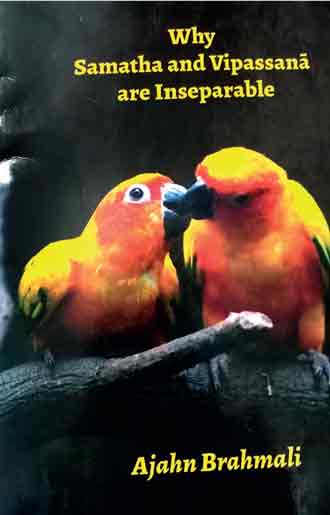 The above headline is the title of a book by Ajahn Brahmali Thero based on the talk given on Friday, 08 May in 2015 at the Dhammaloka Buddhist Centre in Perth, Australia. Copyright Ajahn Brahmali, compiled and published by the Ajahn Brahm Society of Sri Lanka.
The introduction to the book notes that while ‘Samatha’ and ‘Vipassana’ are central to Buddhist meditation, ‘Samatha’ is usually translated as calm, peace or tranquility while ‘Vipassana’ is translated as insight.
Brahmali Thero notes that ‘clear seeing’ is a better translation for ‘‘Vipassana’.’
In the first chapter ‘The word of the Buddha’ it is pointed out that the Buddha spoke of ‘Vipassana’ and about meditation but never linked the two words together.
The aim of the book in general is to find out what ‘Vipassana’ is and how it works and importantly, how it works with ‘Samatha’. “Insight meditation is a powerful phrase and that is one of the reasons why it has taken off. But again, it is problematic because the Buddha never used it,” Brahmali Thero points out, adding that it is problematic for another reason.
“One of the consequences of talking about insight meditation is that you separate ‘Samatha’ from ‘Vipassana’. By speaking of insight meditation you are implying that there is something else called calm meditation. But the Buddha did not use the phrase ‘calm meditation’ either,” Brahmali Thero notes.
“In the suttas, rather, ‘Samatha’ and ‘Vipassana’, calm and clear seeing are outcomes of the practice and not practices in their own right. And they are always conjoined, constituting two aspects of the same process of mental development”, he explains further as follows. In the next chapter, titled ‘‘Samatha’ and ‘Vipassana’’, Brahmali Thero queries as to how we can get insight if insight meditation is not mentioned in the Suttas. He then goes on to discuss what ‘Samatha’ and ‘Vipassana’ really refer to. In clarifying what ‘Samatha’ (calm) indicates he points out that when you sit down to meditate and close your eyes, you generally feel calm. “What does it mean to be calmer?,” he queries, stating that a calm mind is less restless and has lesser defilements and thereby more relaxed and at ease.
“The interesting thing is that the little bit of calm you feel after meditation is only the beginning of this beautiful journey in Buddhism. The degree of calm increases stage by stage making it more and more profound until you feel a sense of peace, a sense of calm that you did not know existed.”
“The more peaceful you are the more you understand what suffering is and what life is all about.”
He then goes on to explain ‘Vipassana’ (clear seeing) explaining that ‘Vipassana’) is the other side of the ‘Samatha- Vipassana’ pair. On the common translation of ‘Vipassana’ as insight he notes that we first need to decide how good a translation it is.
“Having studied the word of the Buddha in quite a bit of detail, I think a better translation would be clear seeing. Another good translation might be discernment,” Brahmali Thero points out. There is an important difference between these two translations,” he states. “Insight refers to something that happens instantly. ‘Oh now I understand!’ It is a moment of grasping something you had not grasped before. Clear seeing by contrast is something that is always either present or absent, in varying degrees. Right now you either see things clearly or you don’t, or you are somewhere in between. So clear seeing is my preferred rendering of ‘Vipassana’,” emphasises Brahmali Thero.
“What does ‘Vipassana’ mean in practice?,” he asks and clarifies that as with ‘Samatha’, after meditation you normally have a bit more ‘Vipassana’ than you had before. Because you are calmer, because you are more peaceful, you see things more clearly. When you look inside of yourself, you see the quality of your mind.”
NOTE: The above book is from the library of Surya Vishwa housed as the Residential Library of Healing in Nuwara Eliya, committed to spreading global unity, wisdom, forgiveness, and introspection. This library is the academic reference hub of the Harmony Page.




