Tuesday Sep 15, 2026
Tuesday Sep 15, 2026
Saturday, 18 July 2026 06:10 - - {{hitsCtrl.values.hits}}
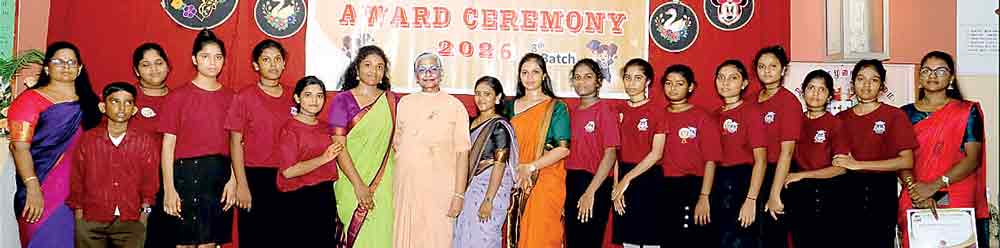
 11 July marked a happy occasion for Atchuvely. As a result of one veteran educator who has a history of over 5 decades of dedication to creating not exam taking robots, but humans who develop a range of wholesome abilities including one that most education institutions in Sri Lanka forget – the ability to live in harmony with each other irrespective of religion or ethnicity, Atchuvely is fast turning into a locale where youth from other regions seek out. This area is now being identified as a place that offers authentic vocational training alongside nurturing a peaceful heart
By Surya Vishwa
Are we aware of the everyday reality of the gap between those who pass out from Ordinary Level and Advanced Level examinations and go to university and the majority who do not? Are we aware that Sri Lanka lacks dedicated educators who could fill the void between youth employability and non-employability? Do the rural areas of Sri Lanka which make up almost the entirety of the country (leaving aside the small pockets of urban cities) fulfil the employability needs of the youth? Are we aware that English, which is the link language of Sri Lanka, is given the lowest priority in schools at provincial level where children at Ordinary Level or Advanced Level are unable to manage even a simple sentence? Are we aware that English as a language not only connects us to the world but also to each other in a nation where the language gap between Sinhala and Tamil exists to the extent that the population as a whole do not understand each other.
Some of the above questions could be answered in the below article for which we travelled to Atchuvely, about 15 kilometres from Jaffna.
To get to Atchuvely one must pass locations such as Puttur and Chemmani and many agricultural areas known for the cultivation of vegetation such as onions and tobacco.
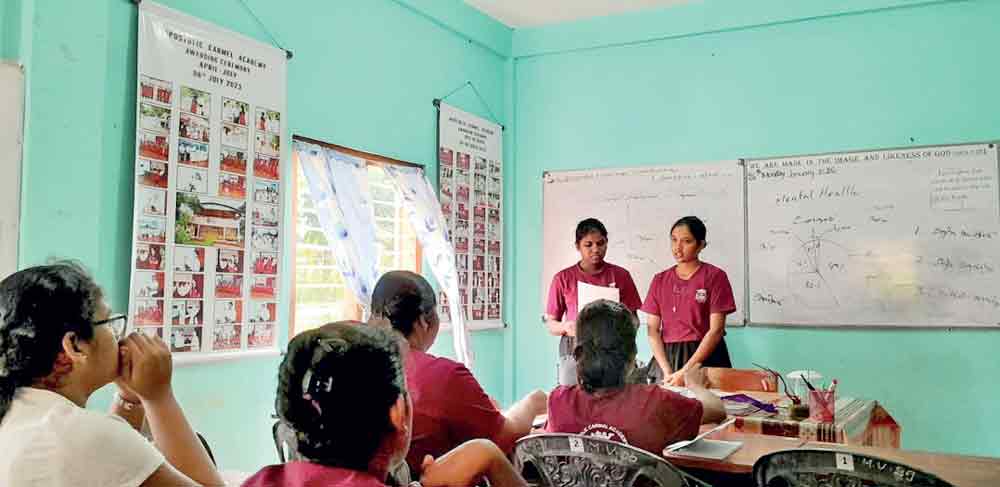
Atchuvely is similar to a rural region in the south or elsewhere in the country in the fact that opportunities for those who either pass or fail their Ordinary or Advanced Level examination remain the same – there are little or no training opportunities that will assist them in the development of what is defined as soft skills that includes personality development, in positive thinking, self confidence in public speaking, articulation, basic proficiency in information technology, skills that will create motivation in entrepreneurship and especially language training of all three official languages of the nation.
In this backdrop 11 July marked a happy occasion for this region. As a result of one veteran educator who has a history of over 5 decades of dedication to creating not exam taking robots, but humans who develop a range of wholesome abilities including one that most education institutions in Sri Lanka forget – the ability to live in harmony with each other irrespective of religion or ethnicity, Atchuvely is fast turning into a locale where youth from other regions seek out.
This area is now being identified as a place that offers authentic vocational training alongside nurturing a peaceful heart.
“Today marks the 8th academy award ceremony following the creation of the Apostolic Carmel Academy within the Atchuvely Convent of Our Lady of Lanka,” stated Sr. Therese Ranee, the initiator of this mission, addressing those attending the event. “Strengthening the mind, empowering the heart, strengthening character, strengthening leadership and assertiveness, are identified as some of the priorities of this institution.
Although currently located at Atchuvely, the academy will hope to shift to Mirusuvil, the village of Sr. Therese Ranee where her ancestral family home located on one acre of land has been donated by her relatives for the explicit purpose of using it for youth development.
 Sr. Therese Ranee’s fame as a peacebuilder which had spread within and beyond Sri Lanka resulted in a UNESCO team visiting her to write about her peace work. Her extraordinary impact in the war time East of Sri Lanka deserves special mention and would serve to show how one human with an elevated consciousness could change others contributing to upholding life when it seemed impossible
“This is the house in which I was born. My family members have all migrated to foreign countries and they have legally given me this property so that it could be used for the nurturing of youth. The estimate for the putting up of a building that could house a large number of Sri Lankan youth, as well as volunteers and teachers have been carried out,” Sr. Therese Ranee points out.
She explains that as a nun she is bound by monastic regulations that emphasise on obedience.
“There is nothing called private property for us. Whatever we have and whatever that we get we have to use for the purpose of common good. It is therefore the wish that we will be able to construct the building in Mirusuvil as soon as possible not as my private property but as an education mission of the convent,” she states. The overall estimated cost for the completion of the building is approximately Rs. 65 m and the time duration that would take for the building to be finalised is around 6 months.
“I am confident that the support for the building will arrive in God’s perfect timing in the same way that the assistance for the setting up of the Apostolic Carmel Academy in Atchuvely was provided,” Sr. Therese Ranee explains adding that the current building is part of the main convent that has to be vacated soon.
“This building is old and is part of the Atchuvely convent that also overall houses a nursery, a boarding house for Ordinary Level and Advanced Level school going children,” she explains.
The Carmel Academy she hopes would flourish in Mirusuvil as a full-fledged youth formation institution that would cater not just to the North but to the rest of the country as well.
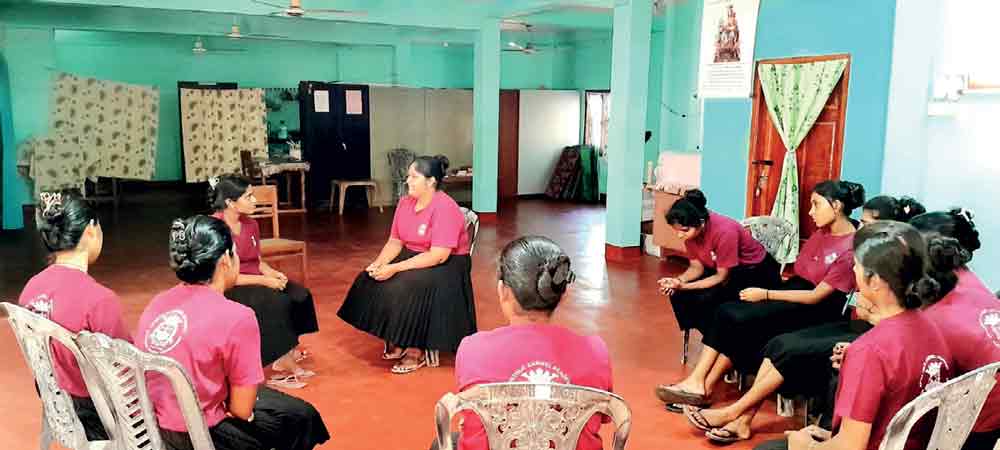
In Atchuvely in the current location and building that the academy functions in has provided personality development and integrated holistic training for over 150 youth in the past 6 years.
“They come here without being able to speak even a few words of English. But you saw how they performed at the award ceremony event,” she quips. The simple award ceremony attended by parents, regional education authorities, priests, nuns and students saw compering, dance and poetic narratives as well as each youth announcing their life goals. These ranged from nursing, tailoring, teaching and serving in the police.
Holding an economics degree from the Peradeniya University and serving as principal in 3 schools; in Kalmunai, Batticaloa and Trincomalee, her background as an education trainer is of national stature, winning acclaim from provincial and central Government levels for the innovation she brought to national education in districts she served where she prioritised also the bridging of gaps connected to ethnicity.
At a time when co-existence was a dire challenge, at the height of the ethnic conflict she spent 19 years at St. Mary’s College in Trincomalee where she had served as teacher and hostel warden, in addition to being principal. She had gained the award of best principal three times and instead of her services to national education ceasing upon retirement in 2004 it had only got stronger, surmounting challenges such as serious health related obstacles.
What keeps her motivated?
“The first and foremost is the fact that I willingly dedicated my life both to the divine will of God and through that will which is above mine, to relinquish every effort to the service of youth.”
“I think we all know that the situation in Sri Lanka is that it produces a lot of exam takers. We know that our education sector does not really recognise that the need is to create human beings who are not just machines who can function within the job sector but those who will create and nurture, within them and within others, a spirit of kindness, understanding, and a deep love for humanity.
“What is the use of creating human beings who are preoccupied with rivalry, competition and superiority?,” Sr. Therese Ranee asks.
Having functioned within this restricted education system that we know, she has attempted to bring as many changes as possible including those that could be described as radical, such as the introducing of yoga meditation in 1989 at St. Mary’s college and at a time when the North and East of Sri Lanka engulfed in war, extending her focus to assisting those affected by war. This writer spent many hours listening to her recounting incidents that can aptly be described as ‘miracles’ where she had received ample support from the military to save lives at a time when it seemed that the only destiny for the North was death. Her fame as a peacebuilder which had spread within and beyond Sri Lanka had resulted in a UNESCO team visiting her to write about her peace work. Her extraordinary impact in the war time East of Sri Lanka deserves special mention and would serve to show how one human with an elevated consciousness could change others contributing to upholding life when it seemed impossible.
We asked Sr. Therese Ranee a few additional questions in relation to her current work:
Q: What is your main goal after the youth complete the 6 month training at her latest initiative – the Apostolic Carmel Academy?
A: The moment the academy training finishes I focus my attention on helping in the drafting of the bio data for each of the girls. Then I personally go to various business establishments and ask if they have the need for trainees. I have walked in, in this manner to Keells and similar other establishments that have set up in Jaffna.
Q: From where has the main assistance come from for your work so far?
A: For the Apostolic Carmel Academy that was started in 2020 we have been supported by my past students who have now migrated and working in foreign lands, as well as some foreign donors. This year I received support from two of my former students from St. Mary’s in Trincomalee; Pamela and Maureen Mathews who live and work in England. The contribution of my former students and others has supported in having an award ceremony that the students and parents could cherish, obtaining computers for IT training, equipping the academy with items such as photocopy machines, fridge and kitchen equipment and furniture such as desks. The girls who seek to get the training stay at the academy which is within the convent territory. In such a safe and secure surrounding they are able to obtain relief from day to day problems their families face. Many families face poverty related issues as well as other complications. Some girls do not have parents or are from families where one parent has abandoned their responsibilities. Sometimes parents have gone to seek employment abroad and not come back. In whatever situation our effort is to calm their mind and to give them fresh perspectives and confidence.
Q: Are the young girls who enlist at the Carmel Academy mostly from the North or are they from other areas of Sri Lanka as well?
A: We have most of the young girls who finish their ordinary level and advanced level who are from Jaffna district. But within the past few years the word has spread and we have got youth from areas such as Mullaitivu, Mannar, Puttalam, Deniyaya and Matara.
Q: Will the subjects that are taught change after the academy is shifted to Mirusuvil?
A: As there will be more space at that location we will be able to expand the reach of what is taught significantly and hope to be a beacon of vocational training in the North of Sri Lanka. One of our expectations is to enable young foreign volunteers to be able to share some of their expertise such as those related to early childhood care and nursing with the students. We hope to provide more space and facilities for teachers and also run training courses for teachers. At the moment we have eight teachers. We pay them from the assistance received from my past students. At the new building which I am confident will be a reality within the next two years we hope to increase emphasis on all three languages of Sri Lanka, a factor that will help in our youth understanding each other.
Q: Are the students at the academy only Christians?
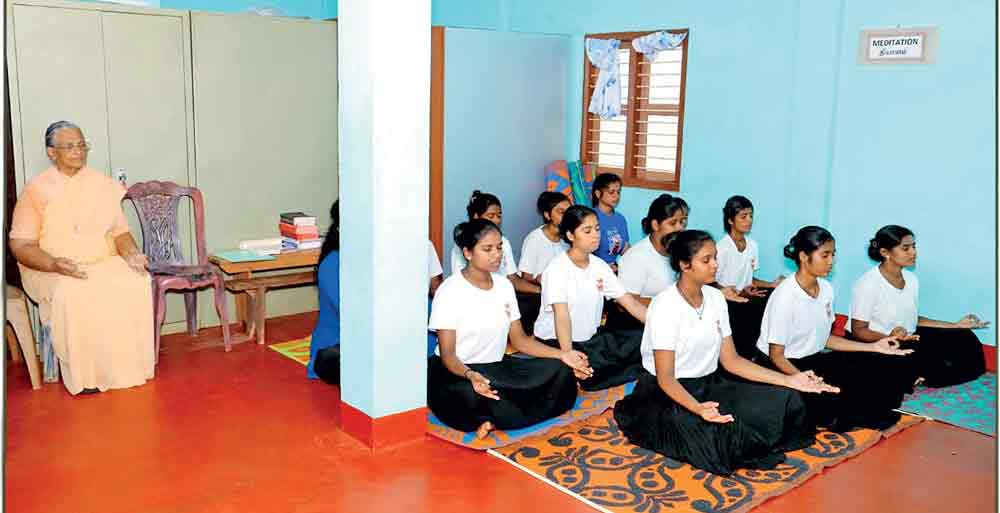
A: There are many Catholics. However there are Hindus as well. Throughout my teaching career I have emphasised peace education – so that we create a strong sense of co-existence in the minds of these girls. All the students also engage in meditation, on deep reflection into their minds and thoughts.
Q: Sr. Therese Ranee, at 81 years you do not look your age – how is it that you manage to look so young and above all how is it that you muster so much energy?
A:When we commit ourselves to God; when we become nuns we pledge to function in the world, beyond ourselves. Our human limitations then cease to restrict us. Therefore neither age nor illness will take away from ourselves the willpower that God and Christ Jesus provides us to serve the world until our very last breath. In 2024 I was diagnosed with cancer and have survived it. There is no vestige at all of that disease in me now and I even wonder if I was afflicted with that illness.
Q: Was this strong commitment to God part of your family ethics?
A: Yes, alongside the commitment to education. My father served as principal in several schools in Jaffna district for over 35 years.
Q: How many members did your family have and did your parents easily permit you to become a nun?
A:I had three older brothers, one younger brother and an older sister. The wish to become a nun entered my heart at the age of 15 when I was a boarder of Apostolic Carmel Convent in Atchuvely. This is the same convent in which this youth training academy is established and where I reside now. My parents accepted my wish to be a nun although there was some reluctance as they were very close to all their children. Yet their devotion to God was stronger.
Q: Your degree was in economics which you received from Peradeniya University?
A: Yes. Thereafter I was also sent for further religious training to India.
Q: How many students attend your academy at present?
A: The last batch for which the passing out award ceremony was held last week consisted of 15 students. We will be enrolling for our new batch in the month of September. At the new building at Mirusuvil we hope to accommodate a much larger number. The students have the option of being housed as boarders as well as day scholars.
For the purpose of writing this article this writer lived in the same compound of the convent inhabited by the youth and the nuns. I witnessed the abject simplicity of the rooms of the nuns. There was almost no difference in the living facilities of the boarders and those of Sr. Therese Ranee except that the boarders lived in a dormitory. The food consumed by the reverend sisters and the students were both simple although nutritious. This writer ate with the students of the academy and witnessed how they all shared in the task of preparing the meals and the decorum they exhibited in their day to day life. Their demeanor was cheerful and their time was structured to be productive.
One of their main difficulties is the ability to write and speak English and Sinhala. Yet the training at the academy has given them a foundation imparting the enthusiasm to perfect the two languages.
Mary Nirosha, the 23 year old assistant to Sr. Therese Ranee who had been a student at the academy 2 years ago is currently based in the convent premises and assists in the day to day administrative matters. “I need more teachers and currently I am searching for dedicated teachers who can be further trained,” she states.
There is currently a past student from Matara who is willing to teach the students Sinhala. But six months may not be sufficient for this task. We at the Harmony Page have expressed our willingness to undertake the publication of a series of tutorials for the regions of Sri Lanka on the Thribasha concept we promote – so that all three official languages are equally prioritised. We will be following this concept in book form as well through the mass media realm and use the first practical instruction at the Atchuvely Apostolic Carmalite Academy under the supervision of Sr. Therese Ranee.