Tuesday Sep 15, 2026
Tuesday Sep 15, 2026
Saturday, 29 November 2025 00:00 - - {{hitsCtrl.values.hits}}
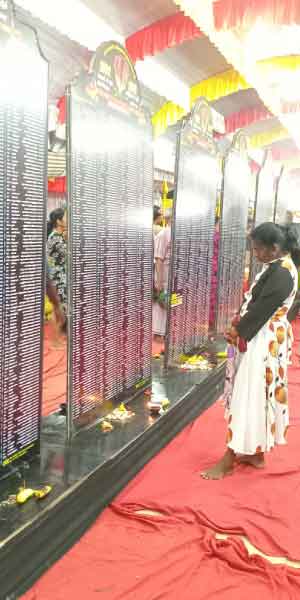 |
| A young woman stands alone gazing at a name of a loved one |
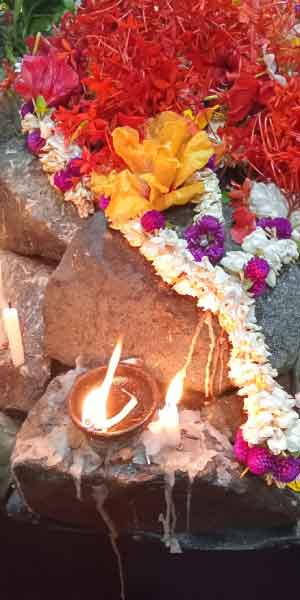 |
| From darkness to light |
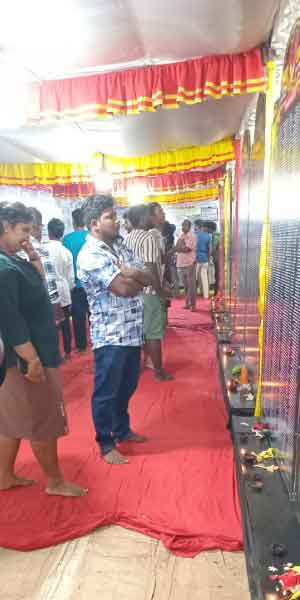 |
| Life and death |
Why did we bring this up now? It is not to delve deep into the beautiful mystery of ancient Hawaiian spirituality. We will do so in detail soon. But the immediate reason that these lines kept resonating in my head were few scenes I witnessed this week in Jaffna.
In one there were Buddhist devotees piously walking around the sacred Bo Tree of the Sri Naga Viharaya—the main Buddhist temple in Jaffna. Then towards evening in Nallur, amidst red and yellow flags, the freedom to mourn the war dead was being exercised by the people of the North.
Scores of names were put up upon mobile structures and there were poignant scenes.
A young woman standing alone gazing silently at a name. Old grandparents with walking sticks peering into the seam of letters to find where their child or grandchild was—now reduced to a few letters—the name their family members lovingly placed on the infant at birth. Youngsters who operate the sound system who look to be in their teen aged years or early twenties were attending to electrical technicalities in a matter of fact manner (there were melodies being played). The faces of these youth did not seem to be scarred as those of others. Jaffna’s youth led café scene pulsed all around. Yet, here was I at a remembrance of pain, excavated from over 16 years ago.
There was a small cardboard structure of a cemetery possibly made by a child at school—as there were some young children around it. At the entrance was a grotto of sorts with garlands of flowers—red and yellow primarily and candles around it. Those who entered this sacred space of mourning their dead—reverently placed their hands on these stones.
As I moved away fast—it was not a place that one could keep the equilibrium of detachment, several paradoxical images overlapped in my mind. The harmless gossipy chatter that I had heard around the premises of the Naga Viharaya in the morning by Sinhalese grandmothers, the gentle smile they would give to an aged female mango seller opposite the temple, a WhatsApp message I had seen by a ‘professor of reconciliation’ of a leading university who was organising some event akin to a lucky dip dinner or whatever of that nature ‘to commemorate Sri Lanka’s peace and conflict studies based reconciliation.’ The image of that young woman who stood frozen as if carved in stone in front of a name representing a life ended over 16 years ago. Alongside these arose many of the similar images witnessed from the South—where agonised parents look for their children in printed name lists and the memory of scores of interviews done by this writer from ‘both sides’ of the ethnic divide.
As I quickened my pace to the waiting tuk tuk I used the ancient Hawaiian prayer to myself to stop phantoms of older memories emanating from the role as a staff young journalist responsible for covering the North of Sri Lanka for a national newspaper and South Asian publications between 1998 and 2006, including the peace process of 2002. I repeat again to myself - I am sorry, Please Forgive me, I thank you. I love you. Let this be the mantra of world peace to awaken the mind to the deathly slumber of ignorance that we live in. The ignorance that we can be happy by watching the pain of an extension of ourselves. May these words influence and expand human consciousness to the fact that we are not different bodies but one large body of humanity. If one limb hurts, it will cause an impact ‘in the other.’ Let this understanding guide us to a genuine flesh and blood reconciliation and push out the sometime nonsensical sounding theoretics and academicisation of ‘reconciliation’ out of boxed in limitedness. [SV]
(Surya Vishwa is a Sri Lankan writer, integrated knowledge promoter and earth healer who strives to transcend beyond inherited birth identity.)




