Tuesday Sep 15, 2026
Tuesday Sep 15, 2026
Saturday, 28 March 2026 00:05 - - {{hitsCtrl.values.hits}}
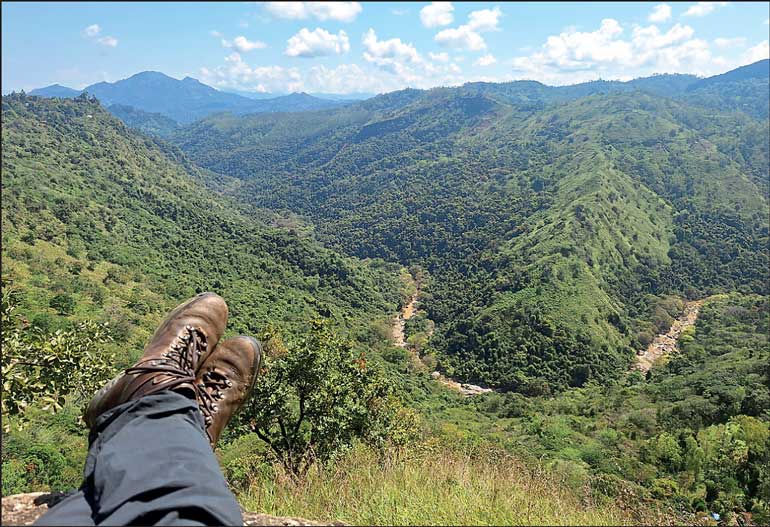
The author captures his boots while atop a rock en route on the Pekoe Trail
By Robert Thompson
Sri Lanka has long been renowned among global tourists for its natural beauty, rich history, and the warm-hearted hospitality of its people. But the island has never been much of a draw for foreign hikers, who instead throng in their tens of thousands to the Himalayas without so much as a second glance at the Sri Lankan highlands. A new initiative has set out to change that.
The ‘Pekoe Trail’, a 300 kilometre hiking path from Nuwara Eliya to Kandy, is the brainchild of Miguel Cunat, a Spanish travel consultant who successfully applied for EU and US foreign development grants to create the first European-style long-distance trail in Sri Lanka. I first heard about the trail in 2024, a year after its inception. I was intrigued but slightly sceptical: could this model of high-maintenance trail networks really be transplanted to the wild and landslide-prone highlands of Sri Lanka? In March 2026 I decided to go find out.
I set off from Nuwara Eliya before first light, my headtorch illuminating the tarmac as I climbed up to the beginning of the plantations. My goal was Ella, 100 kilometres and a five-day walk away. The path took me over a crest and the city fell from view, and all I could see were tea bushes flowing over the hillside, dawnlight slipping through the leaves, and the swaying eucalyptus groves high above. I walked for an hour before the first pluckers started stripping the bushes, each needing to collect twenty kilograms of leaves a day – enough to produce roughly 2,000 tea bags after processing.
The track started to meander through villages, gold and orange temples orbited by concrete dwellings. These are the homes of the Tamils who have worked on these plantations for as many as seven generations, but they take the intrusion of a strange Englishman, huffing under the strain of his rucksack, with cheerful curiosity. Children wave shyly at me from doorways and laugh at my poorly enunciated ‘vannakam’; shopkeepers shake my hand and ask me about geopolitics and the spot price of gold. Four years ago, these communities might have gone decades without a foreign visitor – now they can expect perhaps half a dozen a day. No one I met seemed to consider this imposition anything other than a blessing – despite the economic gains of the trail being negligible for such towns not conveniently located near the ends of hiking stages.
The people who are seeing tangible benefits from the Pekoe are the owners of guesthouses. After my first day of hiking, I reached a remote guesthouse and met one of these businessmen. I was treated to a hearty Sri Lankan curry topped off with Watalappam, and told how, three years ago, exhausted foreigners started turning up at his guesthouse seemingly out of the blue. Since the Pekoe has featured in major international travel magazines, these businesses have seen a sudden boom. But this shift in markets brings its own challenges. Many business owners are rightly averse to becoming dependent on tourists when the market can evaporate overnight: they have survived the pandemic, the cyclone, and now find the Iran conflict threatening to deter foreign visitors once again. This is a lucrative sector, but few are so vulnerable to black swan events.
The next day I am back on the trail. I climb up high to a forest and shelter from the midday sun until I am awakened by what I assume is a fighter jet, only to find a vast swarm of bees thrumming through the sky overhead. A few minutes later, a rat snake glides down into the tea bushes a few metres from my feet. The Pekoe is not for the faint-hearted, hikers often report seeing cobras and pythons, and some lucky visitors see leopards skulking along plantation fringes in the twilight. But far from being a downside to the trail, this is one of its greatest strengths: the well-established European trails and the grand Himalayan circuits, for all their convenience and beauty, are often bio-monotonous; hikers can walk for weeks in the Himalayas without seeing much more than goats and vultures.
However, the most unique aspect of the trail is the landscape. Large-scale tea cultivation has existed for over two thousand years, first in China and later in Japan, and the literary and philosophical cultures of these two civilisations have been markedly influenced by the growing of tea. Tang dynasty poetry is replete with discussions of tea, and the image of a seeker or monk wandering through misty tea farming landscapes is used so much as to be a literary trope; and Japanese Zen practitioners transformed tea preparation into an art embodying restraint, impermanence, and the quiet discipline of attentive living. Yet surprisingly, these countries today have no similar long-distance trails through such landscapes.
In Sri Lanka tea has been cultivated for only 150 years, and no such literary aura has emerged around its landscapes. Tea here is simply a cash crop – and a very profitable one at that. No poetic lustre is needed to justify what is a vital source of foreign currency. But this pragmatism obscures a deeper economic fact. Thanks to the creation of the Pekoe Trail, no other place on Earth has as sophisticated, unified, and extensive a trail network through landscapes of tea cultivation – the path might soon be seen as an economic driver and source of currency reserves in the same way that the export of tea is. Moreover, it can drive tourism sector growth in regions that have historically missed out on the inequitable massing of development around traditional tourism hubs.
I reached Ella sure that I had experienced a very different kind of trail. The Pekoe will never rival the great long-distance trails of the world in terms of high altitude adrenaline or the sense of personal freedom that emerges from sheer remoteness to civilisation. But what it offers instead is something rarer: a trail that is wisely integrated with nature and local cultures, and one that passes through one of the most evocative of terrains: the tea landscape. With continued rational investment and prudent governance, the Pekoe Trail is certain to be a lure for foreign hikers for generations to come, while offering a world-class trail network for Sri Lankans to experience the beauty of their country. It will attract those seeking a different kind of adventure, not the macho peak-grabbing that predominates elsewhere, but a richer, slower, and more contemplative experience.
(The writer is a Mountain Leader from the UK, and works guiding and training groups in the mountains of England, Wales, and Scotland. He holds a postgraduate degree in philosophy and has made multiple visits to India and Sri Lanka for research on Eastern Philosophy.)




