Tuesday Sep 15, 2026
Tuesday Sep 15, 2026
Saturday, 21 February 2026 00:19 - - {{hitsCtrl.values.hits}}
By Surya Vishwa
What we term commercial enterprises are nothing but a reflection of human perspectives of the society around them, transformed into revenue-making ventures. A business endeavour can produce or exploit, and it can add to the pollution of an already fatigued planet. Or it can take what is a problem and seek to make amends, aspiring towards fairness and restoration. It can expand the limits of human resources and change the stagnant thinking that generally governs the psyche of countries branded as ‘third world’ or ‘still developing’.
Against this backdrop, we are today going to gain some insights into the rubber recycling industry as well as ship/boat/yacht making in Sri Lanka. The purpose is to delve into the entrepreneurial and policy vicissitudes that these industries can open for a nation still struggling for industrial identity.
This is an interview with Indhra Kaushal Rajapaksa, a pioneer in creating an industry out of sustainability. He founded the Kalhari Group, exporting rubber scraps and recycled rubber-based products.
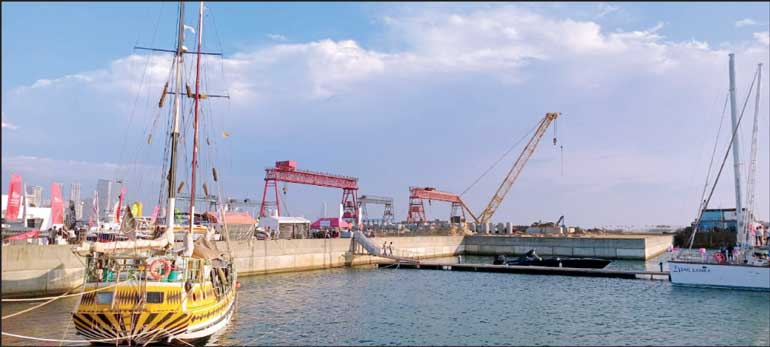
He is also a veteran in the boat and shipbuilding industry, serving as the Group Managing Director of the Sea Leisure Yachting Group, including Sail Lanka Charter. Indhra Kaushal Rajapaksa serves as the President of the National Chamber of Exporters and Chairman of the Chamber of Marine Industries. This discussion was held in the aftermath of the 9th Boat and Marine Show in Sri Lanka, held from 30 January to 1 February at Port City, Colombo.
We will begin this interview by prioritising sustainability in reference to oceans.
Q: It is estimated that around 32,000 to 33,000 tonnes of plastic waste, including rubber, enters the oceans of the world every single day. Were you influenced by this factor when you started exporting recyclable scraps of rubber waste from tyres?
A: In the early part of my career, from 1982, I worked in the footwear industry in the Free Trade Zone (FTZ) Katunayake. Thereafter, I joined one of the major tyre manufacturing companies in the world, Loadstar Pvt. Ltd., started by Dr. Tissa Jinasena and family along with Mr. Pierre Pringiers, a Belgian national. We manufactured solid and pneumatic tyres for the construction and agricultural sectors. With this experience, I was exposed to the rubber and plastic industry as a whole. I gained first-hand insight into the lack of recycling or upcycling options, especially for rubber. After over a decade of research on the scope for exporting rubber scraps as recyclable material, Kalhari Enterprises was established in 2003. Yes, it was started with strong environmental consciousness at a personal level and with a clear understanding that the world faces a serious problem, both for the planet and for humans, if we do not identify opportunities in non-biodegradable waste recycling. At Kalhari, we endeavour to rescue rubber and plastic waste before it reaches the oceans and land.
Q: What are the export markets for recyclable rubber?
A: We export both recyclable products and scraps to several countries, including Japan, India, Thailand and Pakistan.
Q: How do you go about the collection and processing of rubber waste?
A: We first focus on collecting and sorting, followed by processing. This includes all types of tyre manufacturing waste, rubber factory-origin waste and latex product waste. Our processing factories are in Heiyanthuduwa, Mahara and Minuwangoda.
Q: In having made an industry out of waste rubber and similar non-biodegradables, what do you prioritise in this sector?
A: We prioritise being on par with advanced global recycling technologies that will help us innovate further. We also think globally in creating more worldwide awareness and opportunities for environmentally sound waste management.
Q: You are currently the Chairman of the Chamber of Marine Industries of Sri Lanka. At what point did you shift to marine-related activities and the boat-making sector?
A: This is due to a person I deeply respect, Pierre Pringiers. Along with his expertise in the tyre manufacturing sector, he was also a sailing industry enthusiast. He was instrumental in shaping my awareness of this arena after commencing boat building. Pierre Pringiers is the founder and Chairman of the Sea Leisure Yachting Group (SLYG), an industrial venture that builds sailing yachts and rigid inflatable boats (RIBs) in Sri Lanka for local use in sea-based leisure tourism and for global exports. Under the umbrella of the SLYG Group, there is Ocean Voyager, which builds day charter as well as overnight catamarans using superior global technologies. There is Seatek Pvt. Ltd., which manufactures RIBs, fibreglass vehicle parts, stainless steel accessories for boats, safety jackets and sails, with a focus on components and equipment required for the manufacture of marine craft. Sail Lanka Charter is responsible for operating the yachts and providing charter services and cruises around Sri Lanka.
There is also the youth training arm, Building A Future Foundation (BAFF), which provides capacity building for youth, training approximately 100 trainees per year in boat-building technology and technical skills. The Ruhunu Sailing Association (RSA) provides sailing training for youth.
Q: Can we now focus on the potential of boat-making in Sri Lanka, an upcoming industry identified in the national development export strategy?
A: Yes. I am the Group Managing Director of the Sea Leisure Yachting Group Ltd. Overall, what Pierre Pringiers has done in Sri Lanka has changed the status quo of how we view the boat-making industry. His vision is to make Sri Lanka the hub of yacht sailing in South Asia.
Q: Do you see Sri Lanka expanding further globally in this sphere, and what policy gaps may exist that could be rectified?
A: I see great potential in developing and expanding the boating industry in this country. Out of the 63 boat manufacturers in Sri Lanka, only about 10 build boats for export.
The Chamber of Marine Industries, which I head, is carrying out discussions with the Sri Lanka Standards Institute, the Ministry of Industries, the Director General of Merchant Shipping and the Ministry of Fisheries to uplift the quality standards of boat manufacturing. We also see increasing demand for locally manufactured boats overseas, as our quality is on par with international brands. We must amend our regulations to facilitate leisure boating and develop the nautical tourism industry. The rigid laws and regulations that exist have to be amended accordingly. Required marinas have to be developed, alongside slipways to launch boats and the development of separate zones for boat manufacturing.
Q: Could you speak of the technical expertise that the Sea Leisure Yachting Group as a whole is creating?
A: We have our own technical training centre for youth, providing electrical and mechanical training related to boat manufacturing. We train about 75 to 100 youth per year in boat manufacturing. The initial objective in 2004 was to help tsunami-affected coastal communities rebuild their livelihoods. Therefore, the earliest boat-related training focused on boat repair, maintenance and construction at a functional basic level. However, Ocean Voyager builds high-tech boats, including catamarans. All this expertise is gained by Sri Lankans. Only time can tell how many entrepreneurs in this industry we will create and send to the world.
In total, we have trained about 1,000 youth to become skilled boat builders.
Q: Could you speak about the 9th Boat & Marine Show and Conference Sri Lanka 2026, held recently, and how this could boost ocean-linked tourism as well as promote Sri Lanka internationally for its prowess in boat construction?
A: The Boat and Marine Show is organised by the Chamber of Marine Industries, supported by CDB and the Ministry of Industries, in collaboration with the Sri Lanka Tourism Promotion Bureau.
This year, we featured 50 leading marine-related companies. There were 75 stalls and exhibitors. Visitors included boat builders, manufacturers of technologies linked to the marine industry, and providers of diverse water sports and sea leisure tourism products promoting marine tourism in Sri Lanka. This annual event highlights the nation’s growing nautical tourism and marine industry. Key features in 2026 included displays of luxury yachts, boat-building technologies and jet-skis. Our aim through this event is to position Sri Lanka as a regional marine hub.
Q: I attended this event and spoke to both exhibitors and visitors. One visitor was a Northern-born tourism investor in Sri Lanka, a Canadian citizen and an ardent boater who owns boats in Canada and is accustomed to having docking space as part of national policy there, just as there is parking space for road vehicles. He informed me that he has been trying for nearly a decade in Sri Lanka, after returning from Canada to invest in tourism, to obtain formal dock space. He initially tried in the East of Sri Lanka. He remarked that boat shows would be useless in the long run unless Sri Lanka understands the importance of creating dock spaces so that boating-related tourism can move forward seriously.
What is your response?
A: It is a fact that we do not have docking facilities other than in commercial harbours, as there are no proper marinas. We have already discussed with the Ministry of Fisheries converting seven identified fisheries harbours to be used as mini marinas and converting part of the Galle commercial harbour into a marina. We expect the Port City Marina to be completed by 2028. We also expect Oluvil Harbour to be rejuvenated for use as a marina.
I hope that as ocean-related tourism increases in Sri Lanka, alongside local boating demand, there will be policy improvements permitting private docking spaces. We are working diligently towards this and seek to promote private sector partnerships. This is envisaged in areas such as Negombo, Beruwela and Galle.




