Tuesday Sep 15, 2026
Tuesday Sep 15, 2026
Saturday, 13 June 2026 06:29 - - {{hitsCtrl.values.hits}}
By Surya Vishwa
|
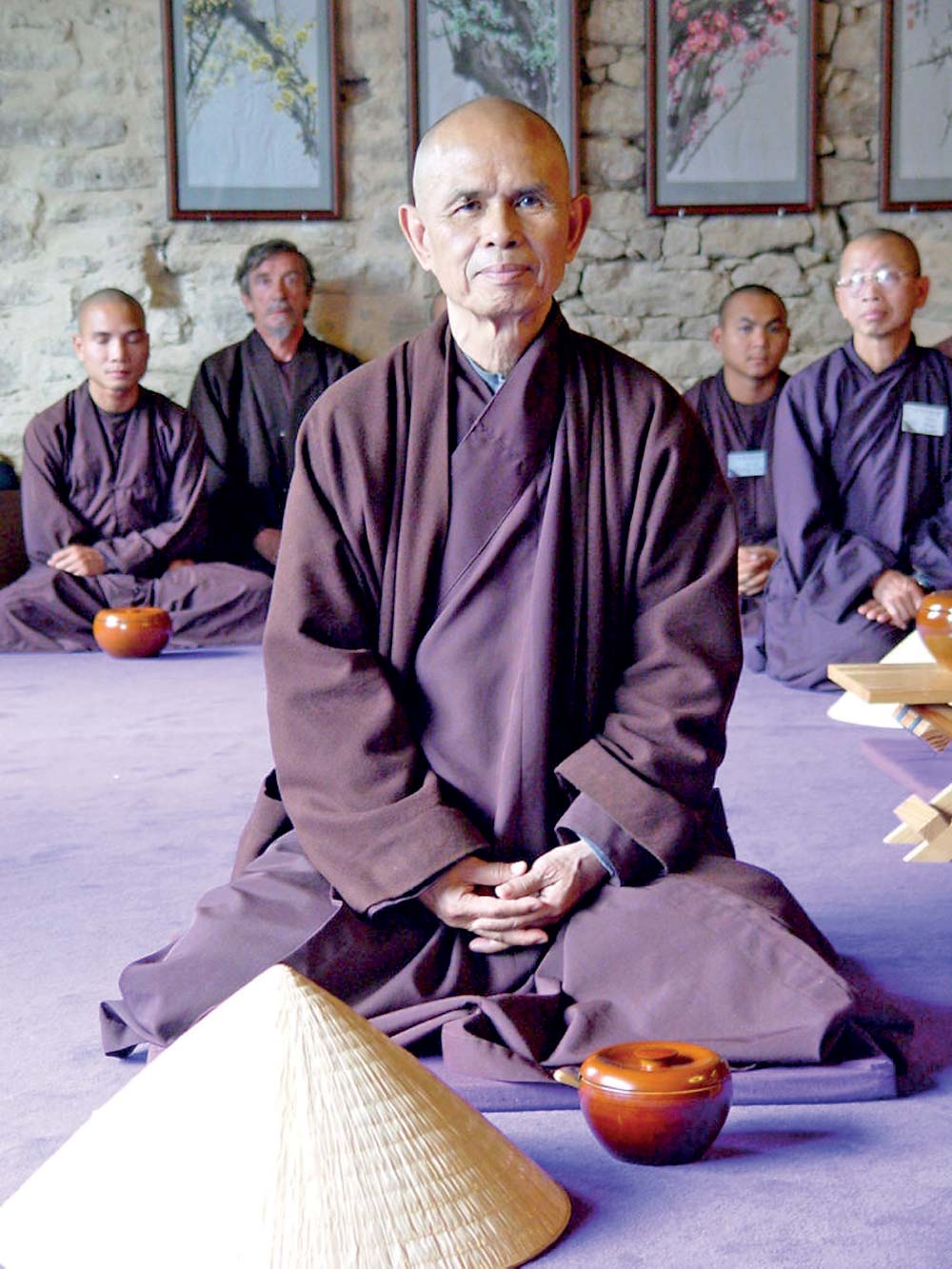
Thich Nhat Hanh
|
This article is based on the book, ‘Cultivating a Mind of Love’ by the Vietnamese Zen Tradition Mahayana Buddhist Monk Thich Nhat Hanh.
(Copyright 1996 by Thich Nhat Hanh – published by Full Circle Publishing, New Delhi, the first Indian edition being in 1996 and the 6th reprint in 2017).
The book, ‘Cultivating the Mind of Love’ touches our mind of enlightenment and our mind of love, marking the moment the Buddhist practice begins in this divided world we live in. The third chapter of this book is titled, ‘The Advent of Mahayana Buddhism’ and helps to rationally understand why this branch of Buddhism emerged and how central it is to the spiritual goal taught by the historical Shakyamuni Buddha. Thich Nhat Hanh Thero points out that during his lifetime the Buddha gave most of his Dharma talks to monks and nuns but that he also taught ministers, farmers, scavengers and thousands of other lay men and women.
However, he shows how in the centuries that followed the Buddha’s life the practice of the Dharma became the exclusive domain of the monks and nuns with the general citizenry limited to supporting the ordained Sanga with food, shelter, clothing and medicine. He points out that by the first century BCE Buddhism had become so exclusively monastic that a reaction was inevitable. It is in this environment that the Ugradatta Sutta was born, he states and then goes on to narrate the developments that led to this Sutta establishing the Mahayana Buddhist tradition. Ugradatta had been an individual keenly following the teachings of the Buddha but refrained from becoming ordained. When asked the reason for his stance, Ugradatta had declared that he need not become a monk to practice the path that focused on enlightenment. This idea was further expanded to the utmost in the Vimalakeerthi Nirdesha Sutra, which speaks of Vimalakeerthi, a layman who was far more advanced than any of the monks or nuns following the Buddha at the time and records that neither Shariputra nor Ananda Thero wanted to go visit him, admitting to the Buddha that this layman was too eloquent and intelligent. The visit is eventually undertaken by Manjushri Bodhisattva where Vimalakeerthi the non monk demonstrates his insights. Thus developed the Vimalakeerthi Sutta and it was a strong attack on the institution of monasticism, Thich Nhat Hanh Thero notes and adds that this Sutta was so successful that there were sequels to it, one about a son of Vimalakeerthi and another about a daughter of Vimalakeerthi and even one about the dharmic commitment based teachings of a woman who had previously been a prostitute. From this point the reader begins to understand who a bodhisattva is and how such a person is important in this current world or ours where wars and every possible spiritual malfunction occurs despite there being diverse ‘religions,’ that in essence based on their original founders, should be annihilating conflict from the soul of the world. What is unique about the book, ‘Cultivating a Mind of Love,’ is that it works on different levels, tracing how and why Mahayana Buddhism developed, tracing the personal spiritual journey of the author Thich Nhat Hanh Thero and how he was, with other monks and nuns, instrumental in ushering in a socially engaged Buddhism in Vietnam in a time that most needed it, in the backdrop of the Vietnam war. The Vimalakeerthi Sutta was followed by the early Prajnaparamit Suttas and the tone of these suttas was still one of attack, he states,
“It must have been difficult to get the attention of the monastic establishment, so taking an adversarial stance must have been necessary,” Thich Nhat Hanh Thero opines adding that by the time of the Saddharma Pandarika (Lotus) Sutta Mahayana Buddhism was already an institution with schools, temples and a solid foundation – a kind of a ‘protestant’ Buddhist community of monks, nuns and lay people working closely together.
The tone of the Lotus Sutta is one of reconciliation and where in the Vimalakeerthi Sutta Shariputra is not accorded any high status, he is elevated in the Lotus Sutta as one to whom the Shakyamuni Buddha shows great love and care. Thich Nhat Hanh Thero added that the Lotus Sutta is at the foundation of Mahayana Buddhism because its tone extends a friendly, loving hand to the traditional institutions of Buddhism.
In chapter five of this book, Thich Nhat Hanh Thero refers to the Sutta on ‘Knowing the Better Way to Catch a Snake’, where the Buddha shows us the way to see reality clearly without getting stuck in concepts and notions. Thich Nhat Hanh Thero states, “I had studied the Diamond Sutta for many years before encountering the Snake Sutta, and I was happy to learn that the simile of the raft and the ‘thundering silence’ statements made by the Buddha have their roots in this early sutta.” It is then shown that according to the Snake Sutta we have to be careful when we study the Dharma because if we understand it incorrectly we can cause harm to ourselves and others.
“The Buddha said that understanding the Dharma is like trying to catch a snake. If you grab the snake by its body it can turn around and bite you. But if you know how to catch it by pinning it down behind its head with a forked stick, it will not harm anyone.”
The Buddha is quoted as follows;
“There are always some people who study the suttas only to satisfy their curiosity or win arguments and not for the sake of liberation. With such a motivation they miss the true spirit of the teaching.”
“Do not practice just to show off or argue with others. Practice to attain liberation, and if you do, you will have little pain or exhaustion.”
Examples are then provided on how the Buddha’s teachings can be grossly misunderstood.
Thich Nhat Thero then recounts from history records of how one time before going on a personal retreat near the city of Vaisali, the Buddha gave a Dharma about impermanence, impurity of the body and non self. Some monks misunderstood him and said – ‘this life is not worth living. Everything is impure and must be abandoned.’ “Then after the Buddha left for his retreat several of them committed suicide right in the monastery where the Buddha had spoken.”
In another paradoxical misunderstanding of the Buddha it is further shown through the Sutta on ‘Knowing the Better Way to Catch a Snake’, where a monk named Aritha claimed that the Buddha taught that sense pleasures are not an obstacle to the practice. Hearing this the Buddha had summoned Aritha and queried, “Aritha is it true that you have been saying that I teach that sense pleasures are not an obstacle to the practice?”
The monk Aritha had confessed that it was true replying, “Yes, Lord, I do believe that according to the spirit of your teaching sense pleasures are not an obstacle to the practice.”
Thich Nhat Hanh Thero states that he had reflected deeply on this passage and done extensive research and emphasises that when one reads any sutta, one should keep in mind its context as well as the whole teachings of the Buddha. Trying to delve into what could have misled monk Aritha so, Thich Nhat Hanh Thero points out to the fact that the Buddha was a happy person who discovered that needless mortification of the body was not necessary for enlightenment and saw things as they are. For example it is mentioned that the Buddha pointed to some rice fields and stated; “Ananda, aren’t those fields beautiful when the rice is ripe? Let us design the robes of the monks in that pattern.” And at another time as Thich Nhat Hanh Thero notes, the Buddha when passing the town of Vaisali had opined how beautiful the town is, and when King Mahanama had treated Buddha and his retinue of monks to a banquet had remarked “Mahanama offered us the best kind of food.” Thich Nhat Hanh Thero then concludes that the first aspect of Buddhist meditation is Samatha (stopping and calming) the mind and the second is Vipasyana (looking deeply) and that if we study Mahanaya Buddhism we will find that Vipasyana – looking deeply is very much at its heart. We are told that when we study the Sutta on ‘Knowing the Better Way to Catch a Snake’, an early teaching of the Buddha, we will recognise it as an excellent introduction to the teachings of Mahayana Buddhism.