Tuesday Sep 15, 2026
Tuesday Sep 15, 2026
Saturday, 3 January 2026 00:19 - - {{hitsCtrl.values.hits}}
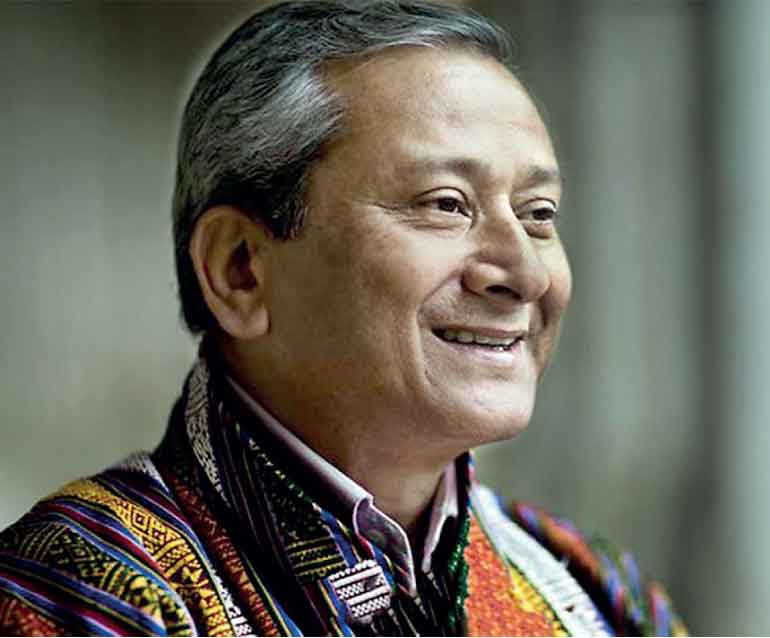
Prof. Saamdu Chetri
By Surya Vishwa
We start the year 2026 by focusing on the concept of authentic happiness and how it is directly linked to transforming a direly harmed planet.
We feature Prof. Saamdu Chetri, recognised as one of Bhutan’s 100 prominent figures, known for spearheading the establishment of the Gross National Happiness (GNH) policies in Bhutan and serving as the Executive Director of the Bhutan GNH Centre.
He has worked for five decades to instil the principles of equality through GNH, and has a PhD in Economics. He has been referred to as the “Happiness Guru” by the BBC, and was honoured with the Buddha Peace Prize in 2016 by the Samata Sahitya Academy in India.
He is currently the Director of the Yogananda School of Spirituality and Happiness, which is part of the Shoolini University in Solan, Himachal Pradesh, India.
Below are excerpts of the interview with Prof. Saamdu Chetri.
Q: You were instrumental in establishing and leading Bhutan’s Gross National Happiness Centre as its founder and Executive Director. Could you explain how the GNH evaluation has progressed in Bhutan?
A: GNH was not measured when it began in 1972. Progress reports to the parliament and other technical reports started to appear, based on the four pillars socio-economic development, preservation of the environment, cultural promotion, and good governance, which were later recognised as the four pillars of GNH. They appeared in parliamentary reports and in all technical reports. It was rather a progress-type report with some comparative statistics.
It all started when the King, as a young person, travelled from village to village in Bhutan and asked people what they needed to be happy. The villagers would leave the decision-making to the king. The King, His Majesty Jigme Singye Wangchuck, although then reigning at 17 years of age, was determined to develop the nation with the concept of happiness. He decentralised power to the grassroots with authority for development and finances. He asked the Government to develop a mechanism of more for less and less for more to bring equity within the nation.
This concept of development began to resonate with the world after the king told a journalist in September 1975 in Bombay (present-day Mumbai), India, that for him and his nation, “gross national happiness (GNH) was more important than gross national product”.
Happiness for me is to be calm, humble, non-dualistic in perspective, accepting of reality, doing what you can for the happiness of others, including nature and all forms of life, and letting go. The development of the science of happiness into a course for universities and institutions brings me joy as an academician. As a scholar, I am happy that I have been able to publish happiness books and continue to do so. As a policy influencer, I could bring changes to development thoughts, including those related to researchers and their educational courses.
The world started to question how to measure GNH. We told them that we live by it rather than measure it. After the UNESCO Regional Summit in 1998 in Seoul, where former Prime Minister Lyonchen Jigmi Y. Thinley shared the concept, more questions were raised about its applicability. They asserted that without quantifiable evidence, people would not accept it.
In 2000, the UN granted funds to develop the measure for GNH. Seventy-five global thought leaders contributed to the development of the measure, with 42 of them remaining committed to the idea until it was finalised and presented to the UNGA in September 2011. However, the first pilot was done in 2007, followed by improved measures in 2008, and finally, the first national survey was conducted in 2010, followed by five-year intervals in 2015 and 2020 (conducted in 2022). The next one is due.
It is remarkable how the measure helps us understand and improve our development parameters. It helps us prepare five-year plans strategically, indicating where the inputs have to be enhanced and why. It measures the growth and changes on either the positive or the negative side of development.
One example I can give you here is when the first democratic Government fulfilled its six promises to the people, we found a sudden decrease in community vitality and a rise in living standards between 2010 and 2015. This could be because road links, connectivity, and electricity gave possibilities for richer families to buy the latest equipment, gadgets, and appliances, including two-wheelers and cars. It brought a fear factor among others who otherwise never felt the difference in the community but worked hand in hand as one family in the community. This development brought fear factors, insecurity, lack of trust, and jealousy within the community. The Government decided to implement equal development interventions in the following plans after realising the decline in two of the nine domains (community vitality and psychological well-being). However, all nine domains showed improvements.
The comparison between 2015 and 2020, conducted in 2022, due to COVID-19, showed gains in five of the nine domains. They were health, education, living standards, and community vitality. While the other four domains—cultural diversity and resilience (cultural participation and etiquette), psychological wellbeing (mental health), and good governance (political participation and fundamental rights)—showed a decrease.
The GNH measures can give you details of how 33 indicators have fared in development and what the level of happiness is in each area, by segregation in gender, places, education levels, age groups, etc., in great detail.
Q: What have been the key research findings of the GNH centre under your leadership in terms of the importance of happiness to a nation?
A: Research was conducted by the Centre for Bhutan Studies. It is mandated to them. We at the GNH Centre did the job of teaching what GNH is and bringing the concept out to the world through discourse and talks to Governments, institutions, universities, and other relevant places. Our job was also to help live the concept for the Bhutanese young people and the world at large. We conducted several yearly trainings on the journey of GNH and helped people (especially foreigners) experience it by living.
Q:How would you define the word ‘happiness’ when you look back at your life – what is it that has made you really ‘happy’ as an academic, scholar and policy influencer?
A: Happiness for me is to be calm, humble, non-dualistic in perspective, accepting of reality, doing what you can for the happiness of others (including nature and all forms of life), and letting go.
The development of the science of happiness into a course for universities and institutions brings me joy as an academician. As a scholar, I am happy that I have been able to publish happiness books and continue to do so. As a policy influencer, I could bring changes to development thoughts, including those related to researchers and their educational courses.
Q: Could you explain the Buddhist basis of the GNH index’s creation in Bhutan?
A: Compassion (karuna – reverence for all life forms) for nature, the eightfold paths (morals, especially in livelihood, action, mindfulness, and efforts), and wisdom with right thoughts and views have a big role to play in GNH. The value in education is about the five precepts, love and respect in governance, community, and family.
The GNH has a deep connection with Buddhist philosophy. For example, in his 2008 Coronation Address, King His Majesty Jigme Khesar Namgyel Wangchuck expressed his commitment to serving his people. I quote him: “Throughout my reign I will never rule you as a king. I will protect you as a parent, care for you as a brother, and serve you as a son.” He also pledged, “I shall give you everything and keep nothing,” and promised to “always serve you, day and night, in the spirit of kindness, justice, and equality.”
Q:What are the key research findings in Bhutan, especially those carried out under your purview, pertaining to the link between GNH and protection of Mother Earth?
A: Bhutan has promised itself to be carbon neutral for its entire life. We are presently carbon negative, with over 5 million tonnes to spare for the southern and northern countries.
Bhutan has very stringent rules and regulations for environmental preservation, which is one of the nine domains of GNH happiness. The constitution mandates that Bhutan maintains a 60% forest cover throughout its life. Presently, it is 72 per cent forested and 80 per cent green.
Q:Climate disasters are currently drastic everywhere in the world, and human actions are seen as the direct propeller of the malfunctioning of our planet. How can the GNH influence climate protection at a wider scale?
A: The problem is that scientists prove that climate disasters are real, but rich people who get richer out of natural resources disprove it by buying ex-scientists with wrong data. However, if every Government in the world adopted the GNH concept, the world would see a new change, like during the COVID period, where human intervention was less and nature flourished.
Bhutan is a good example for other nations to learn from. The world only discusses GNH but does not implement it. The question is, will nations adopt GNH? The answer is definitely no. The GNH measure punishes those who are destroying nature and societal order. Further, Governments are run by business contributions. No business will want to support GNH and give away easy ways of making money through the destruction of natural resources and the factory food, dairy, and meat industries.
Yes, the idea of bringing GNH to the UNGA in 2011 was to get the world to adopt it. There were two resolutions taken: one is that 20 March is to be observed as the “International Day of Happiness”, and the other is “Happiness: An approach to a holistic development”. It is impossible to know how much each country follows it.
I think we should get each institution in a country to adopt it, and the combined effect would be the Government. Like in our country, it has to be a bottom-up approach rather than a top-down one.
Finally, it is we, each individual, who are to be blamed. We easily fall prey to sensitisation and advertisements. If we stopped copying and were ourselves, we could change the world easily. Are we as individuals ready for it? We are the economy that helps destroy the planet. If we stop buying clothes lavishly, if we stop eating inorganic products, if we stop eating dairy and meat products and factory foods, we can bring change immediately.
Q: Sri Lanka has shown interest in the GNH but has not formally adopted it as a national development framework. As a scholar who helped Bhutan adopt the GNH into its national policy, how would you advise Sri Lankan policymakers to initiate the fundamental principles of GNH, especially in sectors such as education?
A: The Centre for Meditation Research (CMR), of the University of Colombo Faculty of Medicine in Sri Lanka, has already started the process. It will grow out of this when people learn the benefits of meditation that would create flourishing youth.
Bhutan provides GNH in education. If we can change one upcoming generation of a nation, we can change the country forever. It need not be taught as part of the subject matter. High-quality classes a week can change the role of students. Give them the opportunity to bring design for change. This means presenting them with a problem that originates from the school itself, such as the overuse of plastics, and asking them to find a solution. I can assure you that once they are aware of the issue, they will find a way to resolve it.
GNH can be introduced as experiential learning with the already-made curriculum, incorporate positive language in the subjects being taught, and ensure that actions align with GNH principles within the curriculum. GNH language can be used in all subjects. For example, in mathematics teaching a class, if a problem were to be formulated as, ‘If you had ten apples and three are stolen/lost, how many are left?’ the casual use of the word ‘stolen’ distorts a young mind into thinking stealing or losing something is acceptable. Instead, if the problem was formulated as, ‘If you had ten apples and you shared three with your friends, how many are left, and what will you do with them?’ you give the child the power to share, imagine, and become creative.
Q: Modern education is often perceived in the world to be rhetoric-driven and curtailing true genius or connection with the natural world rather than prompting it. How has the GNH helped Bhutan’s education sector to stay grounded in developing minds whose priority is curiosity, creativity, spirituality, and the well-being of humanity and earth?
A: Education is truly a factory producing products ready for the marketplace. This has to change. GNH gives freedom to schoolchildren to innovate, create, and practise spirituality through meditation every day in school, and teaching is by example from teachers. Teachers would rather guide than teach and appreciate every little achievement of a child, and competition is with the self and not others. There are quality classes where children learn to innovate and find meaning and an end to an issue. It is not guided by teachers; the students do it themselves.
By saying that, I would not say that Bhutan has been able to bring GNH completely into education. The challenge is that there is no single standard approach to implementing it. Teachers are given the freedom to operate within a framework that facilitates learning.
Q:Do you think the GNH index is directly responsible for Bhutan being the world’s main forest protector, known for the world’s most effective environmental policies?
A: GNH, as a pursuit by our Government, is mandated by the Constitution. Environmental protection and preservation are important domains of GNH happiness. It has helped further strengthen forest, water, and environmental policies. However, our Fourth King, His Majesty Jigme Singye Wangchuck, was very concerned about the environment, and he brought the greatest change in environmental and forestry policies. His Majesty King Jigme Singye Wangchuck, the Fourth King of Bhutan, received significant environmental recognition, including being inducted into the Kyoto Earth Hall of Fame (making him a member of the intellectual elite there) and winning the prestigious Blue Planet Prize (2022) for his nation’s environmental leadership. Bhutan was thereby recognised for its Gross National Happiness philosophy, carbon negativity, and extensive forest cover, truly making him an environmental icon.
One story I wish to narrate here. When a Bhutanese engineer cut a 700-year-old tree that was on the path of his road alignment, he was called by the Fourth King and questioned. He was asked: Could the road not have been built above or below the tree? He was punished for it.
Q: What is your advice to the media in helping concepts like GNH get prevalent in society?
A: When GNH is implemented from within the organisation and helps others to do the same, it will begin to flourish.
Metta.




