Tuesday Sep 15, 2026
Tuesday Sep 15, 2026
Saturday, 20 June 2026 05:07 - - {{hitsCtrl.values.hits}}
By Surya Vishwa
Can the light of wisdom be boxed into a cardboard decoration?
Can enlightenment or wisdom be vandalised?
Can foolishness and delusion also be boxed in a cardboard decoration and hung with much fanfare for all to see?
How many flags does it take for a nation or person/s to be ‘Buddhist’?
How many sermons or chants does it take for a human to transit from listening to practicing wisdom?
The purpose of this article is to get us all to think upon the gap between the actuality, the hypocrisy and the ensuing suffering (dukkha).
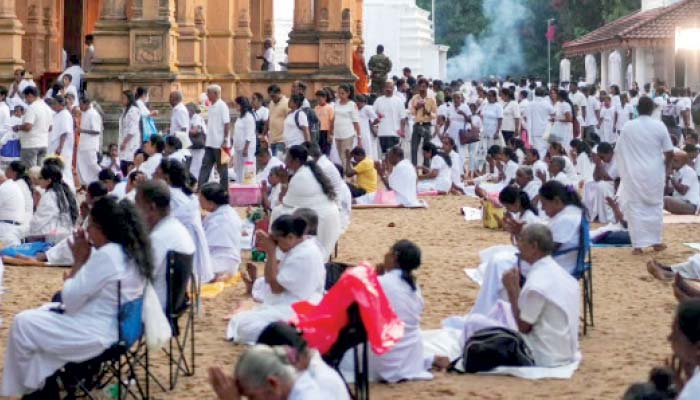
On 1 May around 2,000 Sri Lankans, mostly from the upper and middle class of Colombo flocked to the BMICH in Colombo. They were there as early as 6am demurely well dressed in white and wearing also their calmest visage. What brought them there was a full day of Dhamma interaction with Ajahn Brahmali Thero, the Norwegian born, former Engineering and Finance graduate; a Buddhist monk of international stature. He had taken to monastic life around four decades ago leaving aside a family legacy of significant wealth and ‘lucrative’ professional choices.
This article captures and introspects the depth of segments of his teachings in Colombo that we have not featured before.
We have already covered the broad aspects of his sermons and exclusive interviews in this page and the Daily FT main pages. We today delve into certain statements not yet reported. We extracted these to save them from being lost in the throes of mere ‘sermon listening.’
Spiritual success
As we write, the colourful Vesak lanterns and bulbs have flickered out. The thousands of Buddhist flags flying from every rooftop are hoisted down. And the white clothing taken out on Poya days (and the nicer ones for Vesak) folded and placed in wardrobes.
Now let us in this month of June begin with Ajahn Brahmali Thero answering a question relating to exam stress of youth. When this issue was brought up he nonchalantly asked parents and youth to treat any possible failure in academic life as a boon to cultivate success in another dimension; the spiritual one.
He queried as to why instead of craving for the intense pressure that ‘prestigious’ jobs bring after high anxiety driven ‘education,’ catering to the job ‘market,’ why not treat ‘weakness’ in exam taking, as an opportunity to tread a differing path. One that brings freedom, happiness and time for pursuing knowledge that is not for the job ‘market’; but knowledge associated with the highest levels of insight such as knowing one’s own mind, as taught by the Buddha.
Having said this as cited above and also in differing ways, it was clear that this highly erudite former scholar, engineer and finance degree holder (who never speaks of his academic credentials) thought nothing of these ‘qualifications.’ He had chosen a more challenging path; the one of absolute knowing, going into battle and conquering the self, rather than narrow cocoons of modern ‘education.’
This writer seated amidst the white coloured sea of humans could not help glancing at many a middle aged face of possible parents of school going youth as Brahmali Thero shrugged off their dilemma.
The focus on youth suicides and stress arose as a result of a question posed to Brahmali Thero by some youth following his sermon online. His explanation, at times in mild humor and at times in seriousness, showed that there was an option. That these youth could be directed to a different reality as followed by the Buddha. That they need not necessarily become monks but be humans who create time for the honing of their spirituality. And with this expansive relief given to the mind, provide themselves the opportunity to maximise their own creative intelligence to design paths of earning income in ways where they can exercise their unique abilities, creativity and wisdom. This would mean the creation of a human psyche that is not dictated to by institutions that measure intelligence through rigid exam taking.
But profound advice like this and many other teachings by Brahmali Thero, including the call to think of each moment as one which hides death, could easily slip our mental grasp. We could descend quite fast from sermon listening to wisdom ignoring as we return to our homes.
How many of us would have ruminated further when we got back home? How many of us listening to the sermon and views by Ajahn Brahmali Thero would have honestly considered the path less travelled: the path of deep insight?
If we did, would it matter that our son or daughter ‘fail’ to fill the vacuum of our own desire; to have offspring (that we could boast to the world) as a ‘doctor,’ ‘engineer’ or ‘academic’ graduate? Do we question whether we want these desires fulfilled through our children for the greater selfless good it could bring to the world or for the fickle social position we crave for? Would we then become aware that we are using our children as pawns of our own un-awakened hankering? Would we recognise that this is the opposite of genuine love? Could we then comprehend that coercing, influencing, forcing children towards life paths they have no interest in (or instilling in them an exam based inferiority complex) is just a hybrid form of delusion soaked attachment? Would we become aware that this attachment is diluted in fear? That what motivates us to treat our children as robots of exam victory or failure is the fear of ourselves being seen by society as failures – where we become parasites, gnawing at our children’s equanimity. If we pondered in this manner after returning home from listening to Ajahn Brahmali Thero we could see that exam stress is something we project onto children with the values and world view we have brainwashed them with. We could also become aware that this unrefined mental state of ours has nothing at all to do with a pragmatic, wholesome, holistic and happy approach to life which is the Buddhist path.
Culture and wisdom
Let us now look at ‘culture’ and the juxtaposition with ‘wisdom’ that is a prerequisite of the science of Buddhism. Asked about the relevance of rituals as part of culture and tradition in connection to Buddhism Brahmali Thero was somewhat non- committal stating that some rituals to ‘some extent’ could help and too much may not help. It could be seen in many individuals in the Western world who take up the Buddhist life, do so without the distraction and burden of rituals which are hand me downs of cultural practices of the land.
So, could we say that rituals as part of culture and tradition harm or benefit wisdom and insight? The answer could lie as to how we use these practices and to what end; whether or not we engage in these rituals to support and enhance the state of harmony, loving kindness and equanimity within ourselves and others.
Now let us consider the aspect of gender in a backdrop of various statements being made on the Karmic ‘misfortune’ of being born a woman. It was very interesting that Brahmali Thero, although of course using his unique humour, quipped that he loves Sri Lanka so much that it is possible that he was a monk in previous lifetimes in this nation. He then corrected himself and said that it is more likely that he was a Buddhist nun in past lives in Sri Lanka. The ease with which he said this showed that he did not consider a particular gender as superior or inferior. He took the flow of samsara where humans emerge in differing bodies, across the boundaries of gender, caste and creed, lifetime after lifetime as per the Buddhist and Hindu view, as an unavoidable truth.
There may have been other monks in this world who have stated that they may have been nuns in past lives but this is the first time this writer heard it on a public platform.
What exactly can we learn from this wisdom? We can learn that gender is just a fraction of the whole – if there were only men in this world – say as a result of their great ‘virtue,’ then there would be no women, which of course would eventually result in there being no men! Therefore, what we gathered at the sermon of Ajahn Brahmali Thero is the space to think out wisdom and root out abject stupidity that could parade as truth. The Ajahn Brahm Society of Sri Lanka spends an enormous amount of effort facilitating such visits of dedicated monks. It is up to us Sri Lankans to prevent these initiatives from going to waste. These are not social events. These are moments that define whether we transform from machine-like consumers of ‘preachings’ to actually living out the wisdom.




