Tuesday Sep 15, 2026
Tuesday Sep 15, 2026
Saturday, 11 April 2026 04:09 - - {{hitsCtrl.values.hits}}
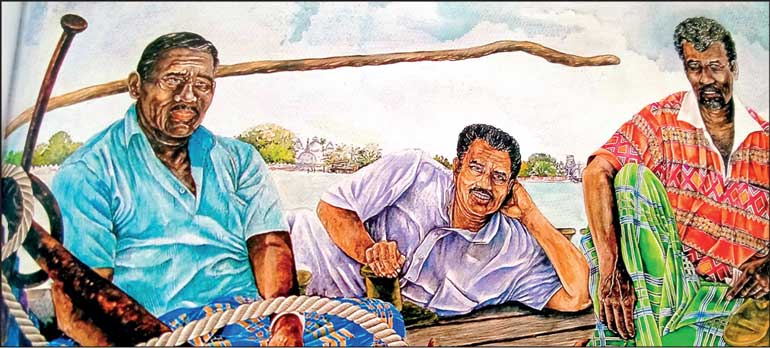
Jaffna citizens travelling to Delft island
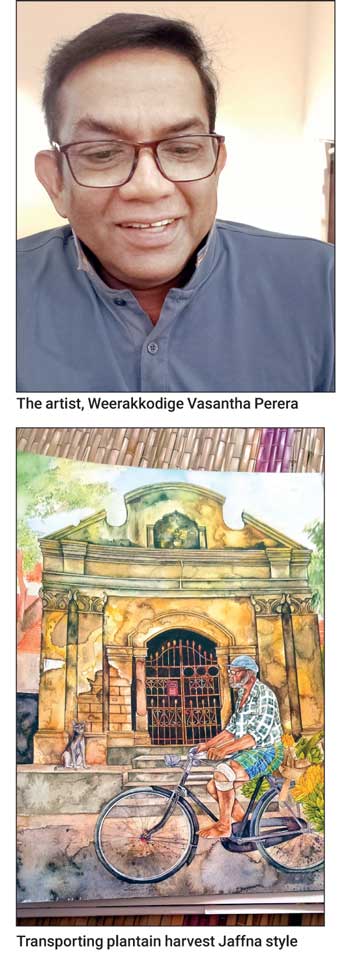 By Surya Vishwa
Is an artist set apart from the rest at birth, born with a unique gift that life should be allowed to perfect?
Is the artist a species crafted within four walls, taught the technicalities of colour, angles and chiaroscuro?
Is it the doom of the artist to die in hunger, suffering for his or her gift?
Is there a purpose in art and how does one find it?
When battlefield intrigue has tormented the soul of a nation, and peace totters about flailing, where should an artist be?
The answers to the above questions are found in the story of Weerakkodige Vasantha Perera. His legacy thus far pulsates within three travel sketchbooks on Jaffna, Kandy and Colombo.
Today’s focus is on the canvas of Perera alongside his recollections of a daring and unique effort, between 2002 and 2008. This was the timeframe of a historic cessation of hostilities between the Government military and the Tamil Tigers. Perera decided upon something no artist, especially one from the South, had ventured to do. The bombs had fallen silent in a troubled peace agreement and there was no guarantee of safety for him, but he had made up his mind to revisit Jaffna, which he had last seen as a child. He knew no one there, did not speak Tamil, and his mission was not sponsored by any entity, local or foreign. From Colombo, he took public transport; the private buses that had begun plying from Wellawatte. In Jaffna, there was a friend of a friend, Aravindan, who took him around on his motorcycle, waiting patiently until he took photographs of sites or people that caught his eye. These would be painstakingly transformed into a storytelling marvel, connecting the South with the North through strokes of the paintbrush.
“The LTTE questioned me in detail during my visits, initially with much suspicion – they thought I was a spy. Finally, they came to the conclusion that I was a crazy Sinhalese running around in war-ravaged areas with sketchbooks, watercolours and a camera,” recalls Perera. There were always some LTTE sleuths trailing him, but he and Aravindan went about their way.
“The LTTE members following me from afar, in civil attire, soon caught onto the artistic vibe and dropped their guard to prod or help me in my task of searching out artistic representation shrouded in everyday life in Jaffna,” smiles Perera.
He is now 60 years old and working on an expanded set of paintings that will be in the next book covering all of Sri Lanka. Looking back at himself then in his 30s, he recollects a Jaffna that did not speak to him of war or a politically turbulent interlude defined as a peace process. Instead, Jaffna mesmerised him with an undying hope and resilience that shone in the dimmest of eyes, which age could not erase.
He would later embark on similar pursuits in Kandy and Colombo, which are now books. The original paintings that adorned those pages have been sold. But it is that initial exhibition in 2008, of the Jaffna images, that captured the essence of what the role of an artist should be when a much-trumpeted peace crumbles into a façade that would soon be dipped in bloodshed. There is also an episode that can teach us about humans—those who have money and could support art, and those who have none and yet support it wholeheartedly.
“I had completed the work on Jaffna. I wanted to exhibit and launch this endeavour alongside the printed book. But I had exhausted the money. It would cost a few more lakhs to have a decent launch. I had chosen Lionel Wendt as the exhibition venue. But money remained the obstacle.”
A turning point
 He was by then known as an artist in high business elite circles, having previously been associated with a star-class hotel. Yet, as he would soon learn, appreciation of his art at a time he needed it most would come not from millionaires who occasionally commissioned him for artwork to adorn their mansions, but from a young girl—a total stranger. She had never met him and had her own financial struggles.
“I was at that time carrying out a TV show on art and there was this young fan who contacted me with an artistic query. In the course of the conversation, I casually mentioned the dream of an art exhibition.”
The young woman questioned why he was delaying, and when she heard that money was lacking, promptly offered to pay the needed amount, which was three lakhs. She insisted that he give her his bank account and that she would immediately make the transfer so that the exhibition could be held soon.
Perera had admonished her not to trust strangers like this, but finally, on the oath that she would accept the return of the cash after he had sold the paintings, the loan was accepted.
The exhibition stirred hearts and minds.
The wording of the invitation went something like, “Enna maath eke Yapane Yanna” – “Come, travel with me to Jaffna”. The timeframe was months before the ceasefire disintegrated. Thereafter, gunfire and bombs would rage and fully stop only in May 2009.
“The Lionel Wendt was full to capacity with a Tamil and Sinhala audience. All the paintings were sold. The first thing I did was settle the loan provided by that young woman,” reminisces Perera.
Browsing through the art books on Jaffna, Kandy and Colombo is like meeting humans living out their life saga on paper. One can ‘read’ their mood, their sadness, hope, joy and the scattered turbulence in between, as one observes the smiles, the grimaces and the frowns encompassing the defiant wish to overcome every hurdle.
The personas of the three districts are made immortal in nuanced hues that capture the essence of individuality, represented by the filigree textures that differ from one another. It is only a sensory sensitivity that has grown into the subconscious of the artist which can summon such distinctiveness and extol it in subtle shades, heralding cultural vivacity and variety.
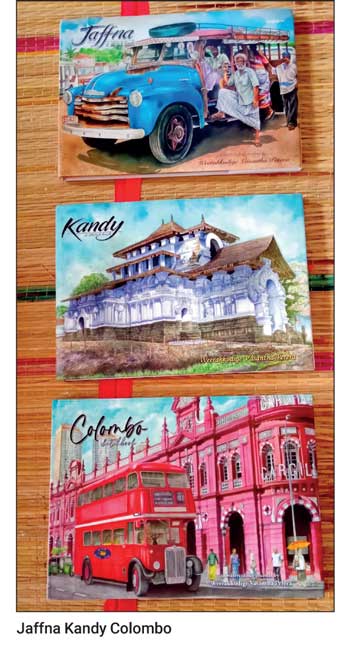 In the book on Kandy, there is Podu Appuhamy, custodian of the Devas (God’s) kitchen in Ambakke Devale, posing before the Dancing Hall/Lounge room. Then there is an aged woman dressed in a faded saree, peering from the front door of the Lawyers’ Office building. Part of the nameboard signs of different lawyers is visible in a depiction showing the scarred, dusty eulogy of time and what it means for men and women desperate for legal redress. The artistic meanderings of Perera are not just about capturing images but also artefacts, architecture, wood carvings and whatever history has left standing.
The wood carvings of Ambakke, the Galmaduwa Vihara, the Lankathilaka Rajamaha Viharaya, the Appallagoda Ambalama and the Daulagala Ambalama are some of the buildings portrayed from the Kandy district. Also from Kandy are a range of artefacts such as the royal sword with its case used by the last king.
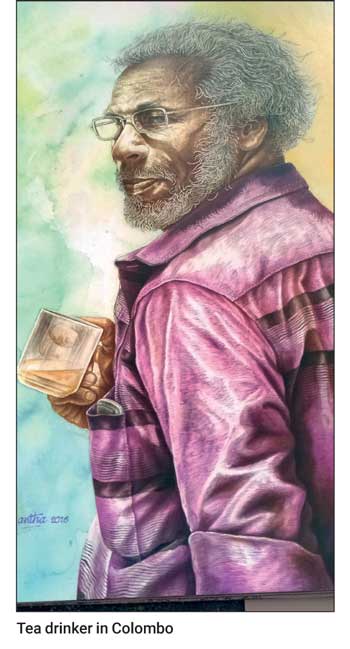
In his most recent sketchbook on Colombo, the cover adorns a surreally realistic coloured portrait of the Cargills building, half covered by a red double-decker bus. This book is replete with sketches and paintings poignant of a Colombo that was. There is a black-and-white illustration from the intersection of Prince Street and First Cross Street of a man pouring out a ‘yard of tea’ from his vintage tea boutique. On the next page is the watercolour image of a bespectacled man, aged but sturdy, with an abundance of frizzy grey hair, holding a nearly finished cup of milk tea bought from that tea stand. There are more coloured depictions of Sri Lankans from diverse backdrops and a black-and-white as well as colour odyssey of architectural marvels, including a house at New Chetty Street, a section of a house on Mihindu Mawatha close to the Hulftsdorp roundabout, the Jami Ul-Alfar Mosque (the Rathu Palliya – Red Mosque) in Second Cross Street, Pettah, and images of deities from the Kelaniya temple.
The book on Jaffna, his pioneering work, is a poignant echo.
These images are from the Jaffna of 22 years ago, when bicycles were the sole family ‘vehicle’ for almost the entire population across all walks of life. Taking us back to those times are many sketches, including a young family on a bicycle, a coloured painting of a bespectacled old man with a bandaged knee transporting his harvest of plantains, and a black-and-white sketch of the traditional wooden Chekku oil mill. The photograph chosen as the cover page shows a bright blue rusted Chevrolet lorry improvised as a bus, depicting passengers getting into it as it chugged to a brief stop along the roads of Point Pedro. The Manthri Manai, the Minister’s House built in the fifteenth century, and the black-and-white sketch of the entrance to the palace of Tamil King Sankilli are among the Jaffna buildings portrayed. Many pages are also dedicated to ornate windows, including those of St. Mary’s and St. James’ Church.
Life of sacrifice
‘How did Perera achieve this artistic excellence? Can an artist make money from art alone?’ I inquired, and he responded, “I never learnt art. Not in school and nowhere else. Art is something that life taught me, and I dedicated myself to perfecting it. I chose art and a full-time career when I was comfortably encased in a cushy job in one of the famous hotels in Colombo. My colleagues, friends and my bosses thought I was insane to leave all that five-star luxury to roam around the country, without a steady income, painting everything and sundry,” recalls Perera.
There is an air of the ultra-disciplined company executive—the opposite of the stereotypical dishevelled artist we usually expect.
“I am that. I am disciplined. And I was a company executive,” retorts Perera.
On the seemingly unbelievable phenomenon that no one had ever trained him to sketch, draw or paint, he grins widely.
“Well, if I had indeed ‘learnt’ art in a school or university, I wonder if I would have produced all this,” he quips.
He then reveals the view of a highly renowned art professor that a portrait painting should start from the head downwards, insisting that otherwise the anatomical proportions would be flawed.
‘What was his view?’ I asked.
“From the hands, feet or toes—from anywhere, one can start a portrait. You get the image sorted as you go on.”
‘And how has it been making a living through art?’ I asked finally.
“Well, I devoted my whole life to it. I nurture my family and make a living through art. But my paintings are not cheap,” he emphasises. I gasp at the figure quoted.
“Why do you express shock?” he asks sharply. “Art does not come low-priced. Not when it has been the sacrifice of an entire life.”




