Tuesday Sep 15, 2026
Tuesday Sep 15, 2026
Saturday, 7 March 2026 00:09 - - {{hitsCtrl.values.hits}}
 |
| Claire Turner |
By Surya Vishwa
When the word medi-care, or medicines is mentioned, the first visualisation could be a handful of pills bought at a pharmacy. This is especially true if one attempts to correlate health or wellbeing within a Western nation. Yet, this entire earth nourishes us, irrespective of the abuse the humans hurl it with, with their wars, chemical poison and pollution, and reciprocates in unconditional love.
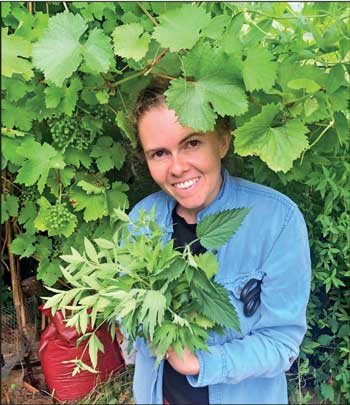
To understand better how humans can nurture their wellbeing through the earth, even in an advanced industrialised nation such as the United Kingdom, this discussion features Claire Turner, human-earth connector, organic farmer and herbalist, based in Gateshead, UK. Together with her Sri Lankan born husband, Thanusan Gunabalasingham, Claire is focused on reconnecting people with nature through food, health, and wellbeing. She works through her herbal centre and through ‘Nourish the Wild’, an NGO incorporated by herself and her husband in April 2024 in the UK to bring humans closer to their mother earth through diverse activities, operating mainly in Tyne and Wear and East London.
For the past two months Turner and Gunabalasingham have been travelling across Sri Lanka as back-packers, especially in far flung rural terrain, meeting those who are on a similar mission as them. Below are excerpts of the interview:
Q: Tell us briefly about your backpacking experience in Sri Lanka. What were you looking for and what is it that you found?
A: I have been travelling around Sri Lanka for the past two months, alongside my husband, who is originally from the Northern province. It is the first time that we have visited Sri Lanka together since we were married. It is also the first time that I have been able to travel to the Northern province, having previously visited Sri Lanka as part of a youth exchange in 2010, when access to the North was not possible. We have been able to visit his family, which I have only seen on video call, and I have been able to see the land on which my husband was born and where generations of his family have lived. I have also been able to reconnect with the kind and generous family who hosted me as part of the youth exchange 16 years ago in the East of the country. As such, this has been a deeply moving and incredibly special experience. Alongside this, because of our interest in plants, herbal medicine and social development, we have sought out meaningful projects and made connections with numerous people across the country.
Q:Can you elaborate about yourself, your connection to mother earth and what you learnt as a herbalist.
A: Having been raised on a farm in rural UK, with grandparents who grew much of their own food, I have always had a connection with the land and with plants. This connection was strengthened by leaving a career in community and social development work to re-train in organic horticulture, after which I combined the two skills to support others to establish community food growing projects, before eventually deciding to study herbal medicine. This journey has taught me that our home, earth, is able to provide us all that we need, as long as we exist in a relationship of reciprocity. As such, I established a herbal practice, Ahimsa Apothecary herbals, to honour this sentiment of reciprocity and non-violence at the heart of what I do as a herbalist.
Q: Tell us about how herbalism exists in the UK; are people drawn to it?
A: Unlike in Sri Lanka, where Ayurvedic and Siddha medicine are supported by the government through an excellent network of university training, hospitals and dispensaries, herbal medicine in the UK does not receive state funding. Herbal medicine practitioners in the UK mostly train and work privately, with the majority of patients paying for their own treatment. Though free medical treatment is provided through the National Health Service (NHS) in the UK, there are very few herbal medications licensed for prescription by doctors in the NHS, unlike in other European countries, such as Germany, where doctors frequently prescribe herbal medications, alongside pharmaceutical medication. Since the Covid-19 pandemic, there is an increased awareness of the importance of maintaining a healthy lifestyle and the role of natural medicines in supporting this. People are finding ways to access herbal medicine. The range of herbal products available online or in shops has significantly increased, meaning that more people can get herbal products, whether or not they consult a medical herbalist.
Q: Is herbalism taught in universities in the UK? Where is it that you did your herbalism training and how long was the timeframe?
A: There is only one degree course in herbal medicine remaining in the UK. The rest of the courses are run by private herbal medicine training providers, with students self-funding their studies. I studied with one of these providers; Heartwood Education, which provides professional level training in herbal medicine, accredited by the National Institute of Medical Herbalists, one of a number of herbal medicine membership bodies in the UK. As I did not have a background in medical sciences, I studied a one year foundation program before undertaking a four year professional course, qualifying with a Diploma in Herbal Medicine in Autumn 2025.
Q: Could you elaborate on the famous medicinal plants and flowers that grow in the rural areas of the UK. Also, in your travels in Sri Lanka did you find flowers or herbs that are akin to British varieties.
A: There are many varieties of plants with medicinal properties growing in the UK, but some exist in historical usage only. It is ironic that the most common so-called ‘weeds’; the plant species that people spend much money, time and effort trying to eradicate, are the most potent medicines. In the UK, these include Dandelion (Taraxacum officinale), Nettle (Urtica dioica) and Dock (Rumex spp.), all of which are mineral rich and can be used in medicine or eaten cooked as a leafy green vegetable. Whilst visiting Nuwara Eliya, it was interesting to see that both Dandelion and Nettle could be found; Dandelion in the cracks of the pavement and Nettle on a patch of waste ground. While most people in the UK would overlook these common plants, they are incredibly potent and nutritious medicinal plants, growing in such abundance that much of the population could be provided with superior nutrition if they were to consume one portion of these leafy greens daily.
Q: As a herbalist do you collect herbs and medicinal flowers from herb farms or do you grow them yourself?
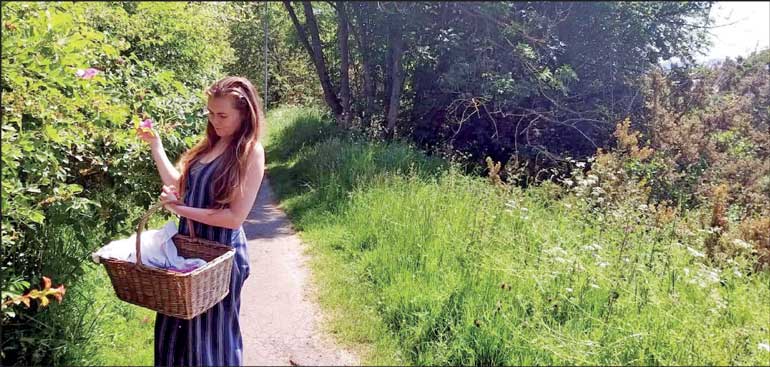
A: I source the herbs that I use from a variety of sources; I gather some from the wild in the lands around my home. I grow some in my garden and on a small piece of land that I rent. I also purchase some from herbal medicine wholesalers. Overall, I spend much time searching out the medicinal flowers and herbs I need in the grasslands around in the village where I live.
Q: Are you familiar with ancient herbs connected with medical traditions such as Ayurveda and if so how would you compare the herbs found in the UK?
A: We were taught about a small number of herbs used in medical traditions such as Ayurveda. Deeply understanding these medical traditions requires much more study, and practical acquaintance with the plants used in the medicine. When visiting Sinharaja Rainforest, I was shown Asparagus racemosus, or Hathawariya (Shatavari). I have used this plant for medicine in the UK. This was the first time that I had met the plant in its native habitat. As a feathery climbing plant, it was much more delicate than I had imagined. I mentioned that in the UK we used only the dried root, for specific conditions relating mostly to female hormonal health. It turns out that the local use in Sri Lanka is much more varied, involving the whole plant and the leaves, both in medicine and preparation of broth (Kola Kenda).
Q: Could you speak of the use of medicinal flowers for various illnesses including those such as stress and anxiety which many grapple with on a daily basis?
A: Plant medicines have an excellent affinity with the nervous system, and can be very supportive in situations where a person is experiencing stress, anxiety, nervous tension or is otherwise unsettled. Through many years existing alongside one another, plants and humans have adapted to be able to support one another through challenging times. In the UK, we have many flowers that support positive mental wellbeing, including St John’s Wort (Hypericum perforatum) to help ease low mood and depression, Vervain (Verbena officinalis) to relax nervous tension and anxiety, and Chamomile (Chamomilla recutita), a very safe remedy for unsettled children and to promote relaxation where stress is affecting digestive function.
Q: Could you elaborate your life mission as an organic grower?
A: It was in my twenties that I first realised the importance of growing without chemicals, after many years of exposure to chemical use whilst growing up on a conventional farm. Now I believe that growing without chemicals is essential for the health of both ourselves and the earth. Just as we have a living microbiome in our digestive system and on our skin, the soil has a living microbiome, and each of these can be negatively impacted by the use of chemicals. As such, in growing herbs for my herbal medicine practice, I am dedicated to growing herbs without the use of chemicals or artificial fertilisers. Where possible, I also choose to buy organic food and plant medicines, to help support those who are making the effort to grow in this way.
Q: Anything else you would like to
share?
A: I would like to share the most powerful experience I had whilst visiting Sri Lanka and meeting a brother from the Vedda people, at the heritage centre in Rathugala. As the life of the Vedda community has changed significantly since being prohibited from accessing the forests, much of the experience was a history lesson in how things used to be done. However, there was a man whose eyes shone with knowing and wisdom, of how to exist holding both the need to survive with the need to protect and honour the earth. When I asked him what he hoped for the future for his people, he humbly answered that it was to be able to protect the forest. If we can all hope for the same, to protect the sacred lands upon which we live and depend, from harm and greed, then maybe we can all coexist in harmony.
Gathering herbs from the wild




