Tuesday Sep 15, 2026
Tuesday Sep 15, 2026
Saturday, 22 November 2025 00:00 - - {{hitsCtrl.values.hits}}
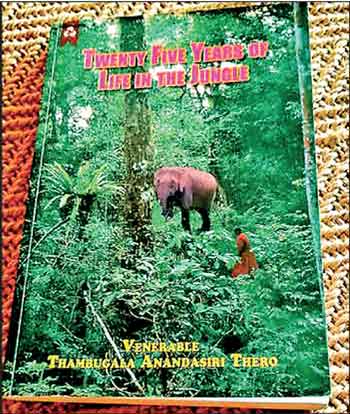 Authored by Venerable Thambugala Anandasiri Thero in the Sinhala language, the English translation of the book ‘Twenty Five Years of Life in the jungle’ is by Kamala Rajapakse, printed and published by Dayawanse Jayakody and Company – Printers.
A fortnight ago we stopped where Yahapath Hami, a village elder known for his expertise in identifying forest herbs was extolling the virtues of different plants, beginning with the ‘Handun Madala.’ It was described as the monarch of all herbs, growing in moisture containing soil and where from the number of leaves you can tell its age, with one leaf taking an entire month to fully grow. The fact that the plant realm has many ‘look-alikes’ are mentioned, citing for example a grass plant that greatly resembles the ‘Kalanduru.’ Apparently this Kalanduru twin when plucked in a specific manner and kept tucked into your waist will turn all fleas that may crawl upto you, into tiny acrobats (they will fall off you).
In this chapter we can learn of the sacredness that elders in Sri Lanka held for medicinal plants. Grandpa Yahapath Hami was the epitome of this reverence, admonishing if he saw someone pointing a stick or feet in the direction of a lifesaving plant.
“Reverend Sir, One must respect the medicinal herbs. It is only then that its power is available,” he would explain to Ven. Anandasiri Thero.
Grandpa Yahapath was familiar with the personalities and power of each of the medicinal plant of the forest probably better than modern pharmacists are with those synthetic tablets we gulp. For example he would point out one plant referred to as a mighty king of herbs which would acknowledge by displaying a little ‘shake’ when a human would humbly worship it and liken it to the sun god. The human could then request this plant to positively influence physical wellbeing. After the plant responds by ‘shaking,’ a sprig could be gently plucked in a specific manner and tucked behind the ear or head. If the plant does not respond by shaking then it means the time is not auspicious.
Grandpa Yahapath, in the presence of Ven. Anandasiri Thero had bowed to the plant, regaled it with complements and made his appeal for protection through its life enriching powers.
“There was no wind at the time. Yet the plant started to shake,” notes Ven. Anandasiri Thero in the book ‘Twenty Five Years of Life in the Jungle.’
This chapter ends with another plant miracle, where an insomniac human would ‘sleep like a buffalo,’ if its root is placed under the head. For best impact a salad made of its leaves could also be consumed. This herb is described as looking quite like a chilli plant but with berries like pepper pods. When Grandpa Yahapath asks the monk if he is amazed at all these plant phenomena the Most Venerable Thero gives this wisdom centric response. “We are amazed at such things by habit. Yet, there is nothing in this world to be amazed at. We are amazed at things we cannot understand. When we understand there is no amazement whatsoever.”
The overall location we are in is the Kudumbigala forest hermitage (Aranya Senasana) located in the jungles around eight miles west to the Eastern coast of Sri Lanka where Panama is the closest town.
Chapter 7 is titled The Dwarf Elephant of Kudumbigala, referring to the miniature specimen of elephants known as the Young Ones of Ruhuna. This chapter gives insight into how seriously humans living near jungle territory take incantations, forest charms, medicines and spiritual incantations. Two days prior to a jungle sojourn Grandpa Yahapath Hami in one of his visits to the forest cave of Ven. Thambugala Anandasiri Thero had inquired if the Thero had any chanted oils. The Venerable monk who only depended on the power of the name of the Buddha, the Triple Gem and related Buddhistic recitations, had nevertheless remembered that there were some chanted oil with him belonging to the forest hermit who provided the monks with alms.
(These would be chanted oil connected to the mysterious powers of forest or Hindu deities, and/or connected to deep earth powers that forest based humans had absolute faith in). The Venerable Thero had handed over some of the oil vials to Grandpa Yahapath.
We quote Ven. Thambugala Anandasiri Thero describing grandpa’s tale as narrated to him 48 hours after he had had left with the chanted oil.
“Myself and that boy of ours, Kutta, walking together approached Salava Eliya. As we came under the great woodapple tree did not this elephant charge at us fuming! Kutta started to run. I ran too.”
“Suddenly I remembered the vial of oil in my betel bag. While still running I pulled it out, kept it in the elephant’s way and ran. I looked back and saw the elephant stop there.”
In chapter 8 titled, The Heenhabara Pill one gets acquainted with the expanse of this eastern forest which in the 1960s ran into two hundred and twenty five thousand acres. In this chapter we learn about the lakes, lagoons and tanks within this terrain. Below we quote from the book where Yahapath Hami recalls the Panama region from his hunting days.
“There are the lakes, the kuda vila of Panama, the Maha vila, Kumana vila, Makada Vila, Ragam vila, Shastra vila and Ulpila.”
It is to be noted that the term ‘vila’ is the equivalent of a water base that can be described in English as a lake.
Yahapath Hami continues;
“There are the lagoons, Panakala, Kunakala, Anarakala, Itikala and Yakala.” Yahapath Hami then goes onto name the many springs (pokunu) close by. “The Maha pokuna of Ullawa, the Kuda pokuna, Rodi pokuna, the Gangoda pokuna, the Maha Yala pokuna, and on this side of Kumana, the Dharmala pokuna and the Gini pokuna. Yahapath Hami then goes onto list the tanks (described as Weva in Sinhala) within the Panama district.
“There is the Divul Palama vewa, the Alutgamuwa vewa, the Bakmeedena vewa, Eraminiyanne, then the Alakola Aru (a canal than runs from Kumana river), Gal Amuna, Kumana vewa, the Wakada galwala of Halawa Eliya, the Ekiriya Watawana, the Amunukolawala, Okadagama and Kadalanchiya of Girikula, the Kurudu Ulpila of Kurudugahavila, the Kudavila of Bagura, Tunmulla, Viyagulla north of Panama vewa, Wadagamawewa, north of Wapurana vila, the Magul pokuna of Sthripuragala, the Ambalayanne wala, Nalitta, Budabava, which lies between Malitta and the Halavatisna Ula, the Kumana vila, Hibitillane Hela and Serenda.”
This elder then goes onto entertain Ven. Thambugala Anandasiri Thero with the ‘saviour drug’ of the great jungle; the ‘pill’ made from the Heenhabara. Soon we will learn how to make this ‘pill.’
NOTE: The book Twenty Five Years of Life in the Jungle is being serialised as part of the education series commemorating national reading months (September to December) in Sri Lanka.




