Tuesday Sep 15, 2026
Tuesday Sep 15, 2026
Saturday, 31 January 2026 01:48 - - {{hitsCtrl.values.hits}}
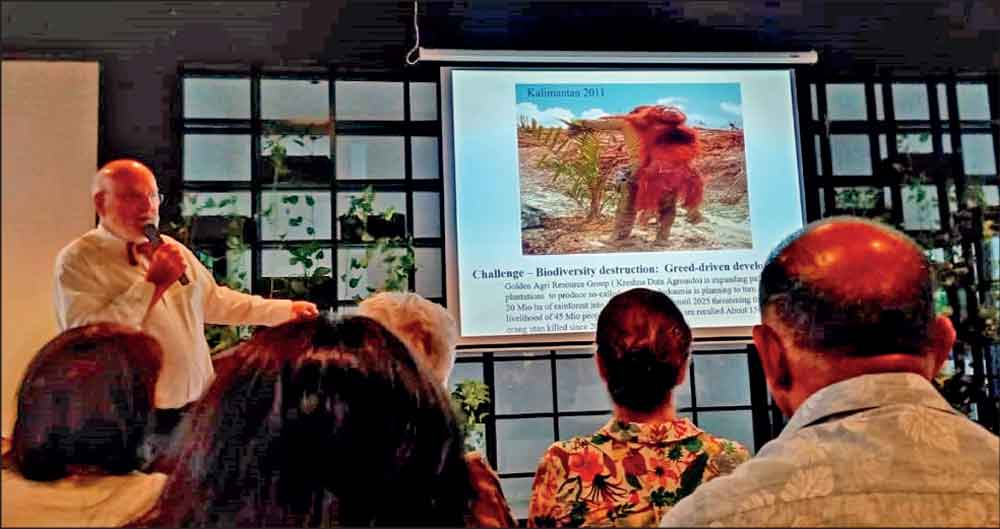
Prof. Friedhelm Goeltenboth speaks at Genesis Thought Leadership series at the Dilmah Centre for Sustainable Future in Maligawatte
By Surya Vishwa
INDIGENOUS tree focused reforestation expert Prof. Friedhelm Goeltenboth on Thursday evening delivered a detailed lecture on restoring landscapes and biodiversity.
Prof. Goeltenboth serves at the University of Hohenheim, Germany and is Scientific Advisor to NatureLife-International, a German-based organisation working on environmental protection and sustainable development.
He was hosted by Dilmah Conservation for the well-attended talk given at Genesis, the Dilmah Centre for Sustainable Future in Maligawatte, as part of the Genesis Thought Leadership series.
A regular visitor to Sri Lanka over the decades, he is familiar with the lament of deforestation in the country and has been working with many likeminded Sri Lankans to rectify the situation with rainforest farming.
Prof. Friedhelm Goeltenboth is an expert in indigenous tree-based reforestation, specialising in tropical ecology and agroforestry with around three decades of experience in ‘closest to nature’ landscape restoration following the Rainforestation Farming model.
Sharing examples from diverse countries including Indonesia, China and Sri Lanka, Prof. Goeltenboth explained the priceless investment humans can make in their lives to keep planet earth alive and busted the myth of monoculture industrialised farming being seen as the answer to deforestation.
Explaining that nature is never the enemy of humans, unless driven by shortsighted greed and humans create such a scenario, Prof. Goeltenboth spoke at length on how the clearing of natural rainforests in diverse parts of the world to farm mass scale crops such as palm trees or cassava is having a disastrous impact on our home – planet earth. He explained that in places such as Indonesia and Vietnam where for example industrialisation of mono crops of palm trees are grown, the earth resembles a cometary with no insects buzzing around due to biological components of the palm tree and high intense agricultural measures. So what is the solution? Returning to the science of the earth – farming through the creation of natural forests beginning with collecting seeds from indigenous plant species, transporting them in nature based means such as wrapped in banana leaves or cane baskets (plastic bags are not recommended due to mould gathering owing to humidity) and thereafter creating sustainable food production units that emulate forests. This means they have a canopy like what nature intended and ancient indigenous community sustainable food growing systems like the Kandyan home gardens in Sri Lanka.
Enhancing forest cover
It is now weeks since Sri Lanka suffered from one of the worst natural disasters in recent history where over 600 humans were buried instantly under collapsing mountains and those listening to Prof. Goeltenboth understood that what we are facing may be just the tip of the iceberg as calamities such as these are building up where any day could be a doomsday. However, what was also made very clear is that each human on this earth could make a difference by choosing authentic and honest to earth means of returning to the planet its due – rainforests. In doing so it was emphasised that humans can carve a niche for human sustenance by creating the forests in a manner that integrate nature driven food production.
Given that this illness infested world has lost most of its plant species of indigenous medicinal nutrients, Rainforest Farming could be the saving grace for the health of humans and that of the soil which are in any case entwined like veins in one body.
The lecture of Prof. Goeltenboth was ‘scientific’ using the yardstick of modern science, however it was clear that he considered the earth as his superior, not a student who should learn from man. One striking photograph that he featured in his presentation was of humans in China contracted to be ‘pollinators’ – perched atop trees, because industrialised chemical agriculture had killed off the bees and bats who do this duty free of charge.
“This is the pathetic state that we have got to in our world. May we end this so that our future generations never see this kind of scenario,” Prof. Goeltenboth stated, stressing that this planet we are occupying for the fraction of time that it takes for a lifetime to be spent is borrowed from the future – from the future of future lives.
He also reminded us of things we may have forgotten – such as how the tea plant which we generally known as a dwarf shrub is actually a tall tree. What we see around us is the version doctored by man to fetch out a particular brew.
Although he did not feature in detail the lists of individual indigenous plant varieties that can be drunk or eaten by humans – it is upto us thinking beings to research into the deep earth intelligence and be introduced to the extent of food and drink that the earth has gifted us. We could then understand the vastness of the bounty we have missed in our race towards the deadly mirage that we have daydreamed ourselves into, myopic of the shortly arriving nightmare.
In his blunt assessment of the worldwide ‘conferences’ that are held in the name of finding solutions to climate change and related natural disasters Prof. Goeltenboth quipped that there are three levels of discussions – talk, small talk and gossip. Much of the international events purportedly championing earth protection realistically fall in the above three categories, he noted.
Carbon sequestration standards
Speaking on carbon sequestration standards his presentation showed that five standards presently cover the essential issues for credible carbon accounting methodologies. What was explained was;
“That Clean Development Mechanism (CDM)“ is only applicable for the carbon offset market afforestation and reforestation and that Voluntary Carbon Standard (VCS) provides guidance on carbon accounting with climate, community and biodiversity standard (CCB) including social and environmental impacts.
Drawing examples from countries such as Indonesia the link between community poverty practices that keep the earth poor as well was pointed out. One example which was narrated was how a relatively small amount borrowed by a South East Asian rural family from a landowner who sold his land for monoculture farming kept the indebted family entrapped for over three generations. The sum had risen to 3,000 Euros which although not a big sum by international standards was a massive amount in a rural village and the male family member was a slave of the landowner.
“We provided 3,000 Euro to this man. We saw the transformation. He changed from being a bonded conspirator who damaged the earth through high intense industrialised farming (due to a family debt) into being an earth restoration focused farmer joining the global Rainforestation Farming endeavor.” The ‘incentives’ that can be obtained through the result of such a metamorphosis was shown. For example, speaking on the intersection between tourism and nature he emphasised that a ‘monoculture’ is of no interest for tourists and that a foreign visitor to a particular geographical location would want to see highly diverse ecosystems. Prof. Goeltenboth pointed out that these indigenous eco systems do not exist in an isolated manner but are immersed with cultural places of interest and traditional rural life.
Economic quantification
One of the most important points of his lecture was the economic quantification of a standing tree (generally we consider a dead tree to be of financial value). Referring to a living indigenous tree of great height growing in the Asian region it was pointed out that in an anticipated total lifespan of about 80 years the oxygen production worth in USD would be $31,250, pollution control $62,000, anti erosion $31,250 and water retention and filtering on a similar financial scale.
The planting of rainforest farming begins with collecting the seeds from forest based indigenous mother trees and then carefully nurturing the trees after planting them in the shade to be transported again very carefully to the designated rainforest farming location. From his experience in Sri Lanka the Winged Seed of Indigenous Rainforest Tree (Dipterocarpus Ceylonica) was cited as one of the seeds that can be collected to save the earth best and be incorporated into rainforest farming. Asked by a member of the audience if seed dropping from planes/sky can be used to aid the reforestation process in locations that humans cannot access, he replied in the affirmative.
We will at this point end this piece of writing but this theme will be continued. We will also publish a discourse with Prof. Friedhelm Goeltenboth who uses his academic training in tropical ecology, agro ecology and environmental sciences to promote sustainable agriculture in the tropics, tropical forestry and landscape rehabilitation.




