Tuesday Sep 15, 2026
Tuesday Sep 15, 2026
Saturday, 16 May 2026 00:57 - - {{hitsCtrl.values.hits}}
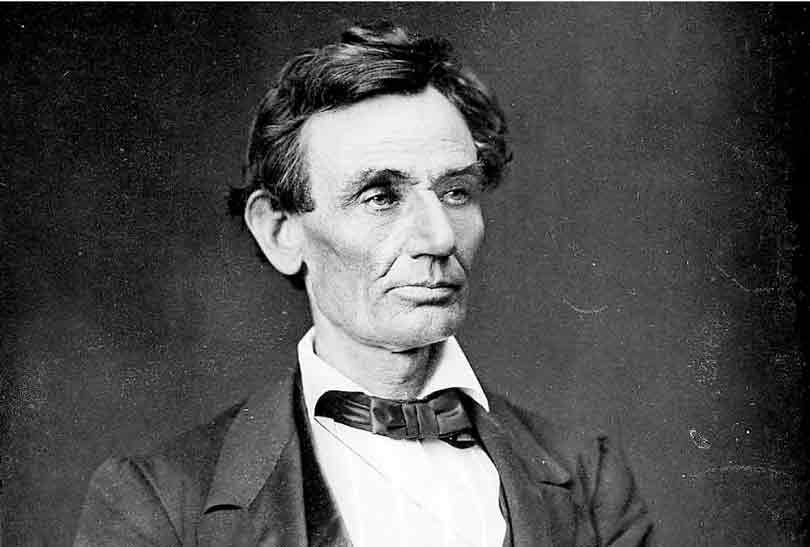
Abraham Lincoln
Based on the book, ‘Strength to Love’ by American Civil Rights Activist and Christian preacher Martin Luther King, first printed in Great Britain by Hodder and Stoughton in 1964, (copyright 1963 by Martin Luther King Jr.) the wisdom of loving those who dislike us will be looked at.
How this means first lovingly conquering the ‘enemy’ within us who would like us to be enemy of those who hate, vilify or criticise us will be examined.
How Abraham Lincoln after he was elected the 16th President of the United States chose his worst ‘enemy’ for a primary position in his government, ignoring the warnings of all his advisors will be further explored.
We will also try to reflect how this teaching can be easily misunderstood as an exhortation towards cowardice as German philosopher Friedrich Nietzsche concluded.
When Martin Luther King preached the sermons that were collated as chapters of the book, ‘Strength to Love’, he was a Christian pastor alongside his widely remembered role as a crusader for equality in America. This was a time in the United States just over six decades ago when humans could not freely laugh and find joy amongst other humans but be constantly reminded of a thing as petty as the colour of their skin. Every segment of life from transport, employment and education would be segregated by skin colour. When Martin Luther King led the Black Americans on the quest for equality he did so on the strong foundations of love and not hate. Today, to his sermon based on the teachings of Jesus on ‘loving’ our enemies which is the title of chapter 4 of the book, ‘Strength to Love’. The author uses an historic example from the US political sphere to show how loving one’s enemies can transform people and nations. He begins this book chapter noting that German philosopher Friedrich Nietzsche interpreted the call to love one’s enemies as a testimony towards weakness and cowardice. Martin Luther King then counters this misunderstanding by reminding us that modern man is ‘travelling along a road called hate, in a journey that will bring us to destruction and damnation.’
“Far from being the pious injunction of an utopian dreamer, the command to love one’s enemy is an absolute necessity for our survival,” he notes, emphasising that Jesus was not an impractical idealist but a practical realist. When Jesus called us to love our enemies, he was not unmindful of its stringent qualities, Martin Luther King notes.
“Each of us is something of a schizophrenic personality, tragically divided against ourselves. A persistent civil war rages within all of our lives,” he points out quoting Ovid the Latin poet who wrote as follows; ‘I see and approve better things but follow worse.’ This is possibly an apt description of our human rights scene in the phase of the world we are in right now. There is so much pontification from the international podiums shouting out for peace but every minute some child, woman, man, animal or tree is being felled by gunfire or bombs.
The alternate scenario to this catastrophe would be to choose the path that Christ advocated for, the path of peace and love instead of war and destruction. J. Robert Oppenheimer, the father of the atomic bomb, deeply regretted what he did with his ‘knowledge’ after he saw its actual impact especially in Hiroshima and Nagasaki that has affected generations to date. So we can see that hate also survives generations on end as love does.
Martin Luther King’s impact as a preacher of the Baptist Church, as an author and as a campaigner for human freedom came from his ability to juxtapose complex often irrational sounding teachings of Jesus with actual examples of the few who followed them. In this book he reminds us of an example from the political decisions of Abraham Lincoln, the man who led the ending of slavery in the United States. “Lincoln tried love and left for all of history a magnificent drama of reconciliation,” highlights Martin Luther King as he tells us of the scenario where Lincoln after he was elected President chose his most ardent ‘hater’ who left no stone unturned to mock, ridicule and criticise him. This man was Edwin Stanton who was a fellow lawyer like Lincoln, known to be very skilled. After being elected as President, Lincoln, to the shock and dismay of his advisers, appointed Stanton for the most powerful post in the country; that of Secretary of War.
Who in their right mind would do this? Would you or I, if we get some important position, appoint our ‘hater’ to an adjacent post giving him power to derail our path to success? Yet this blind trust in the miracle of love is what was asked by Christ – to love those who hate us and Lincoln chose to do just this.
He disregarded what was said of him by Stanton, and valued only his abilities which he knew as he had worked with him previously as a lawyer.
Writes Martin Luther King, “Advisor after advisor was heard saying “Mr. President, you are making a mistake. Do you know that man Stanton? Are you familiar with all the ugly things he said about you? He is your enemy. He will seek to sabotage your programme. Have you thought this through Mr. President.”
“Lincoln’s answer was terse and to the point. Yes, I know Mr. Stanton. I am aware of all the terrible things he has said about me. But after looking over the nation, I find that he is the best man for the job.”
“So, Stanton became Abraham Lincoln’s Secretary of War and rendered an invaluable service to his nation and his President. Not many years later Lincoln was assassinated. Many laudable things were said about him. Even today millions of people still adore him as the greatest of all Americans.”
But of all the great statements made about Lincoln the words of Stanton remain among the greatest, reminiscent of Martin Luther King.
“Standing near the dead body of the man he once hated, Stanton referred to him as one of the greatest men that ever lived and said he now belongs to the ages.”
Death comes to all humans. But to die with a mental state of love, having proven that love conquers all is surely better than rhetoric however intellectual sounding that believes love is for the weak. Although this fact is not mentioned in the book, ‘Strength to Love’, the death of Friedrich Nietzsche, was followed after severe mental collapse, suffering psychological breakdown. In contrast, we could conclude very rationally that the call to love enemies is not weakness but utmost strength that equips one with peace of mind. It could also be described as psychologically strategic. Because if we, each of us, who once hated or humiliated someone is appointed to a high position after his/her subsequent success, would naturally be more inclined towards honouring that trust rather than resurrecting our past views. The strength to love our enemies is thereby the overall panacea that could end all wars – whether in nations or within our mind and restore the sanity of our human world. This path is chosen by only a few in the world of politics but that few is enough to show us that to love our enemies is only for the strong and confident of humans. Nelson Mandela also followed suit, creating history appointing as his bodyguards those from the old order (much to the distraught fear of his close aides) who reminded him that these men were previously tasked to kill the South African freedom fighters. The result was these white bodyguards coming to love their new President as much as the black South Africans and serving him with utmost loyalty. We need the policies of Christ in this world today, as much as when Martin Luther King preached them, because although slavery and apartheid is ended much of the world are slaves of hate with an apartheid reigning consciousness nurturing the misunderstood notion that the idea of love is utopian and weak.




