Tuesday Sep 15, 2026
Tuesday Sep 15, 2026
Saturday, 21 March 2026 00:00 - - {{hitsCtrl.values.hits}}
By Surya Vishwa
This article is dedicated to the thousands of Sri Lankans who do not have the ‘capital’ to buy or rent shops to carry out their chosen vocation of entrepreneurship but still have emerged as champions, sending their children to school, to universities, and devotedly keeping their families fed and clothed. The only ‘asset’ they have– the correct asset they had given the current situation, were the pavements/sidewalks around the country. These sidewalks, which thousands tread on every single day trained them in marketing and selling to the extent that they could possibly lecture any business development or marketing ‘guru’ on the real life saga of marketing when it is a ‘live or die’ scenario. There would have been hundreds of Sri Lankans who have spiraled through fate on the high roads to get to a state of fame in business. The first such case that comes to mind is the now globally iconic brand of traditional wellness, which began eight decades ago with a young child selling his indigenous physician father’s remedies. He carried them on his head in a cardboard box across the roadways of Pettah. Thus began an entrepreneurial journey that would lead to the creation of an indispensable and foremost wellness brand of its kind which eventually led to a luxury traditional treatment centre, hospital and value added wellness products that are widely popular in Sri Lanka and overseas. Around the year 2002, interviewing the above mentioned legend, I recall that he had to brush away his tears when he described how as a 12 year old, soon after school ended, he would begin walking along the pavement in Fort until his feet fell like falling off, and his head spinned by the weight of the boxes of medicinal items. Seated in the grand building that was his headquarters, I remember marveling at the quality of human resilience that can graduate from selling on the street to selling globally. I also recall his advice as I was about to leave – ‘never give up – never ever give up.’
I would like to say ‘never give up,’ to the few men whose narratives are featured below but that seems a pompous thing to do. They have not given up for the past few decades and their weatherbeaten visages are proof of it.
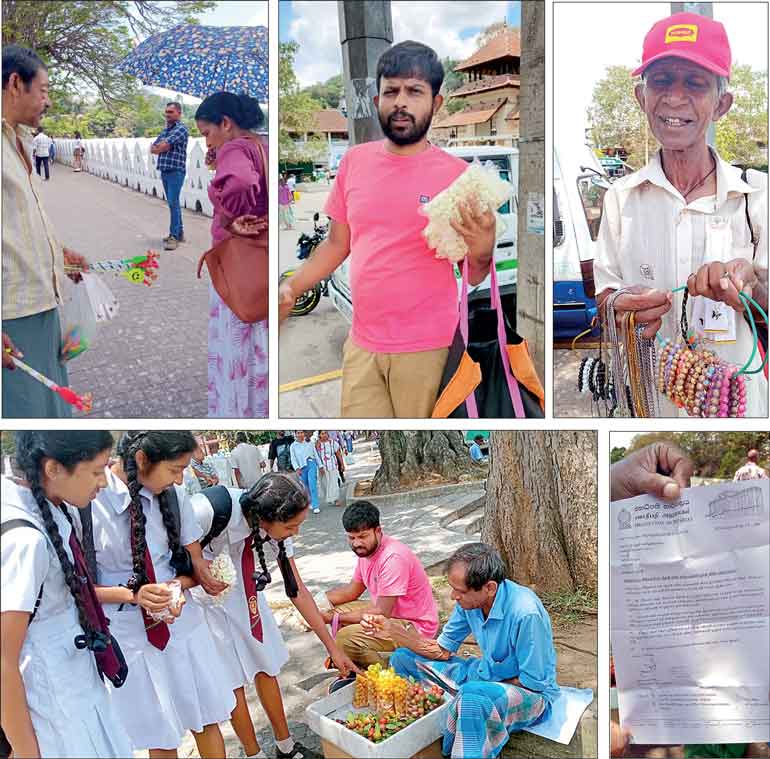
Sixty-nine year old Muthuthanthrige sits on the sidewalk close to the Dalada Maligawa. He arranges and re-arranges a basket full of fruit Amla (Nelli) and a type of cherry guava known to be grown without pesticide. He packs them neatly in small bags. However there is a disturbed look on his face and he surreptitiously looks around him. There are a few men a bit far away and they make a signal that only they understand. He smiles and arranges the fruit. Apparently this signal is to ‘warn’ each other if the municipal authorities or police are nearby. If they are detected they risk losing what they bought to sell. Each fruit pack is Rs. 200. A mother with two children buys 2 bags of Cherry Gauva. He adds a few more fruits for both the children and smiles. He has four children of his own. Hailing from Katugastota in Kandy, he proudly states that all his children have done well in school. One child is in university. He did well in school too but he first entered the streets of Sri Lanka as a vendor to support his large family. Let us listen to him.
“There were 10 in our family and I was the third boy. In the late 1960s I first arrived as a schoolboy to sell various products and then made it my permanent vocation in the 1970s. Costume jewellery, fruits, toys, handbags and electrical gadgets – all of these and more I have sold. I have seen all the macro level episodes that mark the socio-political tapestry in Sri Lanka including the 1971 and 1989 insurgency, and the years of the civil war. Through it all I remained as a vendor. We sell what people buy. We sell to ordinary people who cannot spend high amounts.”
“Business is not a fancy thing for us. We cannot return empty handed when we go home. We have to buy provisions and we have children giving us long lists of things to get for their school life. So, we have to sell.”
Why does he look around him in a scared manner every few minutes?
“Because as per the latest Municipal and overall State policy decision we cannot sell anything on the pavement anymore. It is enforced very strictly. We are here because this is the only alternative to starving. But if we are detected the Municipal authorities will confiscate our things. So we have a few of us who act as ‘watchers,’ and inform us by a whistle or such signal. We then make ourselves scarce. This whole area was thriving with vendors. We used to organise large-scale cleaning of the sidewalk every week. We cleaned thoroughly with buckets of water and brooms, keeping this place spotless.”
He estimates that there are around 100s of pavement vendors across Kandy and thousands more across Sri Lanka.
“Many of our customers were tourists,” explains Pradeep, another Kandy citizen who holds bunches of popcorn in his hand. Technically he too is violating ‘the law.’ This is his narrative.
“I now walk around with all of these in my hands. This is the only thing we can do now. I was the one who handed over a letter written on behalf of all of us who sell things near the Temple of the Tooth to the President when he came to Kandy. I knocked on the window of the vehicle carrying President Anura Kumara Dissanayake and gave him this letter citing our situation. We got a response signed by the personal secretary of the President. I am shown the response on the letterhead of the Presidential Secretariat. Titled ‘Concerning the ousting of the vendors around the Dalada Veediya and the Kandy Lake the letter by the President’s secretary is addressed to the Central Province Governor and requests him to find a reasonable solution,” explains Pradeep.
He continues as follows.
“When we went to the Kandy Municipality we were told there are enough jobs to clean toilets and that we can apply for those. We may sell on the road but we have our self-respect. We are here as sales persons. We have honed that skill. We are humans with the dignity associated with entrepreneurship. We are not vermin to be chased away being scolded in filth as I witnessed when I visited the Municipality. I was asked never to step foot there.”
“You will see that there are many beggars now on the sidewalks. Those who sell lotteries are allowed on the road. Some of those sent away from the roads do not know where to go. A segment of those who were selling across the Dalada Veediya and other Kandy streets were sent to a building in Kandy and given a top floor. Who will go there to buy from them? Others were given space near Bogambara prison. These are not locations which draw crowds. It is like putting them in a desert. Is there no other alternative? Cannot the colorful vibrancy that the street vendors gave be transformed into a tourism attraction with a choice of a public space which draws crowds? This is being done now in Matale,” he explains.
Three more vendors join and the discussion becomes a policy ideation on how street vendors instead of being insulted, vilified and chased can be turned into a national asset.
“Miss, imagine if we were given nice T shirts with the municipality name, and maybe hats and if a small strip of the pavement or anywhere else were installed with foldable stands that maybe designed like a small upstair – and with strict rules to preserve cleanliness of the district – cannot this kind of thing be a solution?” This suggestion is by one of the vendors whose daughter is in university. He explains that campuses like University of Moratuwa will have ideal talent to get the street stalls designed. We discuss a bit further on a possible national level initiative that will recognise, support, and integrate street vending with innovation that will also be a boost for tourism.
“If places are identified for us street vendors it should be with a real understanding about who we sell to. We sell to ordinary people like us. People who could buy a nice dress for Rs. 600 when a similar dress is sold for Rs. 6,000 in those airconditioned shops. Everything you could want was sold on the pavements of Kandy. Bedsheets that could be bought for Rs. 5,000 in a shop were sold for Rs. 1,000. We were not begging on the street. We were selling. We traders used to buy these at stock scale from various places we spend considerable time to identify and sell. Our only crime is that we cannot afford to rent, lease or own property in order to trade our products,” explains Sarath Athulakeerthi, who used to sell various products near the Temple of the Tooth.
“Right now we wander around in desperation holding the items we want to sell. We risk losing these if the authorities identify us, as technically we are outlawed from the roads. We only can appeal to our President Anura Kumara Dissanayake to consider his own journey to where he is today. Was it easy for him? Was not his own journey similar to ours? Did he also not have to go through unbelievable hardship in his youth and to get to where he is now? There are about 20 or more persons who have nowhere to do their selling. Now with the global mayhem and rising prices how will we live? Look around, how many beggars do you see now after the street vendors were expelled? Now this will increase and with it will come those who snatch chains and pick pockets.”
As I prepare to leave, I listen to their final words.
“Please write that we never begged or broke the law in any way. Write that we are not insects. Please write that we are humans who have a skill. The skill of selling. “Liyanna miss api mea kiyana ewa.” – “Write, miss, what we say now.”
As I proceed down Dalada Weediya, the road seems to me like a cemetery. Where there were exuberant calls from scores of sellers, to buy things ranging from sunglasses to elaborate household decoratives, there was now only silence. Yes, there is a lot of room on the sidewalk. Enough to even conduct a perahera on it. As I proceed I see one sole vendor who has been given a few inches of space outside a shop to hang his wares; a few clothing items. I watch him. He does not call out for anyone to buy. He stands in a defeated manner on the steps of that shop which has shown him kindness. I begin to speak with him, but I am not a robot. The emotional weight of what I have heard is too much and I am unable to continue any further.
FT Key Take
It is keeping this in mind that we write the following ideation for capitalising on the entrepreneurship resilience of those we degenerate as ‘pavement hawkers.’
Below is a list of avenues that could be taken to ensure that we respect, support and uplift the thousands of men and women around Sri Lanka who have dedicated their lives to entrepreneurship although they do not have the capital to mould their economic stabilisation.
1.Using innovation by creating a competition run by municipalities and local authorities across Sri Lanka for the designing of portable, unique selling units that could be folded and put away.
2.The age limit of the above competition to be open ended to encourage the participation of youth or seniors from all sectors and not just academia.
3.Running the above competition in partnership with the private sector so that suitable recognition could be given to the first 5 entries in the form of more contracts for similar innovation alongside tokens of appreciation.
4.The entry to be judged by how much of space it saves and how much of upper storied space could be created in an attractive manner.
5.To identify public spaces islandwide where the above innovations could be supplied to vendors for a nominal rent.
6.The private sector could emerge as patrons of this endeavour and pay the rent on behalf of the vendor for the first one year.
7.To reconsider pragmatically the re-use of spaces such as sidewalks for street vending if such inventions are used with enforcing of regulations to inculcate responsibility of the user or under similar conditions.
8.To create tourism linked events across Sri Lanka, with the affiliation of mass media and diplomatic community that will uplift thousands of street entrepreneurs and give back their dignity.
9.To ensure that the municipalities consider their role and to carry it out serving the people of this country and prioritising the weakest.
10.To create tourism focused night markets in relevant locations across Sri Lanka and to work with these traders.
11.To work with the public and private sector to create some of the above.
12.To create a social welfare entrepreneurship development fund for street vendors.
13.To mainstream these vendors by including them in entrepreneurship development activities that currently include only a particular social class.
14.To have entrepreneurship development training by all municipalities to assist in the task of poverty alleviation.
15.For the Presidential Secretariat to directly monitor how the municipalities and local authorities are following up on seeing to the welfare of the street vendors sent out from their previous locations on the street.
16.To ensure that the Nuwara Eliya ‘season’ festivities include the provision of free stalls for those such as street vendors that were sent out from the sidewalks.
To be continued…




