Tuesday Sep 15, 2026
Tuesday Sep 15, 2026
Saturday, 11 July 2026 02:20 - - {{hitsCtrl.values.hits}}
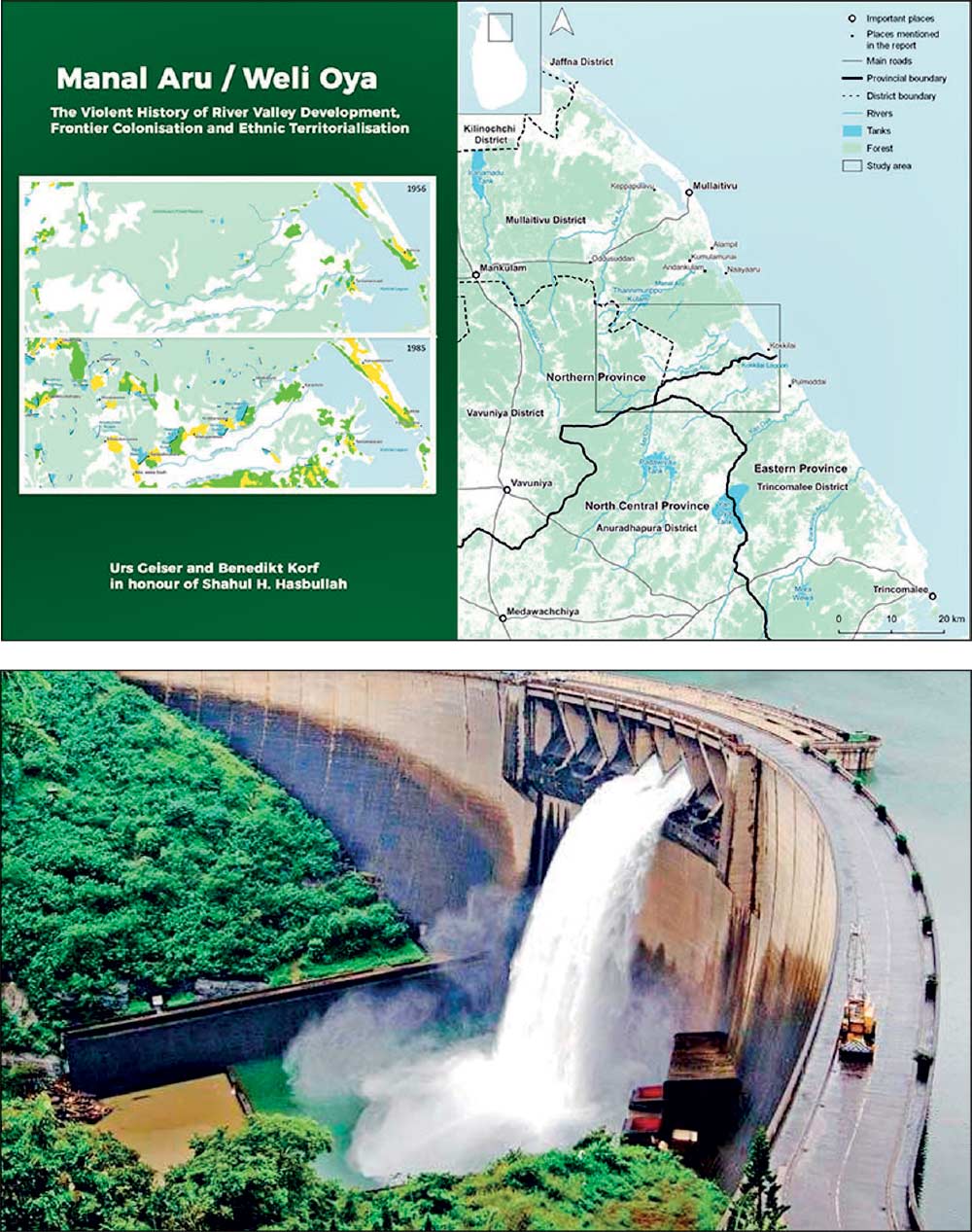
It will be important to research how the mandate and the powers of the Mahaweli Authority are devolved, such as how the provincial governments – and the provinces be empowered legally, technically, and in their administrative capacities to effectively manage the river development schemes in their territories of jurisdiction
By Surya Vishwa
|
Prof. Shahul H. Hasbullah. Pic courtesy: By Bentneck - Own work, CC BY-SA 4.0, https://commons.wikimedia.org/w/index.php?curid=131288948
|
We publish today our last segment from the book “Manal Aru/Weli Oya; The violent history of the River Valley Development, Frontier Colonisation and Ethnic Territorialisation” by Urs Geiser and Benedikt Korf (first print 2026) printed by Big Bird Printers and published by the Social Scientists Association.
We focus on the Manal Aru/Weli Oya post war frictions as shown in Section 7 of the book which begins by explaining that the end of the war gave Tamils, Muslims and Sinhalese ‘enormous hope’ that they would be able to return to the lands from which they had fled during the violence that lasted for over 25 years impacting Tamils, Muslims as well as Sinhalese people living in and around Manal Aru/Weli Oya.
The authors state in this section of the study that they wish to show that the end of the war did not mean an end to ethno territorialism.
“Yes, the military confrontation had ended, and with it the power relations shifted significantly. The total annihilation of the LTTE has taken away a strong force of resistance against the expansion of settler colonies. But the post war regime in power, that (was) the authoritarian Rajapaksa presidency, decided to continue to use the nexus of the Mahaweli System L and the military to continue their practices of territorialisation in and around Manal Aru/Weli Oya as before.”
Here from the point of view of the reader it should be shown that if there is a vacuum that could be cited where this research and thereby the book is concerned, it is the fact that the study covers the time period upto 2020 and its publication in mid-2026, does not throw light on the situation at hand, through the political changes of 2024. Thus the impact, positive or negative thereafter, is unknown. What is however valuable is that there now exists a study with impartial deliberations for the current political context to work with, to ensure that history does not repeat itself.
Weli Oya Consolidated Development Project
The foundation of the ethnographic research in this book had been done by Prof. Shahul H. Hasbullah on the politics of human settlement in Weli Oya and the book points out that from 2014 and shortly before his untimely death on 25 August in 2018 that Prof. Hasbullah carried out field work on repeated visits to various locations on the larger region of Manal Aru/Weli Oya particularly in Kokkilai lagoon area in the east of the Mahaweli system in a backdrop of high militarisation of the area. It then becomes the responsibility of others, both journalists and researchers of the present day, to do their own fieldwork, keeping this book as a reference point to ascertain the current scenario at Manal Aru/Weli Oya.
The authors point out in the book; “We therefore describe, in section 7.1 how the Government launched, around 2010, plans to even expand the existing river valley development scheme of System L, through what they called the Weli Oya Consolidated Development Project. This plan included the expansion of irrigated land and the bringing in of new Sinhala settlers. A core component of the scheme was the construction of the new dam (Kivul Oya dam) to secure water supply to system L.”
It acknowledges a gap in the study stating as follows – ‘It is unclear how much of these plans (referring to the Kivul Oya dam) have been implemented upto 2020’ but point out that the ‘venture as such indicates the continued influence of the ideology of Sinhala-Buddhist ethno territorialism had in the region.’
A sad fact that struck this reader again and again is how the peaceful term that ‘Buddhism’ should ideally mean, is corrupted by the affixation to a particular ethnicity so much so that it is now a label (as in ‘Sinhala-Buddhist) that is used to denote in many instances oppression and injustice as is mentioned in this study. This itself, should be something the nation state that is Sri Lanka should work on many levels to rectify, and uphold the supreme truths enshrined in Buddhism that is above all ethnicity and race, to be used in current and future state making and policy development as a symbol of justice, peace and unity, rather than the reverse.
One of Sri Lanka’s biggest post war calamities
In the theme concerning post war frontier frictions in and around Manal Aru/Weli Oya, the fact that those returning to these lands after the war ended in 2009, were arriving to ethnicised and militarised contexts is cited.
“Tamil and Muslim residents who want to reclaim the land and resources they were using prior to the war, which they had to leave behind, face countless conflicts and disputes over legal land rights and land claims,” the book points out.
Here we can argue that one of Sri Lanka’s biggest post war calamities was that it failed to consider that for people destabilised from their lands countless times during three decades of bombings and bloodshed, undergoing unimaginable war time deprivations and barely escaping death with only the clothing on their back, merited that the standard practice pertaining to land related documentation be replaced as a national endeavor.
The importance land plays in ushering a feeling of justice or the reverse, is pointed out by the study as it states as follows.
“In Manal Aru/Weli Oya and beyond, these struggles over land pitted the majority nationalist politics of the post war governments against the continued (and even intensifying) nationalism of influential Tamil politicians in this post LTTE area. These struggles produced ‘frontier frictions’ in the borderland.”
Returnees and contested claims over land
Under the theme ‘Returnees and contested claims over lands,’ quotes are extracted from the Lessons Learned and Reconciliation Commission which refers to ‘returnees’ in the Vanni and thus Manal Aru/Weli Oya as well.
“The commission is of the view that the mere physical return and resettlement of the displaced persons in the Vanni would not resolve the totality of the problem faced by the displaced. A daunting and more complex and time consuming task, which at times could even ignite controversy, still lays ahead. That is the checking, confirming and reissuing of official documents guaranteeing user rights of each family or head of household to their particular allotment of land.” – LLRC 2011:212f).
The book continues further, pointing to the work of the Centre for Policy Alternatives (CPA).
“CPA has investigated these legal challenges in a number of reports. For the larger Manal Aru/Weli Oya area, CPA (2011:186) brings together three additional questions: First, how several types of valid permits could have been issued on a particular plot of land; second how the Mahaweli Authority and other officials who issued permits at a later stage could ‘have missed the fact that some lands had permits issued previously and some are privately owned’: and third ‘why only Sinhalese were issued permits by the Mahaweli Authority when Tamils have been residing and farming lands in the area for decades.”
The book further adds that to complicate matters further that the Lessons Learned and Reconciliation Commission found that in the Mullaitivu district, the land records in all five DSD were completely destroyed during the war (LLRC: 2011:223).
Arrested for ‘trespassing’ upon their own land
This writer recalls several meetings in 2020 and 2021 with Kilinochchi and Mullaitivu land owners, some of whom were arrested for ‘trespassing’ upon their own land and another strange instance where the Forest department had declared an entire village as ‘forested’ and plunging the lives of these Tamil communities into utter chaos. Even though this was not Manal Aru/Weli Oya, the area in question focused upon here, it raises the haphazard and obscure manner in which post war land policies were carried out.
This then shows us that the issue of post-2009 land justice is a mired tapestry. The reality of militarisation crops up again and again in this study.
Pertaining to the Padaviya scheme it is pointed out that where the return of the Sinhala settlers were concerned many Sinhala settlers from Manal Aru/Weli Oya fled permanently or temporarily across the river to the Padaviya scheme; and most of them had stayed in refugee camps (LLRC 2011).
“We assume that after 2009, many of them returned to their lands in Weli Oya.” “What we can assume is that they did not face problems (or less so) in regaining their lands when compared to Tamil villagers in the surrounding areas,” the authors of the book note.
The Sinhalese settlers being prioritised over Tamils and Muslims is a thread that runs across the study from the point of the inception of the River Valley Development scheme.
Although the study as a whole does not detail out the context from 2020 to date and implications connected to Manal Aru/Weli Oya settlements therein, the post script of the book gives however a glimpse of how the change of governance structure in 2024 leading to the liquidation of the Mahaweli Authority and the recommencement of the Kivul Oya Development project could evolve.
Powers of the Mahaweli Authority
To authors of the book comment that it will be important to research how the mandate and the powers of the Mahaweli Authority are devolved, such as how the provincial governments – and the provinces be empowered legally, technically, and in their administrative capacities to effectively manage the river development schemes in their territories of jurisdiction. It is also pointed out that the recommencement of the Kivul Oya Development project – although there is no reference to settling people, triggers concern, because the Kivul Oya project is located within Manal Aru/Weli Oya. How the current regime steers development within this area is to be seen as the book notes. In conclusion it could be stated that it now becomes the responsibility of writers and researchers to explore newer and possibly hitherto unforeseen dimensions that impact poverty, equality, land rights and overall justice in a country that marks 17 years following the ending of Sri Lanka’s civil war. It is upto these writers to seek out opportunities for the nation to herald genuine equality and prosperity for the nation and all its people.