Tuesday Sep 15, 2026
Tuesday Sep 15, 2026
Saturday, 24 January 2026 05:47 - - {{hitsCtrl.values.hits}}
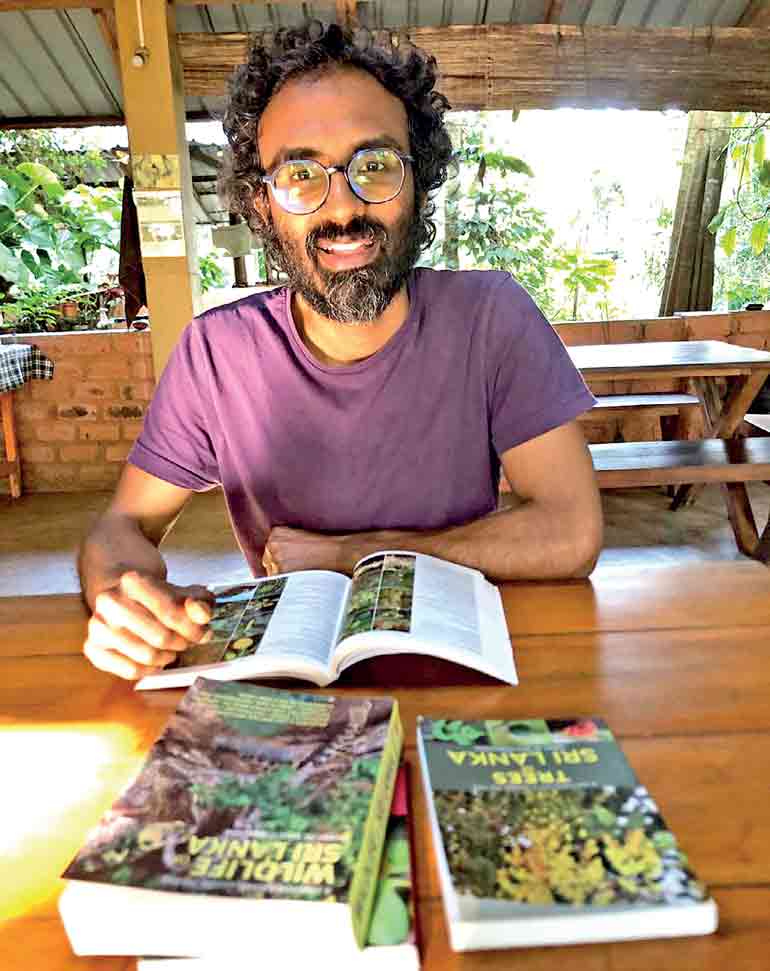
Thanush Bala
By Surya Vishwa
It is only the bones that remain of over 600 humans. Sri Lanka is emerging out of one of the worst climate disasters in history. This writer experienced it first-hand, as written in our previous editions. Human beings are fragile creatures. They can ruin the planet as they like and when retribution comes, they can also forget in the blink of an eye and be lured once again by the fallacies of want rather than need. Recently, on this page, we featured the iconic Bhutanese guru of Gross National Happiness, Prof. Saamdu Chetri, on some fundamentals of that concept.
Today, we feature a young Sri Lankan-origin British national whose mission is investing into grassroots communities so that we help them to champion the preservation of Mother Earth. We are happy to welcome Thanush Bala to the Harmony Page.
Q. How did your mind transit into this philosophy and life calling?
A. My path to this line of work was not a straightforward one. At university, I studied Economics and International Development. At that age, I was still trying to find my purpose. I knew little about the world, but I did know that I wanted to help alleviate poverty. My degree, however, quickly left me disillusioned about the kind of world we were being taught to create.
It became clear to me that the story we were being sold about “development” was not compatible with living alongside the rest of the beings with whom we share this planet. We were told that the only way to progress was economic growth – to accelerate the production of things and increase the speed and scope of human activities. In almost all cases, this seemed to mean the loss of indigenous cultures and the pollution of our soil, air, and water. It was plain to see that economic growth did not mean people were healthier, happier, or living more fulfilled lives.
Having realised this early on, I found myself after graduation working for an NGO to promote and support a more local food economy. I later retrained in environmental science at postgraduate level, working for an environmental consultancy on projects for the UK Government and the European Commission. This too, I realised very soon, was not my calling, as I felt real change ought to come from the grassroots level. I focused on training in organic food growing and other sustainable food-growing systems and now teach about the principles of ecological land use.
Q. How applicable can your international knowledge be for Sri Lanka?
A. I left Sri Lanka at the age of four and have since been living in the UK. As such, I have seen what works and what does not in a country that is purportedly one of the most “developed” in the world.
This has given me an insight into what well-being really means. Most of the world seems to be aspiring to emulate the “rich” countries. However, living in a rich country does not mean that people are happier. In many ways, the population is sick, with every lifestyle disease on the rise. Current statistics, for example, show that one in four people in the UK will get cancer in their lifetime. It is increasingly difficult for young people to buy a house as prices have skyrocketed. If they do, then they will be tied to paying a mortgage for most of their lives. These are just some of the many challenges.
That said, there are many good things too, like processes, systems, ways of doing things, and attitudes that can improve the well-being of all. My international exposure helps me see the global economic order through a broader lens. It helps me understand the rise and fall of Western trends, along with their impacts on the rest of the world. Importantly, it teaches me how to navigate the pitfalls of a general global system that is extracting the resources of “developing” countries for the benefit of a few.
Q. Could you explain how your work in ecological management can truly benefit Sri Lanka, which is still reeling from the floods and landslides witnessed just six weeks ago?
A. Each country has to build its own strength in protecting the earth and thereby the people in a time of extreme climate hazards. In the context of my own work in ecological land management, I can see what needs to be done if Sri Lanka is to build on its diverse food system, whilst avoiding the trajectory of the West in the industrialisation of farming and the depopulation of rural areas that comes with that. I can see what attitudes to the land need to be cultivated and how to raise environmental consciousness. Much of the damage to the land has been done in the West long ago; Sri Lanka cannot afford to make these mistakes.
Q. How do you see the following two words – ‘investment’ and ‘development’?
A. Investment, to me, means to give my time, energy, ideas, and resources to do good in the world, for the people, all creatures, and our Earth Mother. The reward is not some future financial reward for me, but rather the well-being of all. We are all connected. My happiness lies in the happiness of all. Ultimately, through my own investment, I want people to invest in themselves, their communities, and the earth rather than being dependent.
Development can be a debilitating word, in my opinion, as it implies that there are those who are undeveloped in contrast to those who are. What we really need is a development of minds and ways of thinking that create the conditions for well-being on all levels.
The real work of development is to help communities organise and create their own futures and fulfil their creative and spiritual potential. In my view, this starts with access to land, shelter, healthy food, clean air, fresh water, and connection to nature. Everything else is optional and builds on from that, not the reverse. If development means exploiting other creatures and the looting of the earth, then it cannot be called progress, as it will one day bring suffering to all.
Q. How can we juxtapose ‘development’ with aspects such as health and happiness?
A. Oftentimes, development has come to mean more jobs or money, but these are not ends in themselves. They mean nothing if people are sick and unhappy, or if the soil is lost and the last trees have fallen.
Q. Sustainability is a word much overused and quite unauthentically. How do you see the word sustainability?
A. Sustainability means to live in such a way that it can be continued forever. Our present way of life, certainly in the West and increasingly so elsewhere, is fast depleting all earth resources. This means our actions now are robbing the rights of future generations to enjoy the earth. The First Nation Indigenous peoples of Turtle Island (USA) lived by what is known as the seventh-generation principle. Every decision they made as a society was only after they could be sure it would not affect the rights of seven generations into the future. Just think about that – a 500-year plan. What government or business plan is that far-reaching?
The word sustainable is often misused by large businesses to cajole us into buying more and more things we do not need and to prevent us from knowing the truth of what is happening to our earth. Human beings fundamentally care about the world. So much must be done through clever marketing and language to cloud our decision-making and normalise the unethical. This is why it is our duty to educate ourselves about what is going on and the impacts of all of our day-to-day choices.
Q. You are from the North of Sri Lanka originally. In your current stay, what are your observations of the North in relationship to youth entrepreneurship? I hope you visited some of the places and youth highlighted on the Harmony Page.
A. The youth of the North are fundamentally no different from youth in any other part of the world. They may have slightly fewer resources, but they have energy, ideas, and dreams. Until now, society has been telling the youth that their happiness lies in finding a secure and respectable job. But we need to be telling them that they can organise, create their own livelihoods, and pursue their creative passions. This is the best way to empower young people.
During our stay here, we visited a café in Jaffna run by youth, Zen Café, that was featured on this page. The café was a breath of fresh air, having created a vibrant and inviting space for students. The two brothers who started the café also seemed to be employing other local youth, with benefits cascading to more and more people. What we would like to see next is urban youth entrepreneurship working in partnership with rural youth. Can these cafés, for example, source from local organic farmers, trial diverse foods, and source locally made natural packaging? What is needed is mentorship, support, and small-scale finance to help youth along the way.
The same can be applied to youth who have the benefit of a university education. Departments can think about how we empower young people in their respective fields to become entrepreneurs and create resilient local economies.
Q. How would you like to be involved in investment in Sri Lanka as a whole, and the North in particular?
A. I would like to inspire people here to become more spiritually connected to the earth and this land – to its forests, its creatures, and all her people. I have seen beautiful ways of life here, where people are growing almost all of their own food, are healthy, and mostly content. But that way of life is at risk of dying out if the next generation is not supported to become stewards of the land.
In the North, I want to support the development of land-based projects that revive knowledge of local wild plant foods and work with nutritionally dense trees and cropping plants suited to this unique climate. I have made it part of my mission during this stay to understand the immensely diverse flora of this country. I want to support more people to grow food and farm on a small scale and do so without the use of chemicals or exploiting animals – first and foremost for themselves, for their own health and well-being, and then to work together to trade and build the basis of a local land-based economy.
Q. How do your personal life choices influence your work?
A. As an ethical vegan, all of my choices and investments are based on my fundamental concern for all sentient beings. I therefore want to support the creation of alternatives to animal exploitation and promote whole-food, plant-based lifestyles. This land has seen much bloodshed and incarceration. But it is also the land on which the Buddha set foot, as is widely believed. The land must be healed, but it can only do so if we end the killing and commodification of animals for the benefit of our species.
From the Harmony Page Team: We will connect you with some of the ‘earth-grown’ human resource expertise we have featured on this page over the past years, and we look forward to linking you with some of those working on similar missions in the South of the country. This is part of our goal to interconnect humans through the realm of mass media for the overall purpose of enriching humanity, promoting ‘lived-in’ peace-building, and protecting our beautiful and naturally wealthy planet.




