Tuesday Sep 15, 2026
Tuesday Sep 15, 2026
Saturday, 25 April 2026 00:00 - - {{hitsCtrl.values.hits}}
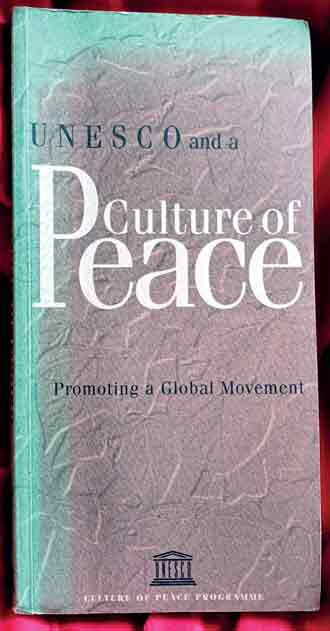 Prepared and published by the Culture of Peace Program in 1995, edited by David Adams and printed by EGOPRIM in France, the first-ever publication on ‘UNESCO and a Culture of Peace, Promoting a Global Movement’ is a quintessence in its timelessness. Revisiting this pioneering document is globally relevant today and reminds us of the possibilities of peace in every public endeavour in the life of nations. This is a book that has to be kept at hand and in mind by all those who may otherwise fall into the abyss of justifying war.
In the preface of this publication, Federico Mayor, the then Director-General of UNESCO, explains that our goal should be to build peace permanently in our families, in schools, in the media, and in sports, and to inspire hope and persistence. It reminds us that the purpose of UNESCO launching its Culture of Peace Program in February 1994 was to encourage a move from imposition to discussion, and highlights the maximum use of the skills of the mass media in this regard and every possible opportunity to bring minds to peace.
Hence, the ideations in this article, while being independent and already implemented in some ways, are rooted in the ethics of inspiring a culture of peace in an integrated manner.
Two vital pillars that could be revitalised to bring this divided world together are media and tourism. Considerable relearning, and moving away from how media and tourism are conventionally viewed, is needed.
There is a global need for a transformation-focused media, guided and honed by a spirit of unconditional love rather than aggression.
This means the ushering in of a new global media culture where media colleges train journalists to see the world through the lens of love, compassion, and wisdom, where the focus begins with the nurturing of deep compassion within.
Such an inculcation can change the world by shaping how interviews are conducted with aggressive personalities, whether in politics or among those who promote division and hate.
Here, journalists can be taught to research deeply into those who promote division and to prepare their questions based on any positive aspects they may find about them.
The crux is that the interview process becomes a doorway for the person being interviewed to see the possibilities of good, to understand how it would benefit him or her in terms of how the world perceives them, and to be reminded of anything they have said, planned, or done previously that supports peace. In any person we label as evil, there is always some good, or the potential for transformation into goodness. The journalist, too, is human, with both the possibilities of darkness and light. Institutionalising this belief within media establishments will be a catalyst for changing the world for the better and for enabling media establishments to transition from reporting to influencing heart-based change.
The other route that could foster a very strong culture of peace is through youth tourism. Travel, especially when undertaken at impressionable ages, helps in creating a healthy, non-prejudiced, and empathy-based consciousness that can last a lifetime.
We need to globally ideate on creating a worldwide culture of peace through travel and tourism.
Can we posit a hypothetical question as follows: if some of the world leaders addicted to war had been youth travellers to countries of differing cultures, and had visited their neighbouring peoples, lived with them, and understood their cultural values and quest for dignified lives, would they take the political stances they hold now? The youth traveller of today can mould the political reality of tomorrow, and a backpacker roughing it out in a homestay could be a world leader a few decades later.
Nations should therefore see tourism in a new light and support the initiation of countrywide homestays, offering cheap meals, affordable accommodation, and exposure to global literature and books that speak of peace. Where possible, the divide between travel and media could be bridged. Travellers could be encouraged to write about the cultures they encounter and stories of change, hope, peace, and resilience. These could be published by mainstream media. The Weekend FT, through the Harmony Page, has done this.
If we guide young people to meet other humans as destinations of peace, they will visit not just a place but the heart of another being. The Residential Library of Healing, the personal study of this writer with its thousands of books that promote peace and the healing of both humans and the earth, is housed in a simple structure atop a mountain in Nuwara Eliya, in a location where very humble houses dot the way. It is linked to the local community and has so far hosted youth from countries such as Australia, the United States, England, Russia, Turkey, China, Austria, Germany, and the Maldives, to name a few. It was starkly observed that most of these youth were backpacking to free themselves from the dominant, division-eulogising mentality of our world. These youth hold hope for the heralding of a more loving world, as opposed to a warring one. When confronted with what seemed like squalor, they saw hope and enjoyed meals in the humblest of homes. Their eyes saw love, not poverty. They had no fear of food contamination. They were young and uncorrupted by adult fears. The beauty of humanity shone in their eyes.
The below-quoted Ten Commandments for a culture of peace are from the document issued for the Fourth World Congress of UNESCO Clubs, included as part of the 1995 publication ‘UNESCO and a Culture of Peace – Promoting a Global Movement.’
1. War and violence are not automatically part of human nature; the desire for peace lies deeply in the heart of every creature.
2. Nothing should be excluded from the peace-building process: all methods must be explored, from the simplest to the most sophisticated.
3. The creation of a culture of peace is a work of the spirit, based on convictions; let us be guided by the spirit of pacifism and non-violence.
4. The culture of peace has several dimensions and includes several areas of development: democracy, human rights, tolerance, sustainable development, the environment, and disarmament.
5. Armed peace is not true peace. It is merely enforced security. Peace should be made concrete.
6. One day disarmament will become a reality. We shall contrive it. There will be ups and downs… but in order that the process should not be too long, let us start now.
7. Let us demonstrate that peace lies neither in speeches nor in utopias. It is strictly linked with our behaviour in everyday life.
8. The continued existence of humanity, of our planet, is dependent on the preservation of peace. But because every war worsens the evils it is supposed to prevent, even an unjust peace is to be preferred to a just war.
9. Now and always, let us oppose fatalism and indifference; let us remain awake, ready to support every peace project, whether at local or universal levels.
10. UNESCO Clubs are wedded to peace. Let us from now on carry the torch; let it burn day and night. Let us propagate the message of peace and fight for this just cause, the noblest of all.
Let us now look at how media can usher in a culture of peace and examine a blueprint for a media interview of any political leader or personality who may hold fixed views. This model is based on one used by this writer for interviewing (under her inherited name) the radical Sri Lankan Buddhist monk Gnanasara Thero in 2019, on the insistence of an international publication. As preparation for this task, this writer undertook a stringent meditation and introspection period of 10 days and structured the questions in complete opposition to the conventional interviewing she had carried out during her days in standard journalism. The result was that the monk in question, seen in the media as highly aggressive with a tendency to become volatile quickly, visibly changed in both demeanour and the answers he provided, speaking often as if he was introspecting and almost without realising that there was a journalist present.
Below is a model of interviewing rooted in the kind of compassion taught by spiritual practitioners and peacebuilders such as the Vietnamese Buddhist monk Ven. Thich Nhat Hanh and professor of peace studies John Paul Lederach.
Q. Could you describe your childhood?
Q. Who were your friends as a child, and do you have any interesting memories?
(These two questions, if asked in a calm, non-judgemental manner, will instantly create a sense of reminiscence in the person about when he was a child and take him to that mental state. This will help the journalist to understand the child behind the adult.)
Q. Did you have friends who were not of your ethnicity or race?
Thereafter, one can seek out any words of peace that the person may have uttered and ask him to elaborate on them. For example, if it is a President who, although waging war, has once repeatedly spoken of peace, ask him to elaborate on what motivated him to make those statements. (Again, the question should be asked in a calm manner, with an understanding that even the utmost evil can house some purity. The purpose is to draw out that innocence and keep the interviewee at that level in order to ask direct questions pertaining to a particular situation at the very end, when the person has been steeped in a peaceful, non-defensive state.)
Q. Why are you waging war or making statements opposite to what you previously stated?
(Here, the journalist should, apart from her or his spiritual preparedness, have carried out thorough research on the political scenario concerned. If it is a case of nuclear weapons, land rights, or race incitement, then the exact development of those instances and historical accounts should be held accurately in the mind of the journalist in order to ask relevant counter-questions. Research-based journalistic rigour should be at its strongest.)
The rest of the interview could be guided by an inner confidence that any human can change for the better.
The task explained above is extremely difficult for a mind steeped in conventional media, where aggressive questioning, which immediately puts the interviewee on the defensive, is common and considered the norm. Is it naïve to expect a journalist to practise a mind of compassion when interviewing a person steeped in ignorance or a thwarted sense of power? No, as those such as Martin Luther King or Ven. Thich Nhat Hanh would declare. What is the purpose of such journalism, which is not practised currently? The purpose is to usher in an inner awakening in the interviewee, who may then confront a peace-loving, gentle self hidden under layers of aggression, hate, or delusion. Can one journalist mark any notable change with this alternative stance? Yes and no. Yes, if this becomes a media culture with intense training of the mind for spreading a culture of peace through media. Can one such interview change the world? No. But many such interviews by many journalists, operating from a mind of peace, non-judgement, inner calm, compassion, and equanimity, can.
The last clause (g) of the general conclusions from the first international forum on the Culture of Peace notes that “a culture of peace should be elaborated within the process of sustainable, endogenous, equitable human development. It cannot be imposed from the outside.” This brings us again to the UNESCO Culture of Peace publication and its championing of each human as a potential vessel of peace, and the exploration of every possible route towards transformation.




