Tuesday Sep 15, 2026
Tuesday Sep 15, 2026
Saturday, 27 June 2026 00:30 - - {{hitsCtrl.values.hits}}
By Surya Vishwa
|
Maria Beatrice |
Mountains. In many places on planet Earth, those high slopes that reach the heavens seem to hold a celestial mystery. But in some instances, mountains are not isolated appendages of nature. There are people linked to them, living either on their peripheral slopes or, at times, on the summits.
Sri Lanka, a country representing a diversity of nature and thereby climate, boasts mountainous locations in the Central, Uva and parts of Sabaragamuwa Province. While, for a visitor, these are territories of great beauty, for those living in these locations life is often very arduous. They face limited transport, scarcity of job opportunities, and walking for miles on end is the norm. This is generally the case for all mountain people across the world. It is also the case in the mountain areas of Nuwara Eliya in the Central Province.
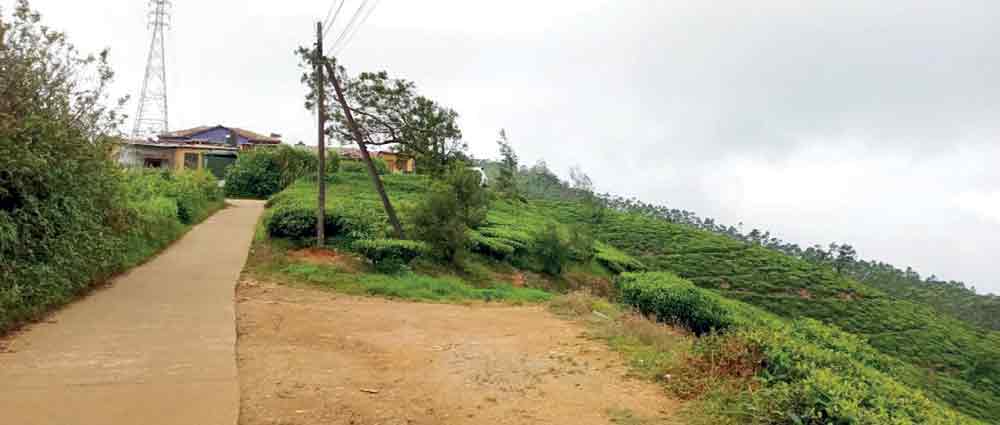
Let us today visit Kalapura in Shanthipura, the highest-altitude village in Sri Lanka, standing at about 1,960-2,045 metres (6,440-6,706 ft) above sea level. Kalapura and Shanthipura are in the district of Nuwara Eliya, where the skies seem to bow down to say hello to humankind. To get to Kalapura in Shanthipura, we must leave the crowded Nuwara Eliya town and take the road that eventually forks and then turns left, where one sees several placards and planks. These announce comfortable holiday inns that are often operated by those originally from Colombo, who can afford to buy land from locals and build international-standard hotels and resorts.
Often, the locals gawk at these buildings and sigh, looking through the glass windows and wishing they could at least briefly step into that luxury. Yet, these thoughts vanish quickly as life overtakes them and they struggle with the land, cultivating vegetables or fruits that will be sold to those who collect them to supply vegetable shops islandwide. So, how can a visitor get an authentic glimpse of the people of the mountains? How can they see into their lives without filters and witness the raw breath of everyday existence that the mountains and sky know but do not reveal?
You can take time to choose entrepreneurship in the mountains and make the effort to speak the language of humanity.
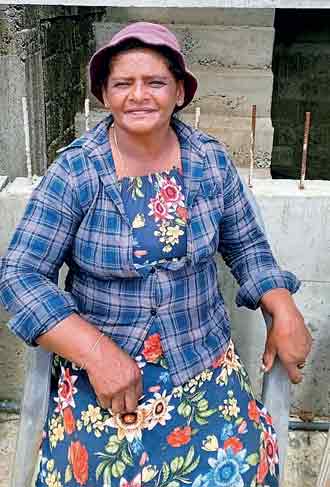
As part of this mission, we today hiked up to Kalapura in Shanthipura to meet Maria Beatrice, whose story is a textbook lesson on how to create something from nothing more than a few biscuit packets. The purpose of featuring her story has several objectives. One is to encourage the reader, local or foreign, to visit her and others like her.
A visitor can, while purchasing the many products Beatrice offers, including wonderfully flavoured tea, coffee, rotti and many snacks, ask her about her hopes, fears and dreams for the future. Beatrice has also created space for ornaments, playthings for children and flowering plants supplied by her neighbours.
What is the ultimate purpose of featuring stories like these? Overall, it is to raise the social consciousness of richer Sri Lankans on how they could assist mountain people to start up their own businesses.
The most important goal of a mass media initiative such as this is to get the district- and provincial-level government machinery to think through its role in grassroots development. They could travel up to Kalapura and Shanthipura and analyse for themselves how little it would take to lift these people from what we could define as poverty hiding behind innocent smiles on weather-beaten faces. So let us listen to Beatrice.
Beatrice’s tale
She is now around 60 years old, and her roadside business, which is opposite the viewpoint in Kalapura, has existed for 25 years.
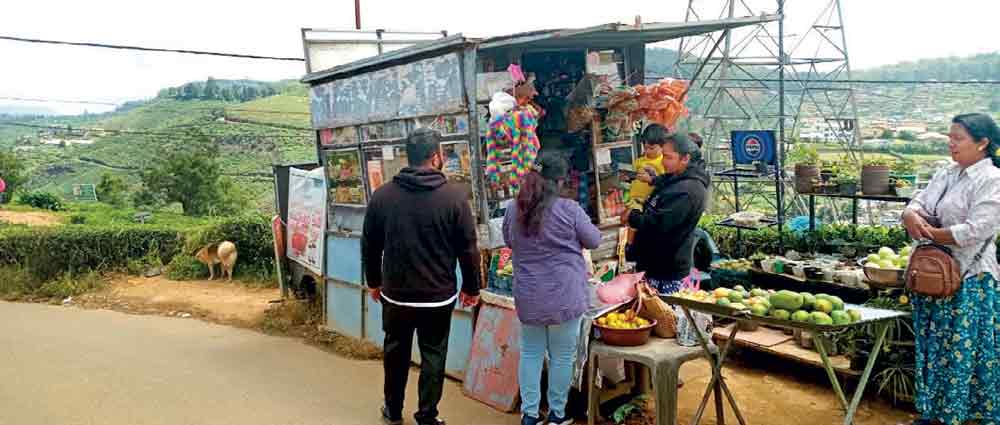
There is now a Barista outlet that provides a sky-high viewing experience. Cheek by jowl with this building is her small house. A little further away is her attractive mobile food boutique, which has occupied the roadside spot for over two decades. It technically belongs to the Oliphant Tea Estate, and occasionally officers from this plantation visit, although they have so far not raised any objections.
“God has looked after me and miraculously grew my business for me from nothing, when I could get no help from anyone. And I trust Him every day that He will provide,” she explains, stating that she is a Christian and never lacking in faith.
Faith seems to be the only luxury of these mountain people, who almost equally represent Buddhists, Christians, Hindus and Muslims.
“My story started with the police and the Pradeshiya Sabha giving me the responsibility of guiding visitors to the viewpoint as it existed 25 years ago. Now you can see how it is,” she states, pointing to the spiralling stairway of the newly constructed viewpoint manned by the Sri Lanka Air Force. It is operated as a tourism development initiative, and the newly opened Barista is an added attraction.
“When I started the journey of entrepreneurship, I was in my thirties. My son was already a teenager and bristling with ideas. This is how it all started. When we were faced with many financial hurdles, he asked me once, ‘Mother, why don’t we sell something that people will find useful by the road near our house?’ So, outside my house, I started off by selling the only thing I had – some radishes I grew. Then my son suggested that we get a few biscuit packets and sell those instead of vegetables. Those who come to see the viewpoint would like to munch on a snack, he felt. True to his word, the biscuits sold immediately,” she recalls with a smile.
Encouraged, she got her husband enthused as well. They collected the maximum amount of money they could and increased the number of biscuit packets and snacks to provide to visitors. “Thereafter, we made a fireplace by the roadside and made tea to be drunk with the biscuits,” she narrates. This was an instant success.
Soon, her son set up the roadside shop, which still stands today and has been modified each year. It is located a few metres away from her house, facing the viewpoint. It is a key attraction and one of its kind in Kalapura. Fruits grown in the area, such as pepino, passion fruit and strawberries, appear on the scene according to the season.
Are most of the visitors who patronise her place locals or foreigners?
“Both. At present there are no foreigners. But Sri Lankan families escaping the heat in the rest of the country arrive throughout the year on holiday in Nuwara Eliya. Most who come to Nuwara Eliya travel the additional three kilometres and arrive here in Kalapura to climb to the viewpoint. Yes, they can go to the café over there, but many like the idea of having some tea by the roadside and enjoying the novelty of it all,” she states, adjusting the cloth hat she dons when the sun is strong.
And true enough, during the time it takes for this interview to be conducted, a few Sri Lankans from other districts enjoy a cup of tea, and one of them purchases a small plant.
“I usually make rotti, which visitors can eat with the traditional lunu miris. But I make this only when visitors are assured, like during the tourism season or when there are large local crowds. International visitors are not around here much now as everyone is fighting in the world. I hope it will all stop and there will be travellers from far and wide, as is usually the case,” she adds.
What is the attraction of Kalapura?
“It is the highest place in Sri Lanka, and people like to see the view and enjoy the scenery of the tea estates,” she states.
Through her own entrepreneurial success, she has helped several people in Kalapura in the small ways she can, such as giving monetary value to the fruits that grow in their gardens.
“I buy these passion fruits from my neighbours and sell them, keeping a profit for myself,” she explains.
One fruit is sold for about eighty rupees. While this may seem expensive to those from the area, the price appears reasonable to a visitor who may pay three times as much for an imported fruit sold in Colombo.
“Life is not easy here, but what this business has given me and my family is economic freedom,” Beatrice points out. Her two-year-old grandchild, Raphael, gurgles in glee as if echoing her thoughts before he is whisked away by his mother. Her family usually comes to visit her several times a day and helps her keep alive the determination of her younger days. To continue even when she feels weak as age sets in. To create and innovate with ideas given by the youth of the area.
Having listened to Beatrice, what can we conclude?
Can we think through what it would be like if the State representatives in the provinces acted as her son did, encouraging and creating opportunities for rural home businesses?
What if other estates like Oliphant allowed small patches of land belonging to them to be used by people such as Beatrice? Would it not transform poverty into grassroots financial independence?
What if sections of society such as large enterprises sought out families overshadowed by the weight of the mountains and listened to their stories? What if these enterprises offered mountain people a new chapter in entrepreneurship?
We talk much about developing the country. Does not the country develop when its people uplift fellow citizens? What if rural development banks encouraged staff to leave their office seats and go to these locations and thereafter envisage new and innovative savings and loan models for the explicit purpose of creating family-based entrepreneurship? Is not the easiest way of eliminating poverty at the grassroots linked to the provision of roadside land space and assistance with basic provisions (such as mobile shops) to tread the route of revenue creation? Would not State institutions vested with responsibility for the districts and their extended territories become more authentic in fulfilling their responsibilities if they vowed to assist the country to develop by making as many rural families entrepreneurs as possible, especially in tourist areas such as Kalapura and Shanthipura?
We often speak of investment, which is associated with grand scales. But should not the first step of investment, the investment in people, be at the humblest of levels? And is not the main attraction of a nation’s tourism the resilience and talent of its citizens? Could plush buildings, however comfortable, ever replace this charm of humanity, and is it not time that we seriously thought about it and acted on this ideal?