Tuesday Sep 15, 2026
Tuesday Sep 15, 2026
Saturday, 10 January 2026 00:00 - - {{hitsCtrl.values.hits}}
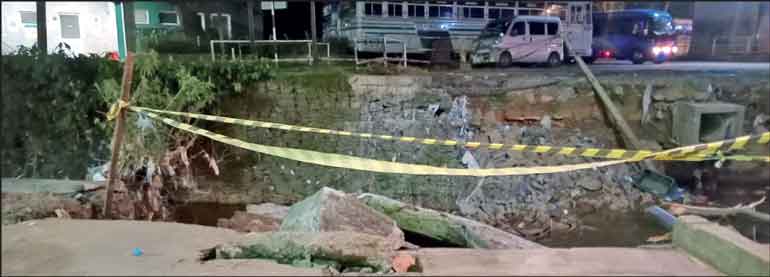
The damage caused by Ditwah in Nuwara Eliya town
 |
| Yasith Hansaka |
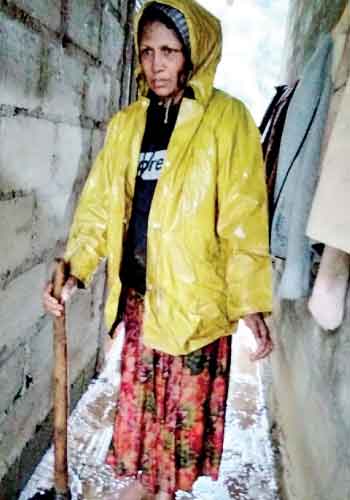 |
| Cleaning up – Anula shows the route the water neatly gushed out of without harming house or lives |
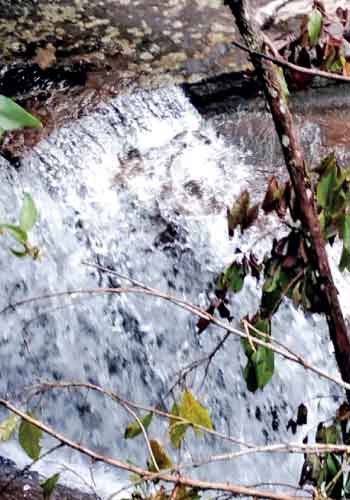 |
| The waterfall-linked stream on a good day |
By Surya Vishwa
The link between earth and man is a seamless fabric which wraps life and death in a swath. Although this is an everyday fact, it is however only after a serious confrontation with nature that most humans realise this.
Sri Lanka is still recovering limbs and decomposed bodies from beneath the collapsed mountain rubble. The number of those dead is estimated to be around or over 600. The technical reason given from a geological perspective is that the rainfall this year was the highest in recent times and that the continuous rain for over three days, recording over 500 millimetres per day, caused the destabilisation of the deep soil. The entire Central Province saw hitherto unthinkable phenomena where human eyes witnessed massive mountains come tumbling down, dragging humans and houses with them. Amongst the mayhem, however, there were some incredible stories of how nature acted in some instances. Before we narrate one such incident, let us contemplate the linguistic difference between two words that describe the natural world.
We have the word ‘Soba Dahama’ in Sinhala that encompasses the ancient-most understanding of what nature is – and is linked to how we understand the spiritual. ‘Soba’ means natural and ‘Dahama’ means a path of wisdom/understanding, generally linked to the ‘religious’. It is strongly connected to the Buddhist perspective of cause and effect (action/karma) as understood in the Buddhist path. A layman’s interpretation of ‘Soba Dahama’ could be the ‘natural cosmic law’ that encircles all of consciousness in this universe. In comparison, the parallel word ‘parisaraya’ – ‘environment’ – describes natural surroundings in a rather impersonal sense.
This is, however, not how some humans see the natural world.
Take the case of 11-year-old Yasith Hansaka, his mother G. M. Anulawathee and her family, living in close proximity to the Lovers Leap waterfall in Nuwara Eliya. The dwelling of this family is a solid but simple brick structure that is still in the making. There is a slab laid for the upstairs unit, which the family estimates to finish in about 15 or 20 years, hoping to begin the home tourism concept in it. The family is known for being very conscious of not polluting the earth and also for their meritorious activities – they have been housing a displaced neighbour for over a month now and habitually help anyone in need without expecting anything in return.
This family had an experience that could be only described as ‘miraculous’ when the natural stream running behind their property gushed in full force right into their house. In a manner that can never be logically comprehended, it was met with a counter water direction from another segment of that stream. The water direction then changed and was precisely led, as if by careful planning, away from the house. Nothing in that entire property was harmed – except for some soil disturbance.
Here is what Anula had to say when she showed the visible marks on the earth of how the two waterways emerged.
“It was late in the night of November and it was raining extremely heavily. Suddenly, we heard a huge sound – it was the soil and water crashing all around. I shouted to the two children – aged 11 and 16 – to just run and save themselves, yelling that the mountains were crashing. They ran outside. I stood still for a second and, even with a pounding heart, remembered the Lord Buddha. My mind was made up – I resigned to listen to the cycle of karma that seemed to be embodied in what I saw and heard. I had no hope that our lives would be spared. The entire stream below, linked with the network of waterways connected to the large waterfall, seemed to have a power that was so frightful that I get goose bumps recalling it.
There was no way that the house would not have got engulfed. I screamed again for the children to keep running. Soon after, I cannot believe what I saw – another path opened as if directed by an earth- or heaven-based hand and manoeuvred the seemingly wrathful invasion away from the house, touching the walls but not beyond that. I cannot to date understand it. In legend, we hear of giants of Lanka cutting waterways – it was like that. I cannot explain it to you. The stream below was like a monster – it was swirling everywhere. It completely washed away the house of a neighbour, a female living alone in one of the adjoining houses. She has been living with me for the past few weeks. I told her to stay here and share our food until she finds alternative housing.”
Anula assists in the earning of the daily bread for her family by cooking the morning vegetarian nutritious meal for a national school in Nuwara Eliya. This is the meal that the school provides to the children. Anula has a contract with the school administration for the provision of the cooked food for the younger students. Her home premises has a considerable land space – all used for the cultivation of vegetables, without resorting to synthetic/poisonous fertiliser. Her two children, when they return from school, tend to the garden, which has several edible vegetables, fruit and flowers.
“I treat what I do as a meritorious responsibility, as it involves the lives of young children. When I buy from the market, I take care to choose vegetables that have not been contaminated with poison. Every day, I use at least two vegetables from my garden to cook for the children for the meal I prepare. I am happy when I do this, as I know for sure that there is no health threat by consuming them. I am now committed more than ever before to engage in all my actions with the realisation that it is only ‘kusal’ (good deeds) that is our true wealth.”
This is what young Yasith Hansaka, known for his close association with nature and extreme generosity, had to say (his parents dread taking him as a shopping assistant – because he will insist that much of the grocery money be distributed to all those asking for alms).
“It was raining and very cold. I was fast asleep. I suddenly was woken up by many sounds – the rain, all of the trees and mountains, and the waterfall-linked stream below seemed to be shouting. Then I heard my mother screaming for us to run. It was raining heavily. I ran out of the room and ran out of the house to the garden and then to the road. There I saw mayhem. Everyone was yelling and running all over. It was pitch darkness. The electric wires were affected and the lights were gone.”
This child then runs to the garden and shows me how the ‘miraculous’ two waterways were created by nature to save their house and their lives.
I then pat him on the head and jovially ask him something his mother had shared with me – that 12 years ago she had gone to a religious place of worship and made a vow for a son. She had by then a daughter. The male child she yearned for so much was subsequently born. As a baby, he would tug at her hand and ask her why she called him from ‘the heavens’ when he was with the ‘gods’, happily eating fruits. This, she says, occurred many times from the age he could speak up to when he was about five years old. To date, Yasith dislikes meat acutely and prefers only vegetarian meals and loves to eat fruits, often plucking the fruits that grow in their garden. He loves to eat them right under the trees.
So what has young Yasith learnt from this?
“Appo, I never knew mountains and streams can be so tough. I will never hurt them even slightly. I will be very, very careful not to dirty them with trash or rubbish. I usually get very angry when people throw their garbage into the streams. See, you can see everywhere, even in this garden, the periphery, how the litter thrown by people into the stream had got washed out. I once got very angry when I went down to the stream to bathe and saw a man (a paint baas) polluting the whole stream by washing all the paint cans and brushes in the stream. The whole stream became multi-coloured and we could not bathe for a whole day. I scolded him.”
With this, his face turns beetroot red and he clenches his little fist.
Soon, I leave this house and walk around the hills and see the destruction of several homes. As I walk, I think of the horrific fate of so many families in Kandy and the Central Province when the mountains crushed and annihilated life instantly. What comes to mind is how all the ancient sages and enlightened beings of yore directly worked with nature, which ensured their spiritual progress and physical well-being, providing for them abundantly nutritious food and clean water. Mountains, forests and streams were never the enemies of enlightened beings but rather the opposite – they were protectors and benefactors, reciprocating the same loving-kindness and respect these sages gave to all of nature.




