Tuesday Sep 15, 2026
Tuesday Sep 15, 2026
Saturday, 25 July 2026 01:30 - - {{hitsCtrl.values.hits}}
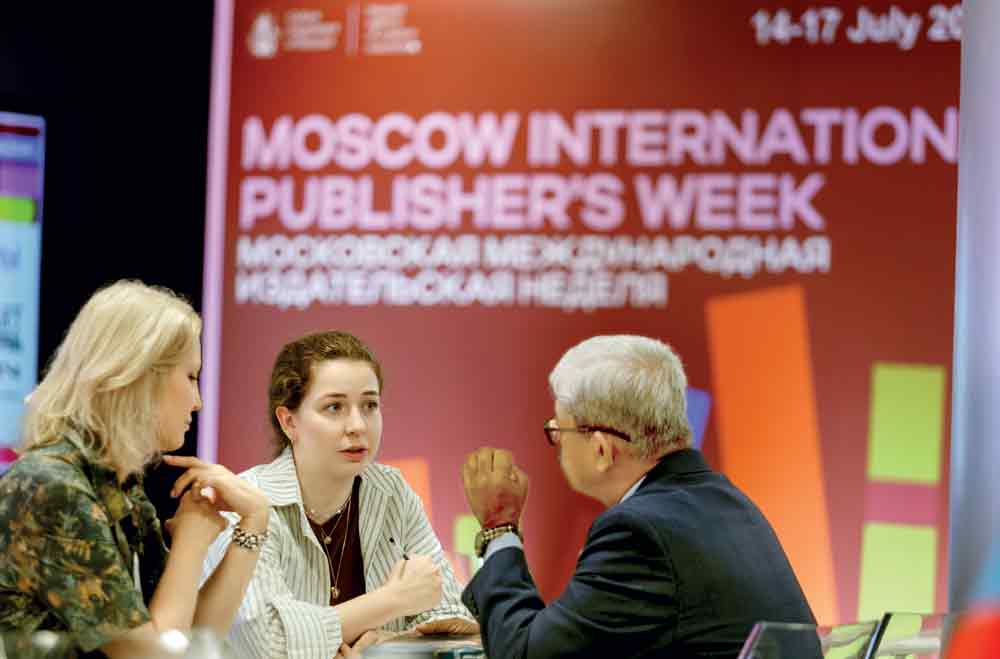
Sri Lanka Book Publishers Association former head and IBBY Sri Lanka National Section President Dinesh Kulatunga (right) at the Moscow International Publishing week
This article will explore the vicissitudes of publishing at a global diplomatic and peace sustaining level while focusing on the Sri Lankan representation at the recently concluded Moscow International Publishing week.
The event was an initiative that was first launched three years ago and serves as a networking platform in Russia for global publishers. The 2026 event held from 14 to 19 July brought together around 60 international publishing houses and featured events connected to the industry, enabling publishers of many countries to meet in Moscow, alongside editors, literary agents, translators, authors and those interested in the art and economy of this industry. It also served as a platform for Sri Lanka to showcase its literature and understand the diverse ways an event of this kind could be introduced
By Surya Vishwa
If the metaphor for the written word could be described as wine then the many glasses that hold it could be equated to the publishing industry.
Publishing belongs within the economic framework of each country and is an industry that has a chameleon nature. It can wear many cloaks ranging from an almost uncountable range of genres. And it could be further shaped into diversified sectors that include but are not limited to education, science, ancient knowledge, nature protection awareness, tourism, diplomacy and something that this planet desperately needs world peace. The potential of the publishing industry is unlimited and within its infinite capacity lies the crucible factor of how publishing serves as a form of entrepreneurship that is like no other. Publishing is the one form of business that creates the route to an elevated mind whatever the chosen stream of knowledge and through the closely linked translation industry, now assisted by artificial intelligence brings the world closer.
“The countries that participated at the International Publishing week included Uruguay, Argentina, Brazil, Uruguay, Chile, Indonesia, Nepal, Korea, Sri Lanka, Serbia, Kyrgyz, Armenia, Azerbaijan and Turkey and of course Russia,” explained Sri Lanka Book Publishers Association former head and IBBY Sri Lanka National Section President Dinesh Kulatunga, who attended the Moscow PublishingWeek representing Sri Lanka and his local and international publishing house Neptune Publications. “The Fellowship Program of the ‘Moscow Publishing Week’ was organised by the Agency of Creative Industries, an organisation reporting to the Department of Culture of the City of Moscow,” he stated.
What is Sri Lanka’s potential to showcase its literature and thereby also its country and its people through multifarious routes globally? How can the Sri Lankan State and its private sector be involved in supporting Sri Lanka publishers attending such events, considering that Sri Lanka’s presence at international literary, publishing and writing related events are low.
 Publishing is a vital intellectual and creative industry that should be guided by skilled professionals to realise its full potential. As a cornerstone of the creative economy, it possesses a unique and dynamic character, embracing a vast range of genres, themes, and knowledge domains. With its virtually limitless capacity, publishing stands as a powerful form of entrepreneurship that drives innovation, inspires critical thinking, and fosters societal progress. Most importantly, it creates pathways to knowledge, lifelong learning, and intellectual growth - Sri Lanka Book Publishers Association former head and IBBY Sri Lanka National Section President Dinesh Kulatunga
“Neptune is a publishing house that wishes to be low key in the external world – we do not house big building or many branches for the reason that we wish to use much of our revenue to pitch Sri Lanka overseas which is a very costly endeavour,” Dinesh Kulatunga pointed out.
As Kulatunga did not respond directly as to what the State and the private sector could do to support publishers and even writers and those wishing to enter the field of publishing as entrepreneurs we as a mass communication initiative that hopes to influence policy, would like to direct the focus of the questions in the direction of local policy makers entrusted with responsibilities such as promoting culture, arts, education, tourism and diplomacy. This can also serve as an introspection to the Sri Lankan business sector who can ask themselves – ‘how can it be more aware of international events that tie up avenues that can help Sri Lanka, an island nation, get the maximum exposure it can.
“I have resigned from my role as the head of the Book Publishers Association of Sri Lanka after being elected in 2025 and serving for nearly a year, and the Neptune Publishing House is currently focusing on reaching maximum exposure for Sri Lanka internationally,” Kulatunga stated.
He shared that the most unique aspect of his recent exposure at the Moscow Publishing Week was learning how such an event can be professionally organised maximising the benefits for the host country.
“What I have primarily learnt from the book and publishing events from the European and other parts of the world, and now from Russia, is that when we use the term ‘international’ to describe a literary, writing or publishing event, we should give authentic credibility to that word. When myself and my team made several inquiries on how these events are arranged internationally we found that sometimes almost two years of work would go into creating the global reach needed for one such event.”
With regard to the Russian event he points out that more than 260 business meetings were held between domestic and foreign organisations, literary agents, editors, licensing and law specialists.
“We are now in the process of following up on those meetings, ” he said.
The Harmony page had more questions and we asked them as follows:
Q: What were the other activities carried out at this publishing event in Russia?
A: There were a series of panel sessions that discussed the development of the publishing industry, new trends in the Russian book market, opportunities for international cooperation, and the interaction of illustrators and publishers.
The delegation visited the largest publishing house, EKSMO Publishing House, GES-2 House of Culture, Gorky Park and participated at the International Session within the Russian Creative Week.
Q: From the larger national perspective, how many meetings were conducted for publication and literary business potential with Sri Lanka?
A: The meetings were professionally organised and were very productive. We had 26 meetings which were very successful as the organisers had planned it in such a way to be productive for both the host country and for those attending.
Q: What is unique about Russia in the publishing industry?
A: Russia as we know has a very long history with the written word and with literature in particular. Russian Publishers are very professional and the new generation in this sector displays much innovation. I met representatives of companies started by Russian youth who are engaged in contemporary modern literature related publishing. We selected many books suitable for Sri Lanka and the readers of our country can now access them.
Q: What kind of interest was generated in Russia for Sri Lankan literature ?
A: There were buyers who were interested in Sri Lankan fiction and non-fiction. A: We were able to promote Sri Lankan writings and obtain interest for business orders.
Q: As the only Sri Lankan publisher who attended this event what kind of response did you get for your representation of Sri Lanka?
A:There was overall a very good response for Sri Lankan literature and for linkages within the industry. One very noticeable factor was that the welcome for international publishers was highly organised. At a diplomatic level, it was very impressive. There was much hard work behind the scenes and there was no malfunctioning of any of the procedures of the event.
The delegates were informed of the proceedings well in advance, so that though I was in Moscow for the first time, it did not feel to me that I was in an unfamiliar place.
Q: What kind of books were available as a whole at the event?
A: Many genres were made available by all the countries that were exhibiting their publishing material. The fact that countries we may not often find in other European publishing related events were exhibiting was a very positive factor. As a publisher I believe in the strength of translations to widen the mental scope of the younger global generation. We therefore are currently focusing on selecting global material to translate to English and also Sinhala and Tamil. Where Sri Lanka is concerned we presented as much as we could a wide array of publications covering our heritage, culture and diverse kinds of writings.
Q: What are the other global publishing events that Sri Lanka could get exposure to this year?
A:We hope to present Sri Lankan literature and publishing at the Germany literature and publishing related events and at similar events in several other European and Nordic countries including Sweden.
Q: Do you believe that facilitating more translations of global literature will contribute at least in a subtle way towards world peace, irrespective of the divide, violence or prejudice that we have today on earth?
A:Yes.
Q: In your own words how would you describe publishing as locally and internationally relevant?
A:Well, this is how we can see it and how as a publisher, I see it. Publishing is a vital intellectual and creative industry that should be guided by skilled professionals to realise its full potential. As a cornerstone of the creative economy, it possesses a unique and dynamic character, embracing a vast range of genres, themes, and knowledge domains. Its impact extends far beyond books, contributing significantly to education, environmental awareness, tourism, cultural diplomacy, and the promotion of peace and social cohesion. With its virtually limitless capacity, publishing stands as a powerful form of entrepreneurship that drives innovation, inspires critical thinking, and fosters societal progress. Most importantly, it creates pathways to knowledge, lifelong learning, and intellectual growth. To ensure the industry’s sustainable development, stakeholders must look beyond annual events such as book fairs and invest in research and development initiatives, entrepreneurship programs, and future-focused engagement with younger generations to prepare for emerging trends and opportunities.




