Tuesday Sep 15, 2026
Tuesday Sep 15, 2026
Saturday, 14 March 2026 00:10 - - {{hitsCtrl.values.hits}}
Conservation of seeds
 By Surya Vishwa
This week we travel to the village of Palugaswewa in Eppawela in Anuradhapura District. We arrive here to visit one of the oldest indigenous farming promoting hubs in Sri Lanka initiated over five decades ago as part of the Movement for the Protection of Indigenous Seeds (MPIS) begun in the 1970s. When you get off the bus near the Palugaswewa Galkanda Purana Viharaya and walk about 100 metres up to the small Ganapathi homage site by the roadside, you will find a gate leading to a small cluster of simple but artistically designed buildings. These take up about 20 perches within three acres of land.
Heirloom rice
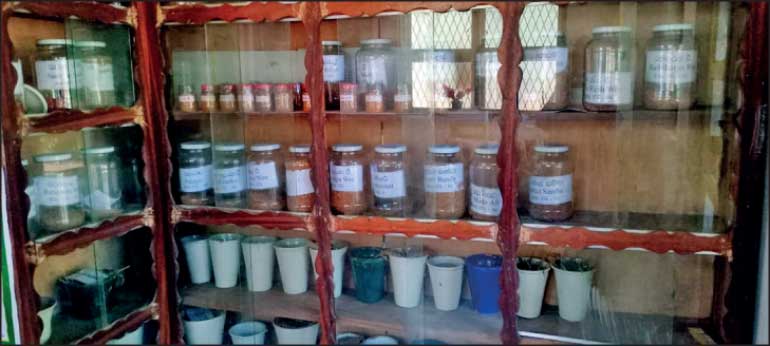
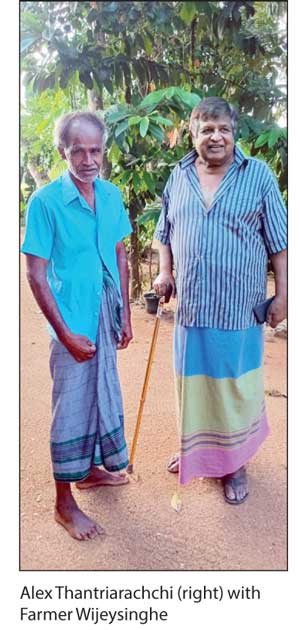
The land had been provided by the Mahaweli Development Authority in the 1970s as part of the scheme to support farmers. This land extent was given to Alex Thantriarachchi, one of the pioneers in promoting organic traditional farming of indigenous paddy varieties and other grains and plant species. Over time, he set up, as part of the MPIS vision, a small library and publishing unit of farming-related books, a butterfly breeding unit, a beekeeping endeavour, a centre for workshops, a small museum of ancient material used for traditional farming, a heirloom rice seed conservation/distribution unit and a plant nursery to grow indigenous plant species.
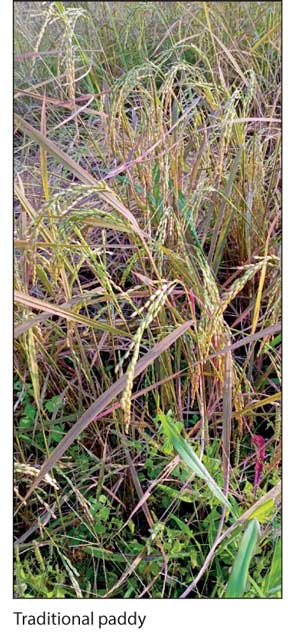
The Mee plant and the Attika are for reforesting the nearby Kolongas Junction elephant corridor. The cultivation of traditional paddy varieties takes place over two and a half acres. No synthetic fertiliser, pesticide or weedicide is used. This has been the way the cultivation was done for the past fifty years here. One can see that the soil is black and there are weeds here and there.
We list here the full list of the traditional rice varieties grown: Rath Kanda, Kaluheeneti, Pokkali, Rathsuwandel, Sudu Heeneti, Madatha Palu, Beheth Heeneti, Kahawanu, Rathmanikkan, Gonagaru, Kahata El, Kahanala, Kirinarang, Batapola El, Kolikuttu Wee, Rath El, Kahata Samba, Kalu Wee, Kirimurunga, Sudu Wee, Hetapanduru, Rambutann Wee, Yakada Wee, Rath El Samba, Handiran, Rathkunda, Kottiyaran and Mahama Wee.
Around five farming families who have been part of the MPIS since inception tend to the fields. They have done this for years in a world that has raced past traditional agriculture.
“I was on this land 50 years ago as a teenage farmer. And I am here now. The country has changed. Most of the farmers we knew from youth do not cultivate the way my father or grandfather did. They have opted for large-scale commercial farming but myself and others continue using traditional methods. The money from what we do is not a large sum but it is a commitment we have to live out,” says A. M. Wijeysinghe who is 67 years old.
He explains that one of the traditional methods of energising the soil is to place leaves of the Giliciriya plant in a barrel with the wild Suriyakantha and keep it for around 10 days, applying it thereafter on the soil. This ensures a good harvest resulting from high nitrogen.
Farmer networks
From the 1970s to date the MPIS has been committed to indigenous seed distribution that is carried out islandwide. This is done by networking with farmers around the country who are committed to preserving indigenous seed and plant species.
Some of the earliest programs that the MPIS has carried out included the Maha Govi Sangayanama (Great Farmers Convocation) in 1992 that focused on the many vicissitudes of agriculture and the mass-scale indigenous rice seed distribution held at the BMICH where over 500 farmers were given five paddy varieties each.
“We have built up farming networks across the country. In every district there are at least seven to eight farmers committed to biodynamic or organic cultivation,” he states.
Meanwhile seeing the Attika and Mee plants we ask him why these are cultivated in abundance in the nursery.
“Atikka is a plant species that the elephants love. Every day we farmers face the danger of elephants rampaging on our crops and I started growing trees that we can plant in that elephant corridor area so the elephants can have enough sustenance.”
“I am at the last phase of my life and had a near-fatal accident falling off a train four years ago. Before myself and the other farmers who were with me from the very beginning on our mission to preserve indigenous seeds and plant varieties say goodbye to this earth we wish to ensure that we finish to the best of our ability what we started out to do.”
He then goes on to state that one of the biggest nature-driven blows in recent times was the Ditwah which flooded the place, washing off many of the plants, seeds and killing the wild species of chicken we call Gung Kukulo. “We rear them in the wild not for the meat but only for the chicken manure. What happened was that the Kala Oya water gushed out here and the close by waterway (Palugaswewa Wewa) also burst over because its water bund broke off. We are still cleaning up from this calamity. We were wading over two feet of water.”
So, what is the full history behind the MPIS?
In the beginning…
Alex Thantriarachchi in 1974 at the age of 25 years, along with like-minded others, initiated endeavours such as farmers’ training schools (Govi Pasel), indigenous seed multiplication fields, experimental ecological farms and traditional rice seed collections which finally culminated in the formation of the Movement for the Protection of Indigenous Seeds (MPIS). This was at a time when the world was fast spiralling towards an agricultural trend that was rooted in synthetic fertiliser, weedicide and pesticide following the Green Revolution.
“I grew up in the district of Galewela in Matale. My father was an educator and served several rural schools including those in Puttalam, Deniyaya and Matale (Yatigalpotha and Wahakotte). Wherever he went I too.”
He explains that during this time he understood that there was a need to safeguard the vegetation that was endemic to Sri Lanka which was threatened by the introduction of genetically modified seed and plant variants. His main focus was paddy.
“The first step taken by myself and others connected to farming in 1974 was in the village of Elle Wewa in Kahatagasdigiliya. We started the Rajarata Pasal Hereyanange Govipola (Association of Farming for School Leavers). This was aimed primarily at school dropouts to be able to connect with the earth and establish themselves economically through farming in traditional ways that helped to nurture the earth and the mission of conserving indigenous seeds. Here they learnt organic farming methods, seed saving and ecological agriculture.”
In the late 1980s and early 1990s this was assimilated into the larger Movement for the Protection of Indigenous Seeds (MPIS), linking many youth and adults alike in universities and schools. “The initial membership was about 300 farmers. Two of those giving leadership to this initiative were Vipulasena Rajapakse who was the Principal of Anuradhapura Central College. The other was Dr. Piyasena Abeygunawardena who was Dean of the Agricultural Faculty in Peradeniya,” Alex Thantriarachchi explains.
He adds that this endeavour represented the strength of many persons including Ravindra Gamagedera who is professionally a farmer and the former Chairman of the MPIS Charitha Wijerathne who was a teacher dedicated to translating and supporting the publications unit of the MPIS. One of the key books to be translated was An Agricultural Testament by British botanist Sir Albert Howard originally published in 1940. Alex Thantriarachchi explains that they consider this publication as an organic farmers’ Bible showing the interrelation between natural farming and soil health.
 Lost to history
He admits that many ancient techniques that Lankan ancestors knew on interacting with the soil are lost to the country today. He also adds that much of the soil is ‘addicted’ to the chemical substances used in agriculture. Therefore, just like a human body that has got solely dependent on antibiotics and is unable to be healthy without it, the soil cannot produce independently of synthetic fertiliser.
We now ask him a crucial question. How does he see the great ambition of Gotabaya Rajapaksa to turn Sri Lanka overnight into an organic paradise?
This is his answer: “Frankly, this only resulted in moving farmers completely away from organic-linked agriculture. Any genuine attempt to get Sri Lanka to honour the soil, protect it and nurture natural methods of food production should have considered that the same time frame (about 20 years) that it took for the country’s farmers to be converted to artificial fertiliser, pesticide and weedicide would be the realistic average timeline needed to create the reversal. The chemical agrarian revolution was created step by step and much effort was taken to change the mindset of farmers. The same effort, technical skills and practical steps to allow the transition without ruining the economy of the farmers were needed. Instead we all saw what occurred.
The end result of this is that any hope for relearning traditional methods of agriculture went backwards by decades. We are now in a position where farmers who suffered from the abrupt policy shift dread natural methods of cultivation and believe it is impossible thanks to former President Gotabaya Rajapaksa.”
We ask about those who have visited the MPIS fields in Eppawela. Many, Alex Thantriarachchi replies, including directors of the Agriculture Department, agriculture-linked university dons, D. L. O. Mendis, Ray Wijewardene and P. H. Panabokke.




