Tuesday Sep 15, 2026
Tuesday Sep 15, 2026
Saturday, 9 May 2026 00:43 - - {{hitsCtrl.values.hits}}
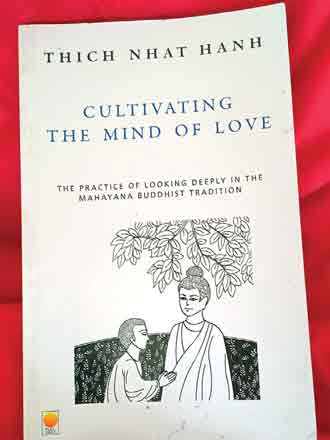 The above headline is the title of the book by Ven. Thich Nhat Hanh, the Zen tradition Vietnamese Buddhist monk of Mahayana Buddhism.
This book (copyright 1996 by Thich Nhat Hanh – published by Full Circle Publishing, New Delhi, the first Indian edition being in 1996 and the 6th reprint in 2017) looks at the Bodhisattva way in how the message of love in Buddhism can be used by everyone irrespective of who they are.
The efforts of Ven. Thich Nhat Hanh to channel Buddha’s message towards peace and reconciliation, especially his stance of non-violence during the Vietnam war moved Martin Luther King to nominate him for the Nobel Peace Prize in 1967.
Even though Ven. Thich Nhat Hanh was not chosen for this peace prize, he was renowned the world over for his non ego driven work to unite humans across race and religion through Buddhistic compassion.
Ven. Thich Nhat Hanh established the Plum Village Buddhist spiritual center in Southwestern France where he spread the message of love through the Buddha’s path.
Ven. Thich Nhat Hanh left this earth on 20 January in 2022 at the age of 95.
The book Cultivating a Mind of Love looks at what it means to be a Bodhisattva and what love in its purest sense could mean.
The book begins with the chapter Dharma Rain providing insights into consciousness as defined by Buddhism and divided into two parts – as ‘store consciousness’ (alayavijnana) and ‘mind consciousness’ (manovijnana). The author explains that in our store consciousness is buried, all the seeds representing everything we have ever done, experienced or perceived and as when a seed is watered, manifests in our mind consciousness. The work of meditation is to cultivate the garden of our store consciousness, he notes. “As a gardener, we have to trust the land, knowing that all seeds of love and understanding, seeds of enlightenment and happiness are already there.”
He further continues:
“If the seed of understanding is watered tomorrow while you are washing the dishes or looking at the blue sky that seed may spring forth, and the fruits of love and understanding will grow beautifully from your store of consciousness.”
By the word ‘understanding’ we can interpret wisdom and discernment. For example, our consciousness these days is shadowed by the deathly vapor of gunfire as we speak over our dinner about what is going on right now in this world, about the prices of fuel, about the dark and dismal uncertainty and its economic consequences. In such a scenario it is natural for people to take sides and there will be those who support the killings and mayhem, with the theory that wars can be ‘just.’ However, if the message of non-violence as preached by the Buddha is in our store consciousness – even though we may not have heard of the Buddha - as the upholding of the sacredness of life at all costs, acceptance that every human life is a gift to this earth and should be nurtured to live out their days in dignity, then the ‘understanding’ that Ven. Thich Nhat Hanh speaks of is already blooming. Not as a thwarted, deformed blood clotted thought, waving a phantom of a partisan, ragged and ambiguous justice, but a pure ideal of love where the other is equal to oneself. In this context Ven. Thich Nhat Hanh explains that our mental framework should be love – and that with such an achievement comes a different view of life.
What is unique in this book is Ven. Thich Nhat Hanh resorted to something that he acknowledges, no religious personage would usually do – reveal their ‘first love’ especially if such a situation arose when they had already taken up the religious life. Yet this is what he does. We can almost see into the non-murky hearts of these two young aspirants of the most noble path. At 24 years of age, he was already a teacher of Buddhism and the 20 year old Buddhist nun was one of the most devout. He begins this story from chapter 2 which is titled First Love and equates what he felt when he first saw this young nun standing looking out from the garden of a monastery at the mountains, to a similar feeling when he was a young child. He had been out on a school excursion into the woodlands. It was said that a hermit lived deep within the wood and he had yearned to meet him. So strong was his desire to see the hermit that he had returned, walking as far as he could till he heard water dripping from a nature rigged stone well. He states:
“When I looked down into it, I could see every pebble and every leaf at the bottom. I knelt down and drank the sparkling water and felt completely fulfilled. It was as if I was meeting the hermit face to face. Then I lay down and fell asleep.” This love and respect he felt for the hermit he dearly wanted to meet is on par with his spiritual love for the young nun which had been further purified by the prudence of detachment. Chapter three which is titled The Advent of Mahayana Buddhism shows that when Buddhist practice was exclusively monastic, a reaction was born in the form of the Ugradatta Sutra. It is pointed out that in the Ugradatta Sutra three questions were asked. “How does a Bhikku practice? How does a lay Bodhisattva practice? How does a lay Bodhisattva practice so that he or she is equal to a monk or a nun?” The backdrop to this Sutra is highlighted, noting that after hearing the Buddha speak 500 lay people had expressed their wish to become monks and nuns but that two hundred others who had been able to produce the mind of enlightenment during the Buddha’s Dharma talk, had not. It is explained that when asked by Ugradatta, a follower of the Buddha’s teachings, why he does not become a monk he replied that he need not.
“I don’t need to become a monk. I can practice just as well as a layman,” Ugradatta had responded. This chapter goes on to explain the origin of how the Mahayana line of Buddhism was thus created and gives several insights into the sutras that directed the resolve of the Bodhisattva. Ven. Thich Nhat Hanh also states how himself, fellow monks and nuns initiated teaching, attending to the marginalized in society, and undertaking service oriented tasks, which was a few decades ago not the norm in Buddhistic monasteries in Vietnam.
(SV)
Surya Vishwa is a researcher of comparative spirituality for the purpose of authentic peacebuilding. The above books are from her library housed as the Residential Library of Healing in Nuwara Eliya, committed to spreading global unity, wisdom, forgiveness, and introspection. This library is the academic reference hub of the Harmony Page.




