Tuesday Sep 15, 2026
Tuesday Sep 15, 2026
Saturday, 20 December 2025 00:03 - - {{hitsCtrl.values.hits}}
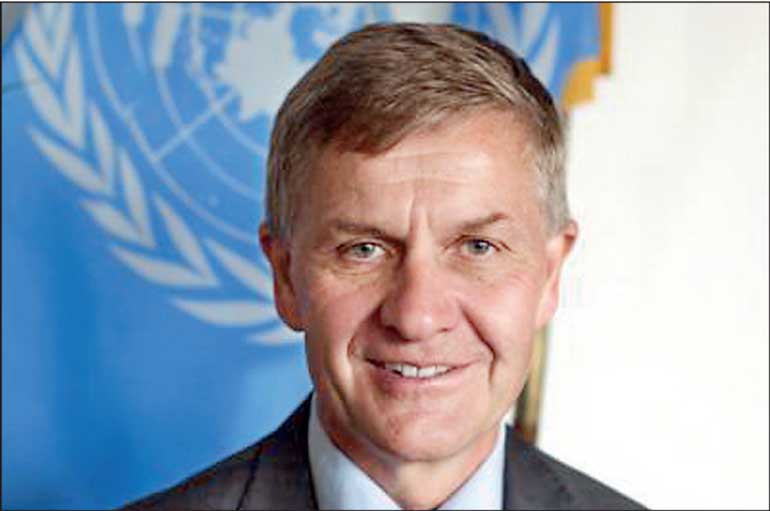
Eric Solheim
By Surya Vishwa
In this interview Eric Solheim, a Norwegian diplomat and politician speaks in his capacity as a climate specialist who had served as Executive Director of the United Nations Environment Program. He expresses willingness to visit Sri Lanka if needed to help the current Sri Lankan regime in climate preparedness and calls for better early warning systems and solar energy to be adopted as disaster preventive methods. He cites climate change as a worldwide phenomena that all nations have to be well prepared for in taking the necessary multiple steps towards stabilising the future. The Harmony Page is publishing this interview as part of our endeavour to bring global insight to prevent further climatic catastrophes in Sri Lanka. We have in recent editions called for human sensitivity to the earth to prevent its total collapse. Below are excerpts of the interview with Erik Solheim.
Q. As a climate expert who worked as Executive Director of the United Nations Environment Program what is your view of current climatic situations across the world, including Sri Lanka?
A. The extreme weather which caused such horrible loss of life and damage to properties and infrastructure in Sri Lanka is exactly what experts have warned us we should expect when the planet warms up. Global warming will bring more extreme weather events—floods and droughts. Sri Lanka with its tropical climate is particularly vulnerable.
Q. What do you think needs to be the first priority across the world to address erratic climatic extremes that result in cyclones and floods/earthslips?
A. We need to work in parallel on stopping global warming and preparing for more extreme weather.
Fortunately, we now see the Global South is taking the lead in the green energy and transport revolution. China is the indispensable nation for the green transition, the green super power where 60% of solar, wind, hydropower and electric cars/batteries are produced in China. China is the world’s number one tree planter, embarking upon the largest national park system. India under Prime Minister Modi is also moving fast. Last month I visited the new enormous integrated renewable energy facility in Andhra Pradesh. It’s six gigawatts. Tamil Nadu just announced a wonderful new eco circuit from Chennai to Rameswaram, that’s where you can see across to Sri Lanka.
When it comes to preparedness for climate catastrophes there is also a lot to learn from Bangladesh.
Q. What is your advice to Sri Lanka in handling the current flood related debacle?
A. I believe Sri Lanka can learn from what happened. We know for sure that new extreme weather incidents will continue to occur. Sri Lanka can improve its warning system so that people get alerted to move out of hazardous hot spots. Sri Lanka can make infrastructure climate resilient. The nation can plan better for future disasters.
Q. Are you ready to visit Sri Lanka to assist the current regime address the situation?
A. Indeed. Whatever I can contribute I am happy to share with the current government and all other Sri Lankans whether in politics, business or civil society.
Q. How does Norway rank in geological expertise?
A. Norway is fortunate from a climate preparedness point of view. We are a cold northern country with a very sparse population. While Norway also needs to prepare better, we will never experience massive droughts, big floods or huge landslides similar to what Sri Lanka just has been through. The climate in the tropics in many respects are better than up north. It supports human life more widely. But the tropical climate is also wilder, wetter and more stormy. Sri Lanka will do very well comparing notes with other tropical nations—learning from them and sharing its own experiences. India, Indonesia and Thailand are good examples, but for sure also tropical nations in Africa, Latin America and beyond can be studied for how they are handling similar issues.
Q. What are the changes you think are needed before we humans make this earth completely uninhabitable?
A. The most important is to make the connection between economy and ecology. In the past, if a nation wanted to grow prosperous, there were no choice but fossil fuels. Now solar energy is the cheapest anywhere in the world. Sri Lanka can bring every single citizen up to the middle class level through a green economy. The reason why China and India are leading the green change is that they see going green as an opportunity—for jobs, prosperity, better health, longer and more joyful lives.
NOTE: The Residential Library of Healing in Nuwara Eliya which houses thousands of books, especially earth related and is the main reference resource of the Harmony page and has been used for curricula writing for a national university is directly impacted in the current climate disaster. We are currently striving to save the books and relocate. In our firm understanding that hope and resilience emerges out of the worst of circumstances, we will initiate/support a new earth saving global endeavour which will be announced soon.




