Tuesday Sep 15, 2026
Tuesday Sep 15, 2026
Saturday, 16 May 2026 00:59 - - {{hitsCtrl.values.hits}}
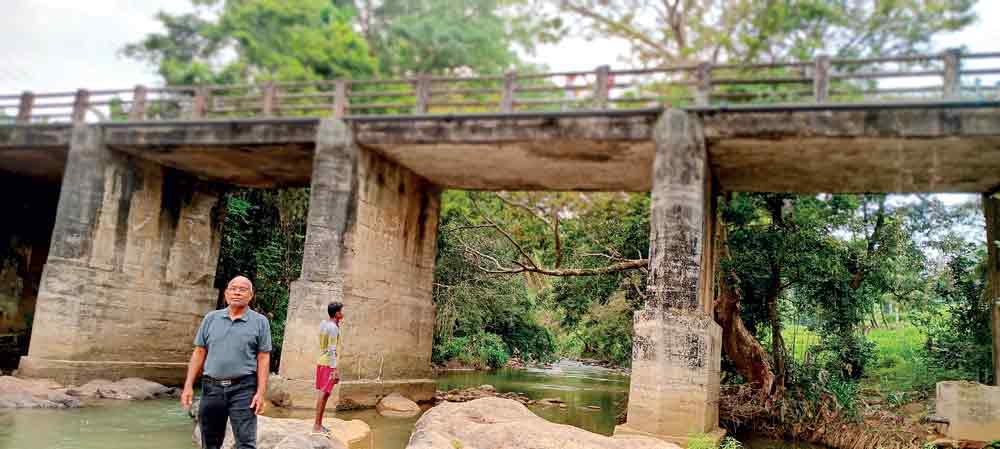 T. Kandiah stands below the Madulla bridge
By Surya Vishwa
The title of this story does not refer to bridges in a general engineering sense alone but rather the bridges of national unity that Sri Lanka has needed since independence from the British to date.
This article is produced as part of the social narrative series of our mass media effort published since 2021 heralding the wisdom of declaring May as a month commemorating peace.
This year we will carry through this initiative until end December 2026, featuring inspiring stories that will in turn inspire the nation to usher in one uniform national peace commemoration when remembering the end of the 3 decade conflict in Sri Lanka on May 18th 2009.
We continue writing in the hope that in 2027 all citizens will unite in celebrating peace and collectively mourning the needless loss of all lives, together, as part of a policy decision, with the vow that such calamities never occur again.
The article below is written as part of this initiative.
T. Kandiah has lived for the past three decades in Australia. He is an engineer by profession and from the North of Sri Lanka. This year he arrived in Sri Lanka to embark on the poignant journey of tracing his steps as a youthful and idealistic engineer in the 1980s. We met him a fortnight ago. The Residential Library of Healing, the book collection of this scribe, dedicated to world peace and the reference hub of the Harmony Page is opened to the world as a homestay and usually attracts young backpackers. This time though, the inquiry came from a retired engineer. He explained that he had arrived in his hometown Karainagar, Jaffna, from Australia. Could he book into the library of healing, he asked. He was arriving in Nuwara Eliya and wished to see some of the constructions he had been responsible for in the 1980s during the three years he was working for the District Development Council (DDC) in Nuwara Eliya after graduating from the University of Peradeniya as a civil engineer. He soon arranged to travel to Madulla and several other rural areas. His father had served as a medical professional in some of these locations and he had been an engineer responsible for village constructions by the DDC.
I accepted the offer to travel through Central and Uva Province to seek out bridges and persons he had known in the 1980s. By chance the driver hired to drive Kandiah to the locations he wanted to get to, was a relative of a deputy director in Nuwara Eliya that he had worked with.
Soon we were travelling in a hired car, on a journey seeking a bridge that was built 35 years ago. As we wound through the hilly routes, he began speaking of his time in Nuwara Eliya.
“Yesterday evening, I went to the Nuwara Eliya hospital to see the unit I had built. Everything has changed and there are now many new units that have replaced the old hospital. I am keen to see if the Madulla bridge, one of my first major responsibilities as a young engineer, is still there in the village of Madulla,” he shared, explaining that he had rented out two houses while living in Nuwara Eliya from 1986 to 1989. Although he remembered the house numbers and overall locations, we could not find them as the vicinity had changed much.
Before going to Madulla, a small rural village in the Central province border with Uva province, we went to a few estate areas in Nuwara Eliya to identify the estate hospital his father had served as an Assistant Medical Practitioner (AMP). The hospital in the Pedro Estate was no longer standing in the location. There was a new building being erected.
“My father served for several years in a rural hospital in a village called Galauda in the Uva province. As a child I was growing up in the official quarters given to my father,” he reminisced.
As a young engineer, his office was in Nuwara Eliya Kachcheri. He was affiliated to the department of local government. He had to report to the Government Agent (GA) and work with different deputy directors from various government departments. The roads, the places, the structures – everything had changed. But the memories in his mind had not. “My first job was at a then internationally owned garment factory in Nuwara Eliya. I was hired as a trainee production manager for about six months. Thereafter I joined the National Building Research Organisation (NBRO) as a junior scientist working on a landslide research project. After that I joined the local government services as a civil engineer in the district of Nuwara Eliya.”
“I was very excited about the major project I was entrusted with; the construction of a bridge over the Madulla River in the village of Madulla. At the time that we started this project bridges over Madulla river were washed away by floods. Madulla was a very rural village with rough roads. This bridge was a dire necessity for the villagers to cross the river safely.”
“The contract for the construction of the bridge was awarded to a local Rural Development Society (RDS).
“The metal and sand for concrete were locally sourced. The metal was produced by manual labour closer to the site. There was a flood during the construction of the deck threatening to wash away the bamboo scaffolding. I stayed overnight during the concreting of the deck. I became acquainted with the local doctor, a Tamil from Jaffna and I stayed at his quarters when needed.”
This writer had never been to Madulla and Kandiah began describing it.
“It is a paddy growing village. There was much poverty. But the people were resilient and kind. I used to travel to Madulla by a vehicle belonging to a senior official.”
Having finally got to Madulla now began the challenge of finding the bridge.
“You must be looking for the sturdy old bridge which is the only one remaining after Ditwah,” a village man quipped. Following his directions we soon found it.
“This is the one,” Kandiah declared after inspecting the structure from different angles. It certainly looked 35 years old and sturdy it definitely was.
The Madulla river flowed below. All around us, we could see bright green tiers of paddy land. Kandiah and the driver went down some grassy pathways to the river and looked up at the solid pillars that held up the bridge.
After several photographs and several minutes of quiet time Kandiah spent with his bridge we decided to return.
Before we departed, he inquired from a betel chewing villager about a senior clerical officer called Menike,
“Where is her house? Is she still alive?”The villager identified the officer but stated that she and her family had moved to Nuwara Eliya.
“If the war had not taken place, I would never have migrated. Fortunately, I was not affected during the 1983 riots. I was a student in Peradeniya and it was the time of university holidays so I was in Karainagar. My sisters migrated to the West first and then in 1992 I left for Australia. I worked as an engineer in Australia. Life is easy if you enjoy what you do. I have now retired and spend time travelling to different parts of the world. This time I wanted to re-connect with my early engineering career in Sri Lanka,” Kandiah explained as we traveled back. Thereafter he kept viewing the many photographs he had taken of the Madulla bridge on his phone.
Time like the Madulla river has flowed. Much has occurred. The past, we cannot change. What is left of the future, we could and strengthen what we can. Therefore when we look back 35 years from now, we could return to the river of time and examine the strength of the bridges of unity we have repaired through strong national policies.




