Tuesday Sep 15, 2026
Tuesday Sep 15, 2026
Saturday, 14 March 2026 00:00 - - {{hitsCtrl.values.hits}}
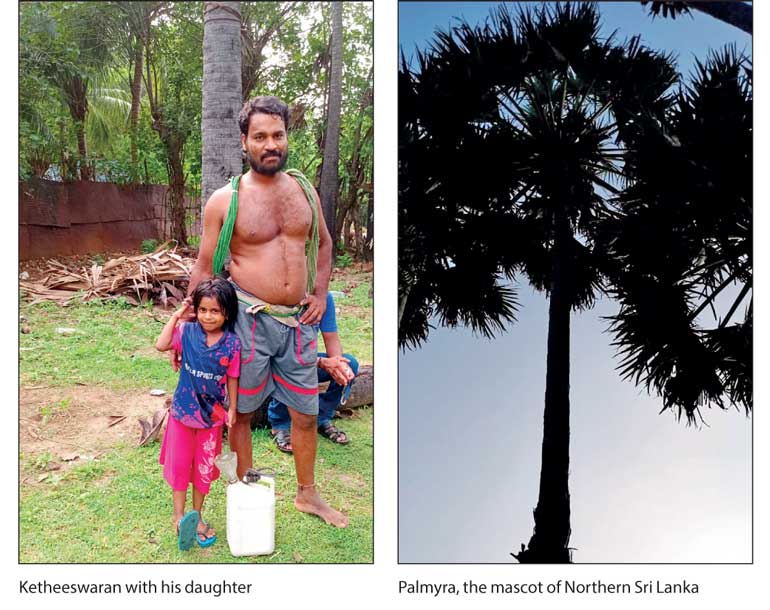
Proceeding stoically in its journey heavenward as far as nature would allow it, varying in height from 30 to 40 or as far as 60 metres, the Palmyra tree (Borassus flabellifer) could be called the mascot of Northern Sri Lanka.
When you proceed by road from anywhere else in the island, the first signal that you are nearing the most resilient of regions of Sri Lanka is the glimpse of this tree. With its fan-shaped leaves, clusters of purple-black fruit, and scaly trunk showcasing its diamond-shaped patterns marking the legacy of older leaves, this tree, just like the people of Northern Lanka, has withstood over 30 years of bloodshed. Testimony to this fact would be the many headless trees with their charred trunks, reminding the world of the misery of war.
This tree integrates its enduring nature with a multifunctionality that makes the Palmyra an economic enigma. It is said that there are nearly 1,000 uses from this tree including furniture, mats, arts and crafts, food and drink in the form of toddy, desserts/tonic from the jelly-like interior of the fruit kernel, flour made out of the root which also doubles up as an instant energy-boosting snack whether boiled or consumed in its dried form.
In understanding all these, let us now focus on the humans who ascend these trees in order to give us the drink and the fruit and who have been linked to this plant species for generations.
An 87-year-old Jaffna dweller explained as follows:
“In my time, each house which had Palmyra growing on their land had assigned different families who by heritage were associated with this tree. They were the climbers and toddy tappers who were linked to the tree in multifarious ways so that they were the chief coordinators of the economy linked to the Palmyra. There would not be any money exchanged. Our family had Palmyra trees in the immediate vicinity of our house and in several other lands we owned. All of these were assigned to different families whose livelihood was linked to these trees. They would climb the tree and extract the fruit or convert the sap to toddy or a kind of fruit-based drink, and they would give us these as much as we wanted. The rest they would trade in the village. Out of these trees they managed their entire household needs,” he recalled.
Today times have changed. While fifty years ago there used to be many Palmyra tree climbers and families whose different members would have perfected diverse skills connected to this tree, today this is not so.
In the area of Vadukoddai in the village of Mudalikovil, Ketheeswaran is one of the few Palmyra climbers around. This is a village where hundreds of Palmyra trees live amidst many kovils. The name of the village Mudalikovil insinuates that once this village had one or many kovils connected to a Mudaliyar family.
Although this village once had 30 toddy tappers the numbers are fast reducing. Despite many others who were connected to these trees through generations taking to other jobs, Ketheeswaran remains dedicated to the Palmyra. He has a land of 40 perches which he carefully nurtures. His income comes from toddy tapping, from the pulp as well as from nurturing young roots for sale. Several times a month there are also different tour guides who contact him to bring groups of foreign tourists to his land. Once they arrive he speaks to them about the tree and then sprints up to bring down some exotic-tasting toddy.
This is what he had to say:
“On this land there are 40 perches. I appreciate my freedom and these trees have been connected to the core of my consciousness ever since I was a child. Although there would be better money doing something else I would be sacrificing these trees.
I learnt all there is to know about the Palmyra from my father and he learnt from his father before him. In his father’s time there were many families and communities who thrived and depended economically upon this tree. For those of my father’s and grandfather’s generation this tree was not so much a commercial entity as a spiritual one. How do I say it? Maybe I can say this tree was connected to their innermost heart, their soul. To them this tree was not a commercial enterprise alone. It reflected life. The life force that they had was connected with the life force of the tree and they respected this bond. The first thing I see when I come out of my house are these trees,” he explains. “The taste of the toddy differs with the time of day it is tapped,” he adds.
As he speaks his five-year-old daughter Vishnuja tugs at his arm. She cradles a Palmyra fruit in her arms like a doll. And soon she runs off to play with it.
In this modern world where children are attached to phones and expensive toys, it is breath-taking to see the innocence with which a child is still linked to the earth and its offspring. Far off, we can see her speak to the Palmyra fruit the way city children speak to a doll.
How does the tourism industry in Jaffna impact someone such as Ketheeswaran?
“There are sometimes busloads of tourists who come to this land. If there are a large number of tourists then I earn something like 10,000. It also depends on the tour guide who may keep something for himself. If there is an individual tourist then usually I get about Rs. 1,000 or 1,500.”
This narration makes us think about how those such as Ketheeswaran are vital to the Palmyra industry as a whole. It makes us question the following:




