Tuesday Sep 15, 2026
Tuesday Sep 15, 2026
Saturday, 21 February 2026 00:17 - - {{hitsCtrl.values.hits}}
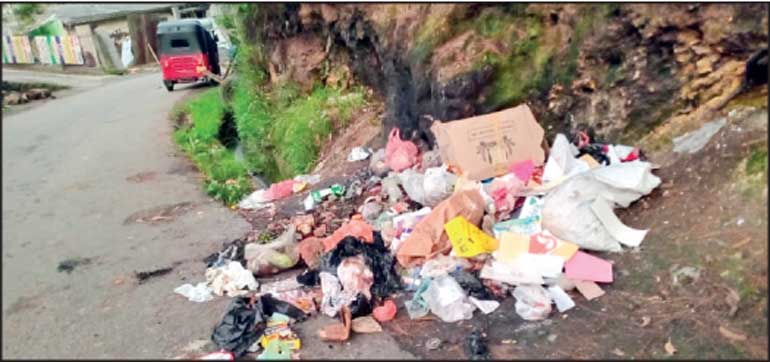
From our pic file - in October 2024 when we wrote about the garbage menace in Nuwara Eliya
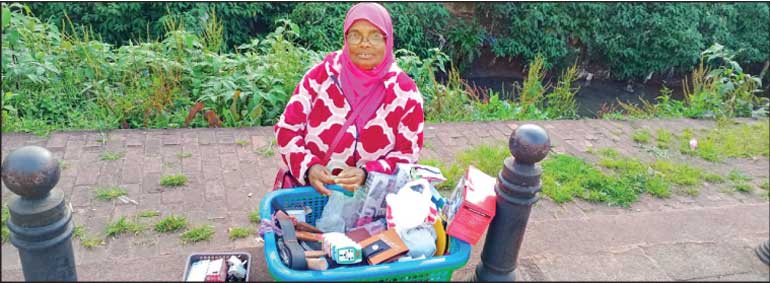
Kadija Umma
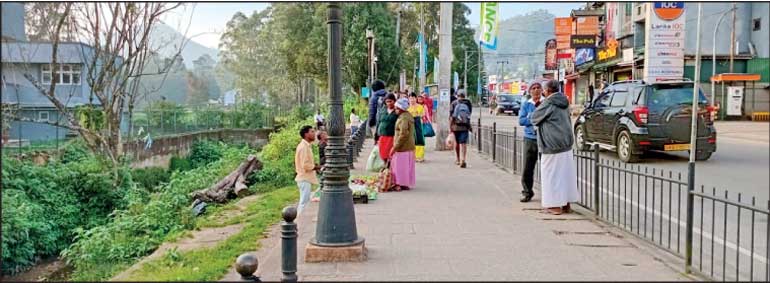
Nuwara Eliya street vendors
Kadija Umma seemed to be between 60 and 70 years of age. When I met her this month there was such a flurry of activity around her that although I asked her age, all I got in response was a disjointed rant.
“Giyada, Giyada?” she asks me. The same question is asked by several others selling various things on the pavement in Nuwara Eliya. “Giyada, Giyada,” a young man asks another as they haul up baskets of electrical material, socks and woolly jackets concealed out of sight on a slope below. We are in the central town precincts in the mountain terrain of Nuwara Eliya. Kadija and her friends, as described above, are human beings who sell various things on the roadside. This is where ordinary people, who cannot afford large sales outlets, buy things. It is possible that some persons who make up the Government within this current regime – who represent ordinary life as lived in a country where earning enough to afford a meal a day is a task in itself – may have resorted to saving a few rupees by buying some essential household goods from Sri Lanka’s pavements/sidewalks. Everything is available here: chic attire, bedsheets, electronics, fancy gadgets, small piles of assorted vegetables costing as little as Rs. 100 – your solution for about three days’ meals if used sparingly. Very sparingly. As these roadside sellers do – selling just about everything and anything – to be able to stay alive.
The last time I spent considerable time on main road sidewalks was in the last week of September 2024 when Sri Lanka created political history by electing en masse a political party known for representing the ‘Nirdhana Panthiya’ (working class).
Between 25 and 30 September 2024 I was gathering the roadside sentiments of Kandy by recording the comments of street vendors in the district. I was also lugging a humongous knapsack, shopping for things I needed to set up base in a remote mountain in Nuwara Eliya. Possibly like many members of the JVP, the political party elected to power, I too could not be bothered squandering money in fancy malls when something could be bought for a fraction of the cost from a fellow Sri Lankan who was on the road selling goods and thus showcasing the lack of opportunity for small-time trading and traders in this country. I recall how the streets of Kandy echoed with overjoyed pavement hawkers announcing 50% reductions on their products with slogans like – “Api Adu Kala – Rata Anurata” (We have reduced prices, Country for Anura).
On 9 February 2026 the scene differed drastically and was in Nuwara Eliya which, although lacking the robust sales activity of the pavements in Kandy, was nevertheless replete with men and women hoping desperately for a sale. The difference between a sale and no sale would be a meal for the family – or not. This scenario also, possibly, some of those who are now in positions of high political power may have undergone in life.
In Kadija Umma’s case, a sale would mean medicine for a sick family member at home.
“Ledek gedera. Giyada? Aney miss, balanna, torch, plug point, speakers, okkoma thiyanawa. Gannako.”
I peer closer. I glance at a very functional-looking large-sized torch. I recall I need a torch. The last time I checked, one of this type was Rs. 8,000. Kadija announces that this is Rs. 2,000. Having bought it, I smile back at the smile that has bloomed on her face and attempt to engage her in a discussion, hoping she would be more coherent.
“Kadawada giye?” I ask her (Who went?). “Nagara Sabhawe vahanaya. Heta Janadipathi enawa. Apiwa elawanawa. Ath iwarai. Me badu undawa pahalata edala.”
This could be translated as: The Municipal Council officers in their vehicle. They are chasing us. The President is coming to Nuwara Eliya tomorrow. Our hands are aching from shifting these things up and down.
Then comes a younger man – he sells bed covers suited to a cold climate.
“Meka Clean Sri Lankalu. Api rata kiliti karanawalu. Colombo 7e gihilla balanna miss clean da kiyala. Api rata kiliti karanna newei pavement ekata awe. Me rate apita wena karanna deyak nethi handa.”
(This is Clean Sri Lanka. They say we litter the country. Go and see in Colombo 7 if it is clean. We did not come here to dirty the country. We came here to sell whatever we can because this country has not given us any other opportunity.)
It is pertinent to mention here that the Nuwara Eliya ‘Season’ annual festivities commence in April. It remains to be seen whether these traders will be given an opportunity to sell their products or whether the preferred choice will be big businesses from Colombo which can pay very high rates.
Meanwhile, the questions that any rational-thinking person may ask, taking into account the above reality as narrated, may include some of the following, which we leave the reader with until we continue this discourse from various standpoints in the weeks to come:
nWhere should a country cleaning up 78 years of myopic littering start, if the intention is to rid the nation of garbage?
nWhat should the role of the municipalities be?
nWhat should the educational system be like for a nation seeking to nurture ‘cleanliness’?
nWhat could we learn from countries like Japan, and how?
nHow can we link poverty eradication to the Clean Sri Lanka initiative?
nWho should authentically represent the Clean Sri Lanka endeavour so it does not resemble a pathetic joke but a long-term, vision-based objective run by people who have dared to walk on the pavements of this country and are aware of where the real garbage lies?
- (SV)




