Tuesday Sep 15, 2026
Tuesday Sep 15, 2026
Saturday, 6 June 2026 01:11 - - {{hitsCtrl.values.hits}}
By Surya Vishwa
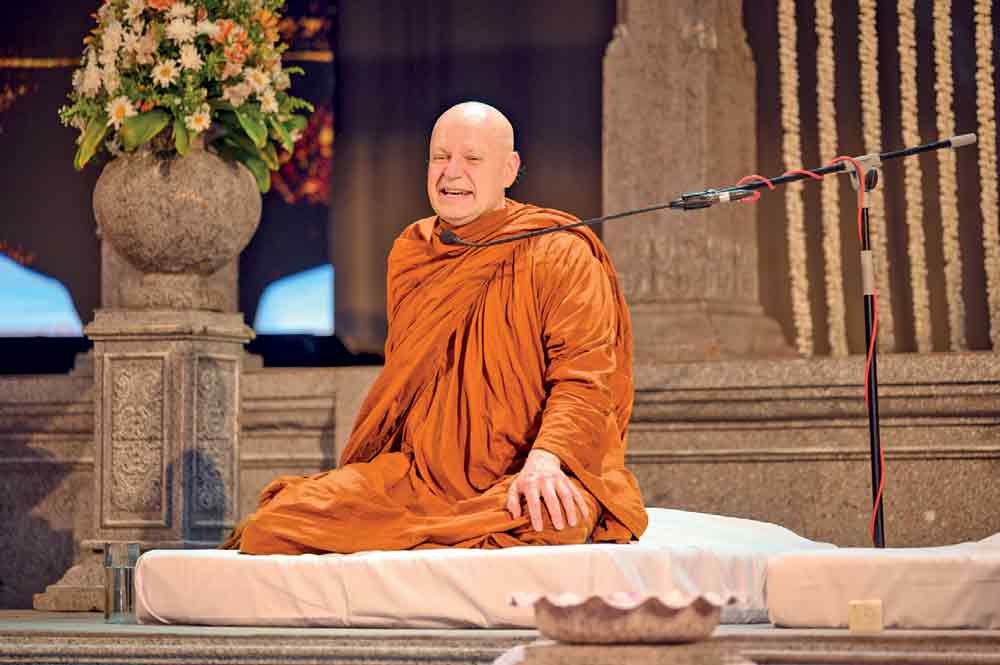
As we get ready to commemorate 7 years since introducing the Harmony page, an alternative media initiative started in 2019 for the purpose of using mass communication for integrating diverse disciplines of knowledge, and creating insight for a conscious and peaceful world, we present today an interview with the renowned Australia based Theravada tradition teacher of Buddhism, Ajahn Brahmali Thero.
Born in Norway in 1964, to a wealthy business family who had lived in several countries including England, Ajahn Brahmali Thero’s approach to life in his youth was rather cosmopolitan.
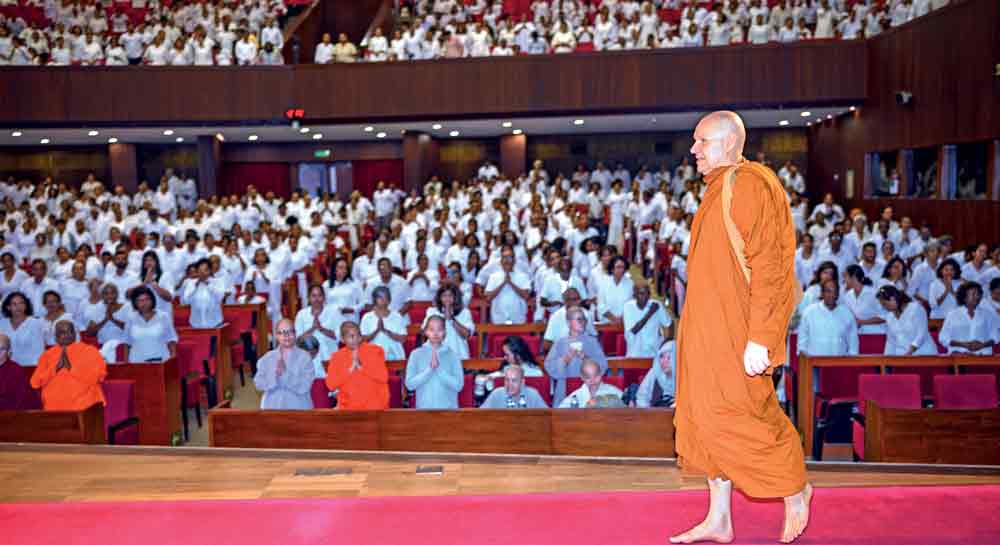
“My upbringing was more or less secular although being culturally Christian. We attended mass maybe only for Christmas,” he shared in an interview with this writer. Brahmali Thero was in Sri Lanka in April and May this year on a Dhamma sharing visit facilitated by the Ajahn Brahm Society of Sri Lanka. With academic degrees in Engineering and Finance (the choice of finance was more of a rote decision based on his family’s link to the business world), he developed an interest in Buddhism and Buddhist meditation in his early 20s after coming across a book on Buddhism in Japan. The book was from the Mahayana Buddhist tradition and ‘rather flowery’ in language for his analytical mind, as he recollects. Yet it served to lead him on a path of no return; the path of wisdom as taught by the Gautama Buddha.
We present this interview in line with the goal of the Harmony page; to blur the lines of division and create space for mental expansion. Although we did not delve deep into the subject of comparative spirituality with Brahmali Thero we asked him some interconnected questions and if the life of Christ had influenced him in any way and his response was that he could not comment as neither himself, nor his family was immersed in the Christian faith. The purpose of this writer asking Brahmali Thero this question was the result of pondering upon his shift from a path that asked for a human to turn the other cheek if slapped and to love your enemy (taught by Jesus) to an even more arduous path. Here one is told (as stated in the Kakacupama Sutta) that if bandits were to carve a follower of the Buddha to pieces with a saw and being so butchered harbours hate for the person slicing him that he would not be following the Buddha’s teaching.
“I am afraid I won’t be able to tell you anything about Christianity,” Brahmali Thero declares with a smile but the parameters of the interview are set. This would be an interview carried out in our present world context where ‘religions’ exist with very little practical benefit for living and dying in peace, or keeping behind a harmonious world of equality and generosity, true to what the originators of all faith traditions teach. Hence our objective is not to create another divide but to allow for wisdom and insight.
Below are excerpts of the interview.
Q: Brahmali Thero, what was your first introduction to the Buddhist path and how did you get to the point of being ordained by Ajahn Brahm Thero and to teaching Pali and meditation at the Bodhinayana Monastery in Perth, Australia?
A: As a university student, while in Japan on a visit I found a book on Buddhism on the bedside table of the premises I was residing in. It was a Mayahana Buddhism oriented book with rather flowery descriptions. But it directed my life. I returned to England where I was based at the time and contacted the Buddhist Society. Thereafter I enrolled for monastic training to become an Anagarika at the Amaravati and Chithurst Buddhist Monasteries in England. Having received information from British-born Buddhist Monk, Ajahn Brahm Thero who was teaching Buddhism in Australia, I contacted him by phone. I blurted out that I want to come to Australia to his monastery. He answered by exclaiming ‘But who are you?!’ I introduced myself and requested him to ordain me. That’s how I ended up in Bodhinyana Monastery in Perth and as a monk as I am now.
Q: You had so many options in life, being born to a wealthy family…
A: Yes, but I chose the best one. I certainly did not become a Buddhist monk because I was poor. My family had property and a lifestyle that one could call luxurious. But I chose the unlimited luxury of seeking freedom from samsara.
Q:In your talk at the BMICH on 1 May you spoke about death as an ever present companion of life and advised Sri Lankans to think everyday that they are in their death seat.
A: Yes.
Q: Do you think relatives could really help the departed if they have lived unwisely and now are abandoned in the vast cosmos, fettered by their past, and existing without their bodies, in a state of craving and languishing?
A: Relatives offering merit can help somewhat. However, the main chance of detached wisdom that could be accrued while still living is no longer available. This shows how valuable life is and how important it is to live as the Buddha advised.
Q:Phenomena that we refer to as paranormal indicate in many instances signs of those who have departed still hovering in places they had deep attachment to. In this context how much of awareness would be needed for people to realise the magnanimity of the dangers of mindless living?
A: We have the Buddha Dharma because we had one human thinking deeply of death and the consequences thereafter. If they listen to the Buddha and live in awareness of death everyday, eliminate ego and practice unlimited kindness and keep to the eightfold path they will have nothing to worry.
Q:Do you believe that there are life forms on other planets in the cosmos?
A: The Buddha has mentioned similar ideas. Whatever the Buddha found and taught I consider to be correct. The Buddha spoke of the universe and solar systems. In the Pali Canon, the Buddha refers to world systems (Lokadathu) interpreted as cosmic systems.
Q: What is the interest the Western world shows in comprehending death and what happens subsequently?
A: There is rising interest in the West to grasp the saga of death and the experiences thereafter. There are many books published on near death experiences which gives glimpses of what we can expect. These books are very popular in the Western world.
Q: Do you believe that all spiritual traditions have spoken of the most desired state of supreme liberation in different words and cultural contexts?
A: I cannot speak for other religious traditions but only the one I follow but on reflection, yes, a mindful, awareness based life could be achieved with positive consequences through whatever the ‘religion’ you follow. But as I said I am a teacher of Buddhism and the Buddhist path, so I can only verify the truths it teaches.
Q: You follow the Theravada Buddhist tradition – what are your views on Mahayana Buddhism?
A: I believe it is possible to achieve the final objective of liberation from the cycle of life, death and suffering through either Theravada or Mahayana traditions if one keeps focused on the original teachings of the Gautama Buddha.
Q:What form of Christianity is the main religion of Norway?
A: Lutheran Christianity. But no one is really religious.
Q:Many countries in the world which claim to be ‘religious’ are steeped in conflicts, wars or gross inequality while countries such as Norway which are not religious are known to be amongst the most peaceful nations in the world with equal living standards. What do you think is the reason?
A: Where Norway is concerned - it is a country where there is an egalitarian social order with emphasis on respect and equal opportunity.
Q: Buddhism is often misunderstood in the West as being pre-occupied by pessimism and suffering. How do you explain Buddhism to the Western world?
A:Buddhism in exactly how the Buddha taught will explain itself to anyone who follows this path. Buddhism is a route to understand reality. It is a path where there is no fear of God but a clear understanding of how one’s mind can lead to or prevent suffering. A mind led by delusion, unlimited desire and selfishness creates suffering in this life and continues this cycle when the body has expired. Buddhism is not about suffering or pessimism. It is about the end of suffering and thereby optimism.
Q: Do you think that if nations across the world had education systems at school level that teach the commonalities of different religions rather than differences that the world would be a better place?
A: Well, the world does not seem very interested in this kind of thing!




