Tuesday Sep 15, 2026
Tuesday Sep 15, 2026
Saturday, 28 March 2026 00:10 - - {{hitsCtrl.values.hits}}
 |
| Fathma Sabrina Jalaldeen |
By Surya Vishwa
“If a person suffers heartbreak, faces a divorce, and thereafter bears the responsibility of feeding, clothing, and educating three children, and does not have anything that could be defined as ‘capital’ to start a business with, what can they do?”
The story below will give the answers and the encouragement to take action when everything seems to be falling apart. This narration is also meant for policymakers to understand the impact of national policy on human beings in a country where poverty is not a luxury.
Fathma Sabrina Jalaldeen is such a person who single-handedly educated her three children, who are now young adults and burgeoning entrepreneurs themselves.
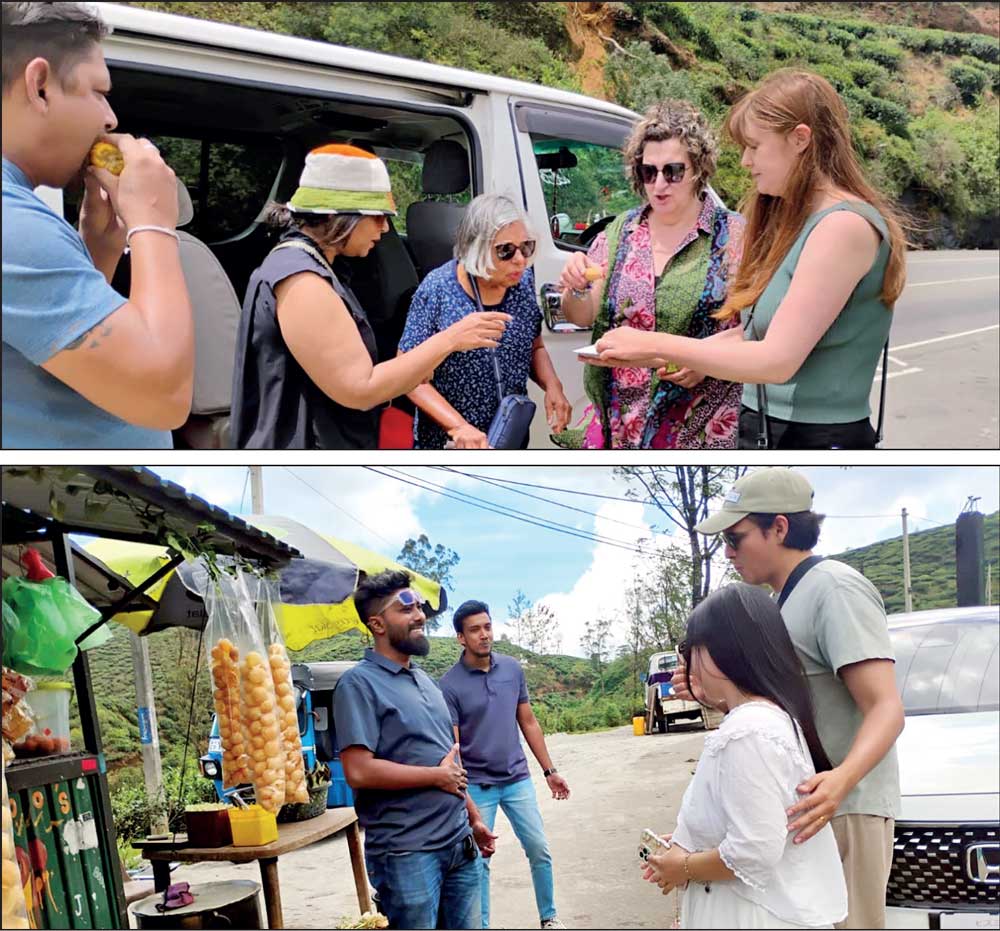
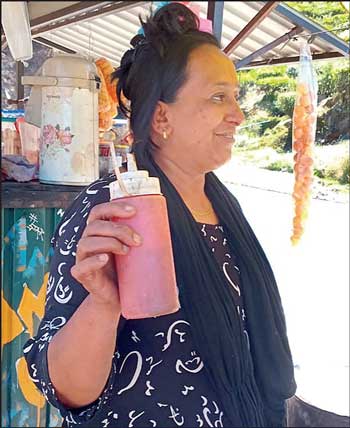
Today, she owns one of the prettiest roadside food carts, which she got constructed and decorated with paintings that her children created. It is perched in an alcove along the roadway surrounded by tea plantations in the vicinity of Kelegala in Nuwara Eliya. Examining this beyond the sidewalk area where she has set up her business, there is no rational argument whatsoever that it blocks the roadway or hinders traffic or passengers. There is also daily proof, witnessed by the municipal cleaners, of Fathima Sabrina spending over an hour gathering roadside rubbish strewn overnight every day—cardboard cups, plastic wrappers, beer cans, plastic bottles, etc.—segregating them and burning what can be burnt. The brooms and brushes she uses are visible for all to see, along with the mounds of ash from recent trash bonfires.
Whenever higher municipal authorities arrive in their vehicles to demand that she dismantle her business on account of a policy decision taken by the current regime, it is the municipal cleaners who come to her rescue to state the fact that she is not a threat to the cleanliness of the country, but rather the exact opposite. They have explained that due to Fathima’s roadside business presence, their work to clean Sri Lanka is made easier and more effective.
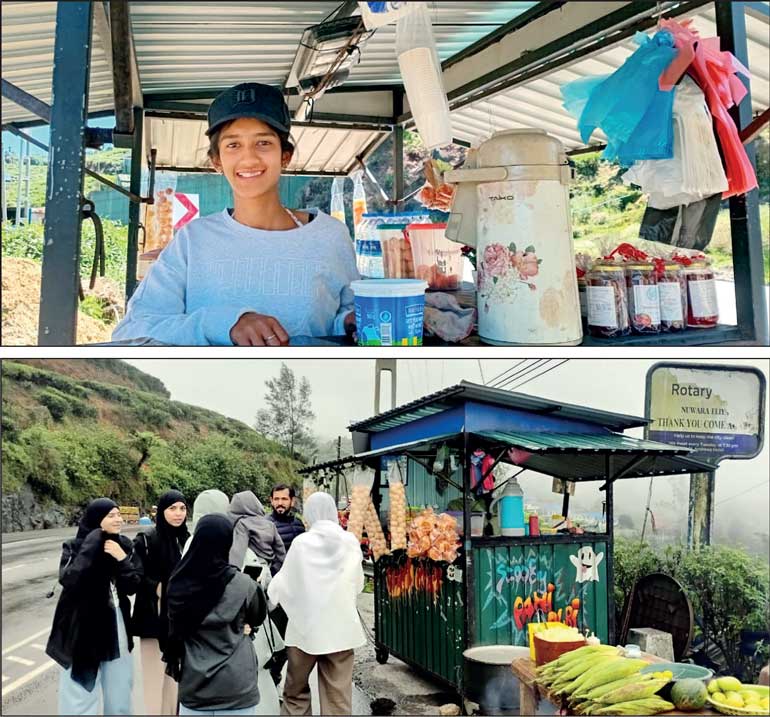
“See, this is what I cleared up this morning. See those ashes. That is all the rubbish that could be burnt. The bottles and cans I separated and kept to be given to the municipal garbage collection,” she explains. Apart from cleaning Sri Lanka, she and her teenage daughter act as strict vigilantes, carefully monitoring the area for mindless Sri Lankans who do not care about turning their nation into a waste bin.
“We have to clean our minds before anything else. I shout and ask them to pick up whatever they have thrown. We never see this behaviour from any foreign tourists. They sometimes ask us where they can throw a biscuit pack they have carried with them for miles,” she states stoically.
Remembering the bags of rubbish we had passed on a different route in Nuwara Eliya as we headed here, it is soothing to the eye to feast on this enduring little family’s roadside clean spot where their delightful food cart is set up.
On all sides hang the panipuri, which are served to customers with her signature sauce, the secret recipe of which will go with her to the grave and, until then, tantalise the palate of locals and tourists alike.
The path less travelled
Seven years ago, facing the desolation of penury, three children to bring up, and a marriage which had ended, she braved the temptation of self-pity and took the path less travelled, especially for a woman from a conservative Islamic culture. She did not ask any male relative or religious superior for permission; she did what felt right.
Fathima first began by teaching herself how to make a panipuri sauce that would be like no other. She spent hours researching ingredient options, watching YouTube cooking sessions, and trying out endless variations, much to the delight of her two children. Even before she started finalising her business plan, they were dreaming up a version of their mother as a proud businesswoman, owning her own vehicle, a snazzy food cart like one sees in street food havens in nations like Thailand, and themselves as mascots of a family entrepreneurship that would make them famous in school and beyond.
Half a decade later, much of what they conjured up seems on its way to being achieved.
The vehicle is a daily polished three-wheeler in which she transports the food. She now not only sells her own wares but also assists two other families by selling their home-produced fresh strawberry and fruit jam.
“Every single cent I spent on my children, myself, and the house was earned from this street food business. See, that is my three-wheeler. I taught myself to drive after I got it, and I use it for business and for any family errand. When there is a family function, we proudly travel in it. It is ours. The lease that I have to pay for it has dwindled rapidly over the past three years, and soon I will own it fully,” she reveals.
She points out that she started out only with three stones to create a roadside fireplace and a pot. Before she perfected the panipuri, she still came out to the high road—the only place for grassroots entrepreneurs—and began by boiling and grilling corn. She served these with different types of spicy mixtures. That was the very beginning.
Gastronomical bliss
She still boils corn, and it is often bought by visitors along with the different varieties of panipuri she offers, including the chocolate version.
There is a small table and a few chairs, which were bought about eight months after she initially started. This spot soon began attracting tourists and locals alike and is now a much sought-after street food hub.
The gastronomical bliss of eating panipuri and spicy corn overlooking the greenery of the tea estates, squinting at the buses on the main road, admiring or buying the velvety handmade flowers Fathima’s daughter Azu has started crafting, and feeling an overall sense of equanimity would be among the nicest memories many visitors cherish from their travels in the Central Province. This place is a firm favourite among many foreigners, who often visit repeatedly during their stay in Nuwara Eliya.
“My daughter has started her own brand—Azu Flowers—and she creates new items every day. They get sold daily to tourists as mementos. My sons handle the YouTube and TikTok promotions, and they are always around for any emergency,” Fathima Sabrina continues. Azu proudly shows me how their business is appreciated on social media.
“Nice, noh aunty?” Azu grins. I grin back and glance at those alluring panipuri. The last time I gulped them, I metamorphosed into a human panipuri gunny bag. This time, I abstained.
“Did the mosque help in your business journey?” I asked Fathima.
“Well, I did not expect anyone to help me. I regularly contribute to the upkeep of the area mosque from my earnings, the most recent being assisting in the purchase of a rack to place the Holy Quran,” she recounts.
I then ask her to address the present political leadership as she would in person and tell me what she would say to them.
“I would say this—we do not want you to help us entrepreneurs in major ways such as facilitating loans. Well, this is what we would ideally dream of, but we all know that this is not the reality in this country for those who have nothing and need support to start a business without possessing any capital. So let that be. At least just allow us the basic provision of using public space when you can assess sensibly that it is in no way a disturbance to transport or passengers. If you do not allow us even this, how can we expect to eradicate poverty? Podi miniha kohomada oluwa ussanne?” (How can humble citizens raise themselves up economically?)
“Have politicians ever come here?” I asked her.
“Famous actors, actresses, and other personalities have eaten here, taken photos and videos, and posted them online. One regional politician from Batticaloa visited and returned with his whole family when he brought them on vacation to Nuwara Eliya.”
“Would Fathima be willing to host the current Sri Lankan President and the Prime Minister if they visit?” I asked her.
“If they are alright eating street food, yes. If they come here, they could personally understand the pulse of ordinary people and gain a realistic understanding of what Sri Lanka should be cleaned of.”
NOTE: As part of the objective to represent the grassroots as authentically as possible, almost all coverage on this page for the past eight years has been carried out using public transport, walking, or three-wheelers, with the rare exception of travel by car.