Saturday Oct 17, 2026
Saturday Oct 17, 2026
Saturday, 11 April 2026 04:08 - - {{hitsCtrl.values.hits}}
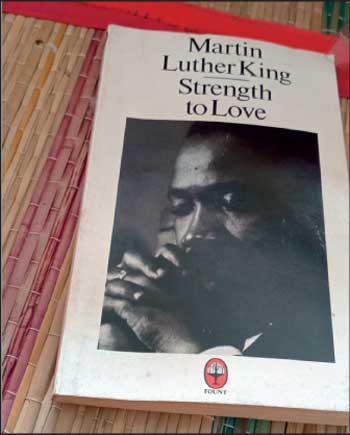 The book, ‘Strength to Love,’ was first printed in Great Britain by Hodder and Stoughton in 1964, first issued in Fontana Books in 1969, and reprinted in Fount Paperbacks in March 1977. The thirteenth impression appeared in October 1980. Copyright 1963 by Martin Luther King Jr. The book was printed in Great Britain by William Collins Sons & Co. Ltd., Glasgow.
A leading figure of the American Civil Rights Movement and a pastor of the Baptist Church, Dr. Martin Luther King was assassinated on 4 April 1968 in Memphis, Tennessee.
Today, we turn to the first two chapters from a collection of his sermons published under the title ‘Strength to Love.’
Martin Luther King’s interpretation of what it means to emulate the ‘Messiah’ has the potential to transform hearts into peaceful action, just as these writings once influenced public opinion and helped end racial segregation. Although today in America it is common to see black-skinned and white-skinned individuals seated together on a bus, this seemingly ordinary reality came after immense struggle. Martin Luther King ultimately paid with his life for championing equality.
The preface to ‘Strength to Love’ states: “All of these sermons were preached during or after the bus protest in Montgomery, Alabama, and I have drawn a number of illustrations from that particular movement, some of which were included in my book ‘Stride Toward Freedom.’” He further notes that three of the sermons – “Love in Action,” “Loving your enemies,” and “Shattered dreams” – were written while he was in Georgia jails.
Chapter 1, titled ‘Tough Mind and Tender Heart,’ highlights the spiritual balance of love, in contrast to the hard-heartedness of the world, where ‘man gives dollars to worthwhile charity but gives not his spirit and humans are impersonal cogs in a mechanical wheel.’
“When our most tireless efforts fail to stop the surging sweep of oppression, we need to know that in this universe is a God whose matchless strength is a fit contrast to the sordid weakness of man,” Martin Luther King reminds us.
Chapter 2, titled ‘Transformed Non-Conformist,’ draws on the spiritual life of the Apostle Paul, who counselled Christians to “be not conformed to this world; but be ye transformed by renewing your mind.” On reflection, the chapter suggests that every damnation humans inflict upon each other—turning the world into a living hell—begins in the mind that unthinkingly conforms to the ‘normalcy’ of such acts. It reiterates the teaching of Jesus: “Love your enemies, bless them that curse you, do good to them that hate you, and pray for them which despitefully use you, and persecute you.” This underscores how radically non-conformist Christ was; even when crucified, he pleaded for the redemption of his tormentors, declaring, ‘Father forgive them for they know not what they do.’ Martin Luther King also recalls John Bunyan, known for the Christian allegory ‘The Pilgrims Progress,’ and his response from prison after spending 12 years there. When promised freedom if he would stop preaching, Bunyan retorted:
“But if nothing will do, unless I make of my conscience a continual butchery and slaughter-shop, unless, putting out my own eyes, I commit me to the blind to lead me, as I doubt is desired by some, I have determined, the Almighty God being my help and shield, yet to suffer, if frail life might continue so long, even till the moon shall grow on mine eyebrows, rather than thus violate my faith and principles.”
This invites reflection: in the face of what the world confronts today, if every intellectual, diplomat, media person, academic, and politician broke free from the chains of conformity and committed to the principles of peace, would there not be a change—one in which humanity lives and dies in dignity, sharing the length and breadth of the planet in neighbourly love?
We will continue to explore this book further, but for this week we may ask ourselves why such a vision seems so impossible, and why the opposite is made so easily possible.
NOTE: The above book is drawn from the collection of Surya Vishwa, housed at the Residential Library of Healing in Nuwara Eliya, which is committed to spreading peace and introspection. This library serves as the academic reference hub of the Harmony Page.




