Friday Oct 09, 2026
Friday Oct 09, 2026
Monday, 15 June 2026 03:37 - - {{hitsCtrl.values.hits}}
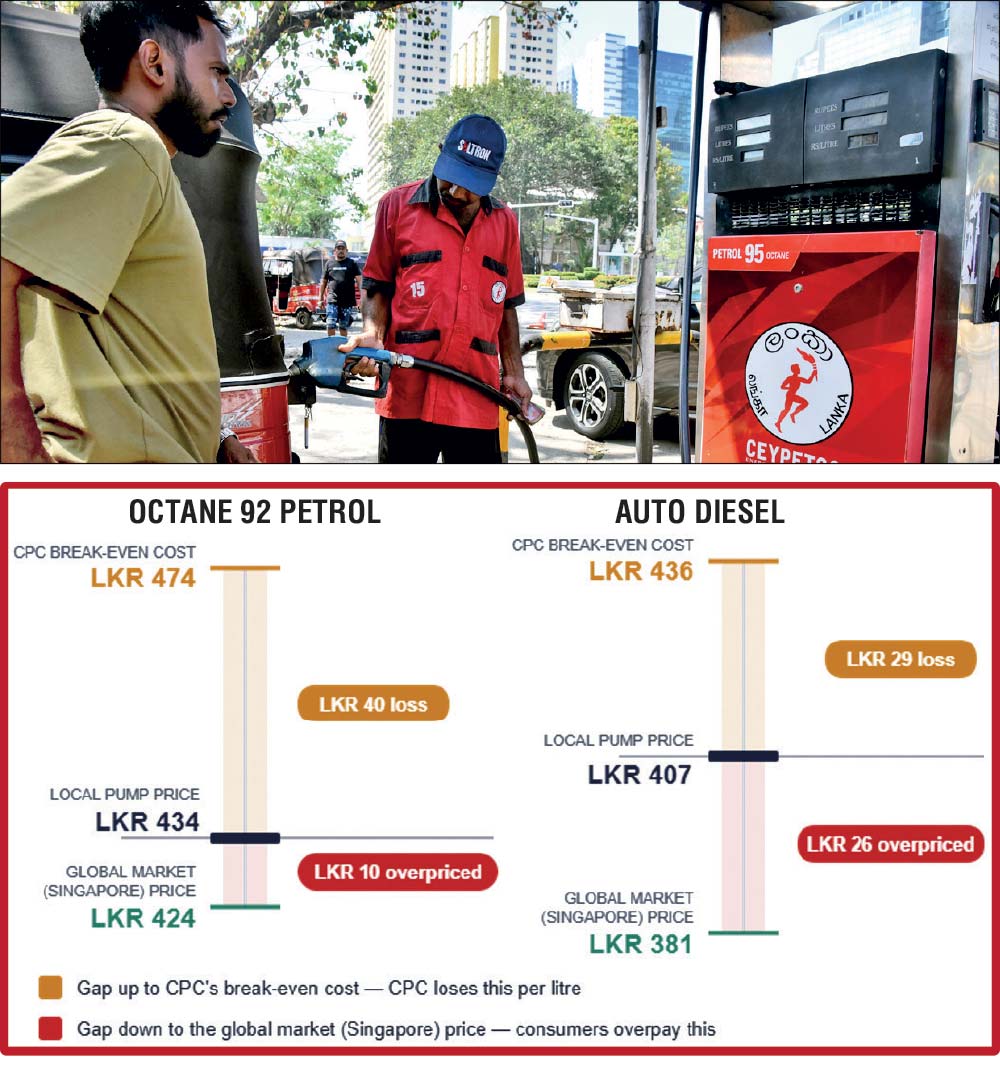
 If CPC is making losses, it is because they paid unduly and unjustifiably higher than average global market prices. But now, covering the costs of those higher purchasing prices, as published, would require charging Rs. 474 per litre of petrol and Rs. 436 per litre of diesel. So CPC loses Rs. 40 on every litre of petrol and Rs. 29 on every litre of diesel — even while charging consumers more than the world market prices warrant
IOC, Sinopec and other private entities that sell fuel in Sri Lanka alongside CPC will not sell at a loss; but they don’t need to either. They can sell at the same price as CPC, because they, unlike CPC, are not putting their money in the hands of profiteers in the middle
The question that needs answering is not why Sri Lanka’s fuel is so cheap. It is why the state institution that supplies fuel in Sri Lanka pays more to purchase it than other comparable suppliers, in Sri Lanka and in the rest of the world
 Sri Lankans are paying too much for fuel — and the state company selling it to them is losing money on every litre. Both things are true at once. That should not be possible. But the fact that it is happening says something concerning about how Sri Lanka’s Ceylon Petroleum Corporation (CPC) buys its fuel.
Start with what fuel should cost. Apply the longstanding price formula to May’s global market prices, take off the Government’s tax refund (subsidy) of Rs. 20 per litre on petrol and Rs. 100 per litre on diesel, and the June 2026 price comes out at Rs. 424 for a litre of Octane 92 petrol and Rs. 381 for a litre of auto diesel.
CPC is charging Rs. 434 and Rs. 407 instead — rounding off, that is an extra Rs. 10 on every litre of petrol and an extra Rs. 26 on every litre of diesel. For a vehicle owner filling a 40-litre tank with diesel, that is over Rs. 1,000 more per top-up than what cost recovery pricing should require.
Measured against average world prices, then, diesel in Sri Lanka is overpriced. Petrol not so much – a 3% or so margin against global prices is not unduly high. Comparable international markets have lower prices. For instance, compared to neighbouring India (Mumbai) Sri Lanka’s petrol and diesel have been 14 and 24% more expensive in the last few months.
But the story does not end there.
CPC also published the average price it paid for petrol and diesel in May 2026 — and it paid well above the world market rate – 15% more for petrol and 13% more for diesel. That is a serious anomaly.
Explanations about conflict-related purchasing premiums beg more questions than they answer. This is because Sri Lanka is not in a unique crisis, unlike in 2022, to face purchasing premiums that comparable countries don’t. The price consequences of the West Asian conflict are already baked into the global market prices. If much higher prices have been paid, those transactions should be subject to scrutiny and investigation – someone is profiteering at the cost of the country.
The upshot is this: if CPC is making losses, it is because they paid unduly and unjustifiably higher than average global market prices. But now, covering the costs of those higher purchasing prices, as published, would require charging Rs. 474 per litre of petrol and Rs. 436 per litre of diesel. So CPC loses Rs. 40 on every litre of petrol and Rs. 29 on every litre of diesel — even while charging consumers more than the world market prices warrant.
So Sri Lanka’s fuel is overpriced against comparable international markets, and underpriced against what CPC claims to have paid for it. Consumers are over-burdened. CPC is making losses, someone is profiteering in the middle, and the economy is paying the price.
The section of public voices saying that fuel prices should be higher are only half right: at the prices CPC reports paying, fuel is sold at too low a price. But the problem is not the price at the pump — it is the price at the port.
IOC, Sinopec and other private entities that sell fuel in Sri Lanka alongside CPC will not sell at a loss; but they don’t need to either. They can sell at the same price as CPC, because they, unlike CPC, are not putting their money in the hands of profiteers in the middle.
The question that needs answering is not why Sri Lanka’s fuel is so cheap. It is why the State institution that supplies fuel in Sri Lanka pays more to purchase it than other comparable suppliers, in Sri Lanka and in the rest of
the world.
(Saliya Wickramasuriya is a Public Policy Fellow at Verité Research. He previously served as Chairman of the Board of Investment, the Sri Lanka Ports Authority, and the Ceylon Petroleum Corporation, and advised the Government on the power sector reforms that produced the Electricity Act of 2024. Dr. Nishan de Mel is the Founder, Executive Director and Head of Research of Verité Research — Sri Lanka’s largest independent think tank, spanning Economics, Law and Governance, Anti-Corruption, and Media and Politics. Anushan Kapilan is Lead Economist at Verité Research, where he leads the organisation›s public finance research)




