Thursday Jul 23, 2026
Thursday Jul 23, 2026
Thursday, 23 July 2026 00:29 - - {{hitsCtrl.values.hits}}
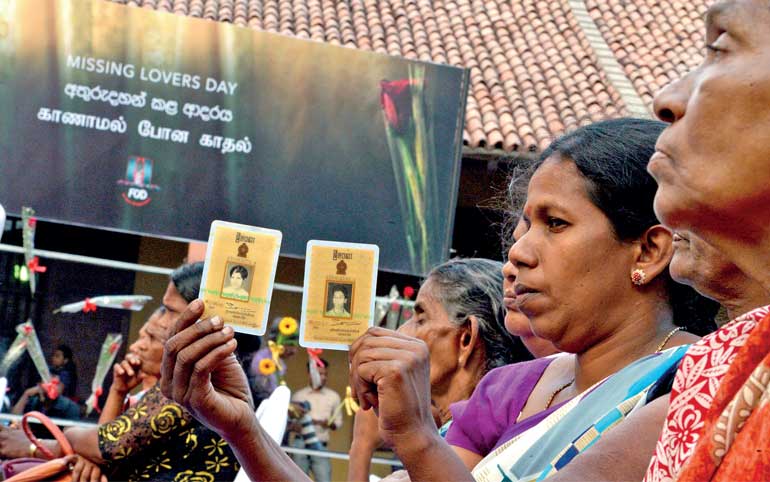
Families of the disappeared continue to demand credible investigations and information about the
fate of their relatives
 Twenty-third July is not merely a date on Sri Lanka’s calendar but rather a recurring D-Day of a moral test for all of us tortured islanders. The anti-Tamil pogrom of that year (1983), which is notoriously memorialised as ‘Black July’, was not the beginning of our once blessed isle’s ethnic conflict. Nor was it the sole cause of our so-called ‘civil war’ (which was anything but civil) that followed. Yet it was the day when many citizens lost their faith that the State could protect them all equally – and effectively at that.
Today, 43 years later, and some 17 after the guns fell silent in May 2009, Sri Lanka still commemorates the dead and the walking wounded; although we do better with the dead… while struggling to answer the challenge of the living: ‘What on earth has truly changed, and what remains unacceptably contentious in the state of the nation?’
Our track record on this vexed issue is mixed. Successive governments have acknowledged the need for reconciliation, devolution of power, and accountability in governance. Important agencies and institutions have been created. Some instrumental gains have been made. But the central transitional justice ‘deal’ – to wit: truth, accountability, reparations, and guarantees of non-recurrence – remains only partially fulfilled. It was ever thus, the truth be told.
Action flashback
First things first: What has been done?
The first major structural attempt to address minority grievances was the 13th Amendment to the Constitution (13A), introduced under the Indo–Lanka Accord, signed in Colombo on 29 July 1987. It created Provincial Councils and provided a framework in situ for devolution. In practice, however, powers over land, policing, and finance remained heavily constrained, and Tamil political parties have long argued that the implementation of 13A has been incomplete.
After the war ended, the Lessons Learnt and Reconciliation Commission (LLRC) was appointed in 2010. Its report recommended investigations into disappearances, demilitarisation, language reform, and measures to build trust between communities. Some recommendations were acted upon, particularly in relation to bilingual public administration and infrastructure development. But many accountability-related proposals were not fully implemented.
A more ambitious phase began in 2015, when the Sirisena-Wickremesinghe Government co-sponsored UN Human Rights Council Resolution 30/1. It committed Sri Lanka to a comprehensive transitional justice agenda and led to the establishment of several new bodies. These were the Office for National Unity and Reconciliation (ONUR) in 2015, the Office on Missing Persons (OMP) in 2016, the Office for Reparations in 2018, and ongoing consultation mechanisms through the Secretariat for Coordinating Reconciliation Mechanisms (SCRM).
These institutions represented the most concrete administrative architecture for transitional justice in Sri Lanka’s history. Thousands of complaints were received by the OMP, and reparations schemes were initiated for families of the missing and war-affected communities.
Orbital scan
Next on the agenda for today: What remains undone?
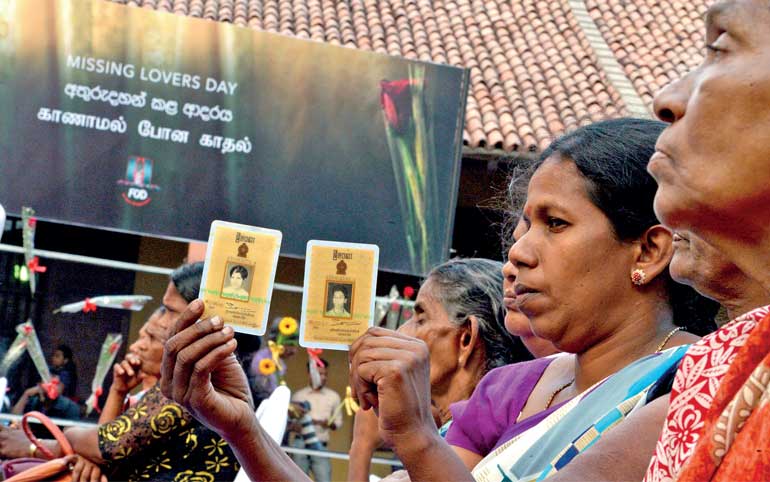
The most contentious issue is accountability for wartime abuses committed by both the Liberation Tigers of Tamil Eelam (LTTE) and Sri Lankan State actors. No special judicial mechanism with international participation was established, despite the 2015 commitments. Families of the disappeared continue to protest across the Northern and Eastern Provinces, demanding credible investigations and information about the fate of their relatives.
A host of other unresolved areas abide. These span the gamut from land disputes and military occupation of civilian land; demilitarisation of the North and East; constitutional reform and meaningful power-sharing; memorialisation, including the right of respective communities to commemorate their dead without intimidation; equal language access in terms of public services; and socio-economic disparities in war-affected regions.
Academic literature across ethnic perspectives broadly converges on one point: that infrastructure reconstruction alone is not tantamount to reconciliation. Sinhalese scholars often emphasise the need to recognise the suffering of all communities, including victims of LTTE violence. Their Tamil counterparts argue that reconciliation without truth and political autonomy risks becoming a technocratic exercise. Muslim interlocutors highlight the distinct experiences of displacement, their own expulsion from the North by the LTTE in 1990, and post-war insecurity.
Post-war vs. post-conflict
So what kind of society has emerged since 2009?
Sri Lanka today is neither a post-conflict success story nor a society on the brink of renewed war. It is better described as a post-war but not fully post-conflict society. We have failed to fully convert our swords into plough-shares and our spears into pruning-forks.
On the positive side, inter-ethnic mobility has increased, younger generations interact more freely in urban centres particularly, and overt separatist politics as such has diminished drastically. The economy, tourism, and education have created new spaces of contact, accommodation and at least some exchange of ideas.
Meanwhile, the national memory is fragmented. Diverse communities often inhabit different historical narratives, with limited shared understanding of what happened between 1983 and 2009.
The 2022 economic crisis briefly created a cross-ethnic civic movement during the Aragalaya. This suggested that class and governance grievances can unite citizens across communal lines. But that unique moment and irredeemable opportunity has not yet been transformed into a durable constitutional or social compact.
Be that as it may (and by the way, I’m asking for a friend): has the National People’s Power (NPP) Government done any better?
The NPP, now two years into its second term, came to power promising a break from the corruption, militarisation, and political patronage associated with previous administrations. Its rhetoric has emphasised equality before the law, clean Government, and a civic rather than ethnically majoritarian conception of citizenship.
Words vs. works
The question, however, is whether rhetoric has become policy.
To date, the Government has taken some tangible steps. There has been continued engagement with the OMP and reparations framework, the release of limited parcels of land, and a less confrontational approach to memorial events than under some previous administrations. Civil society groups have also noted a reduction in overtly triumphalist State messaging, especially at Independence Day celebrations and national functions.
But the deeper tests remain unmet. There has been no comprehensive truth-seeking process, no new accountability mechanism with broad credibility, and no major constitutional settlement addressing the distribution of power between the centre and the provinces. Tamil parties continue to argue that the government has prioritised economic stabilisation over political reconciliation, while Sinhala nationalist groups accuse it of making concessions that could threaten the unitary state.
In that sense, the NPP has improved the tone of engagement more than the substance of the settlement.
MIA
So why has progress been so slow?
For one, opposition has come from several directions.
Sinhala nationalist parties and organisations still resist devolution and international involvement. Sections of the military remain concerned about legal exposure. There is also Tamil scepticism born of repeated broken promises. Weak institutional capacity and political turnover have robbed the process of impetus. And the tendency of each new government has been to abandon or dilute initiatives of its predecessor.
Transitional justice requires sustained political capital over many years. Sri Lanka has instead experienced cycles of reform, backlash, and stagnation.
Be that as it may, there is the path as below that could still prevent repetition:
If Black July is to be remembered as more than an annual ritual of mourning, Sri Lanka needs a cross-community pact against recurrence. Such a pact should include:
None of these measures requires citizens to agree on every interpretation of the past. They require agreement on a simpler principle: no Sri Lankan should ever again fear the State, or their neighbours, because of ethnicity, language, or religion.
Black July began with organised violence enabled by political failure and public silence. Preventing another national rupture will require the opposite: institutions strong enough to restrain power, leaders courageous enough to tell uncomfortable truths, and citizens willing to defend one another’s rights even when they do not share one another’s identity.
The challenge before Sri Lanka is therefore not only to remember 1983, but to prove that remembrance can become reform. The island has already paid the price of learning this lesson too late. The hopeful possibility, which one will argue is still within reach even today, is that a new generation of Sri Lankans may yet insist on learning it in time.
(The writer is the Editor-at-large of LMD and is a senior journalist with a Post-graduate Diploma in Politics and Governance)



