Saturday Oct 10, 2026
Saturday Oct 10, 2026
Saturday, 10 October 2026 00:00 - - {{hitsCtrl.values.hits}}
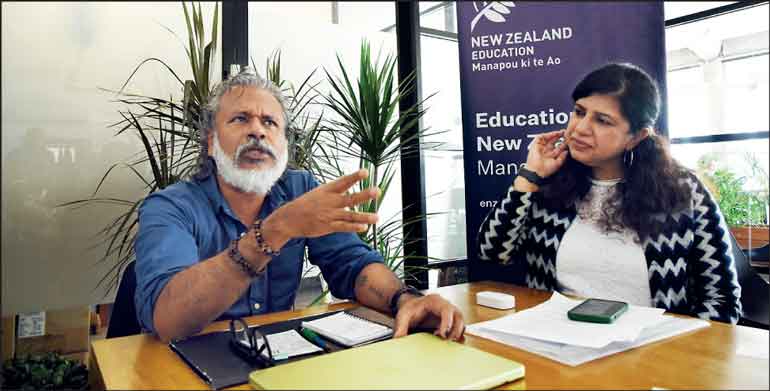
Booker Prize-winning author Shehan Karunatilaka gestures during the interaction with the media
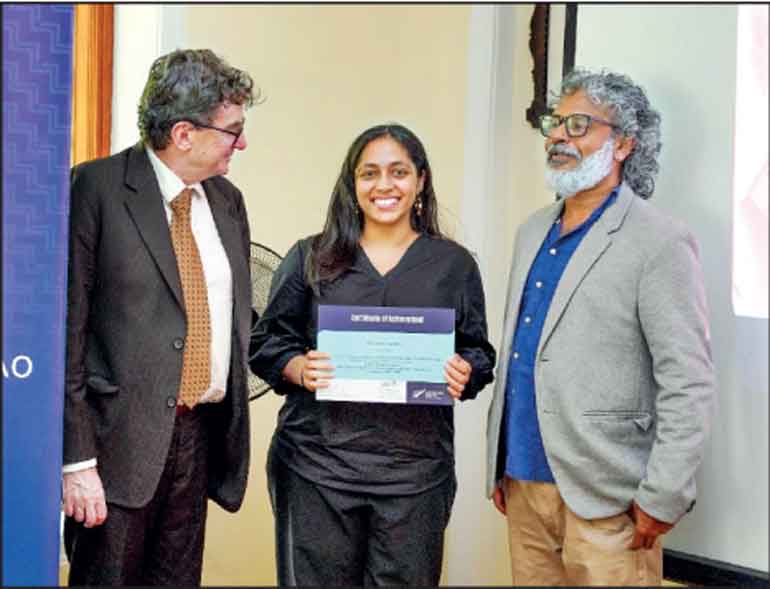 New Zealand High Commissioner David Pine (left) and Booker Prize-winning author Shehan Karunatilaka (right) present a Certificate of Achievement to Shafra Hamid, final year student at CINEC Campus and one of the top 10 winners of the Education New Zealand Short Story Challenge
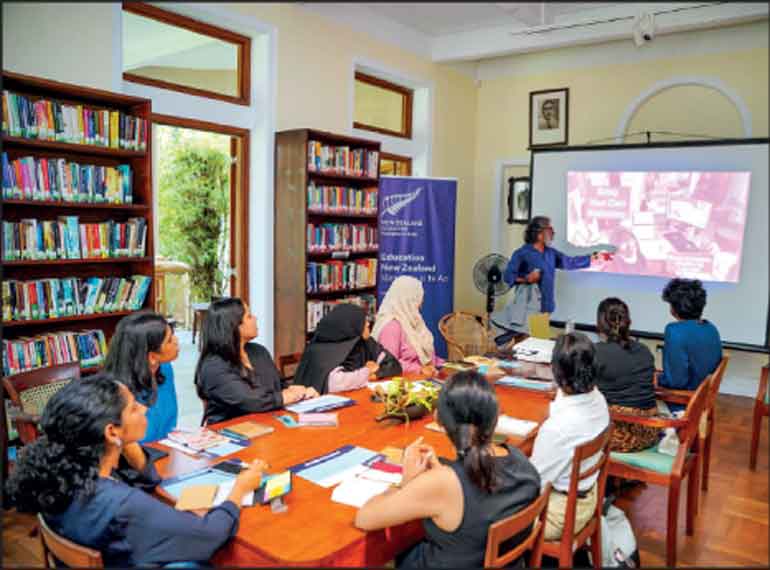 Shehan Karunatilaka conducts a creative writing workshop for the winners of the Education New Zealand Short Story Challenge
By Amira Cader
Finding an authentic voice as a writer requires experimentation, failure and the confidence to move beyond imitation, Booker Prize-winning author Shehan Karunatilaka said at a special media briefing held alongside his engagement with Education New Zealand Manapou ki te Ao (ENZ) recently.
Karunatilaka, who studied at Whanganui Collegiate School and Massey University in New Zealand, was in Sri Lanka as part of ENZ’s engagement with the Colombo International Book Fair (CIBF) 2026, which brought students, aspiring writers and educators together around storytelling, creativity and learning beyond the classroom.
He also led a creative writing workshop for winners of the Education New Zealand Short Story Challenge.
Reflecting on his own writing journey, Karunatilaka said he initially tried to imitate writers such as E.M. Forster, Charles Dickens, Graham Greene and Ernest Hemingway before eventually discovering a voice that felt authentic to him.
Karunatilaka said: “I have been fortunate to learn from teachers, mentors and artists who helped shape my writing. This collaboration lets me share some experiences with young writers and encourage them to keep reading, creating and questioning. If they are dedicated to their craft, they may well discover new voices and unearth new stories.”
“I failed spectacularly at all that until I found the voice,” he said. That discovery became particularly important when he wrote his debut novel ‘Chinaman: The Legend of Pradeep Mathew’, which won the Commonwealth Book Prize, the DSC Prize for South Asian Literature and the Gratiaen Prize.
“When I wrote ‘Chinaman,’ that was when I found that voice – that voice of that drunk uncle, which I felt was unique to me,” he said.
Karunatilaka said voice remained one of the most important, yet difficult-to-define, elements of writing.
“You can say, ‘I want to write like John Grisham,’ and you can try writing like him. But for me, after 50 pages, that would be difficult,” he said.
He also credited writers such as Carl Muller and Kurt Vonnegut among the influences that shaped his approach, while recalling how libraries and second-hand bookshops broadened his literary horizons.
Asked whether technology and social media were weakening the quality of language among younger generations, Karunatilaka said language had always evolved.
“Language evolves. I think that has always been the case,” he said, questioning whether informal digital expressions should automatically be considered inferior.
“Are you saying ‘I’m sorry, my fault’ is better quality English than saying ‘my bad’? I’m not sure,” he said.
He also argued that writers should not necessarily abandon distinctive or more elaborate forms of language simply because contemporary journalism and advertising increasingly favour concise and precise communication.
Karunatilaka said his own writing had benefited from embracing the way Sri Lankans actually speak, an approach he associated strongly with the influence of Carl Muller.
At the same time, he sees opportunities for technology to encourage reading, with platforms such as BookTok and BookTube helping make books more visible among younger audiences. “The generation we talk about reading is kind of cool now,” he observed.
The Karunatilaka-Education New Zealand Manapou ki te Ao (ENZ) collaboration reflects Education New Zealand’s focus on an education experience that extends beyond academic achievement. New Zealand’s learner-centred approach encourages students to question ideas, engage with different perspectives, apply knowledge in real-world contexts and develop capabilities that remain valuable throughout their lives and careers.
Shafra Hamid, a final-year student at CINEC Campus and one of the top 10 winners of the Education New Zealand Short Story Challenge, said the experience had helped her develop her own voice.
“The Education New Zealand Short Story Challenge pushed me to think more critically about my writing and helped me develop my own voice. Having the opportunity to learn from Shehan Karunatilaka and hear how he approaches storytelling has been incredibly valuable,” she said.
The initiative reflects ENZ’s wider focus on education that extends beyond academic achievement, encouraging learners to question ideas, engage with different perspectives and develop capabilities relevant throughout their lives and careers.
Karunatilaka, author of the 2022 Booker Prize-winning ‘The Seven Moons of Maali Almeida’, also revealed that he is currently completing final edits on a new book, which he hopes will be published next year.
“I am doing the final edits now. Hopefully next year, there should be a book,” he said.
For the young writers who had the opportunity to engage with him, his message was ultimately simple: read widely, experiment, question and allow an individual voice to emerge.
- Pix by Shehan Gunasekera
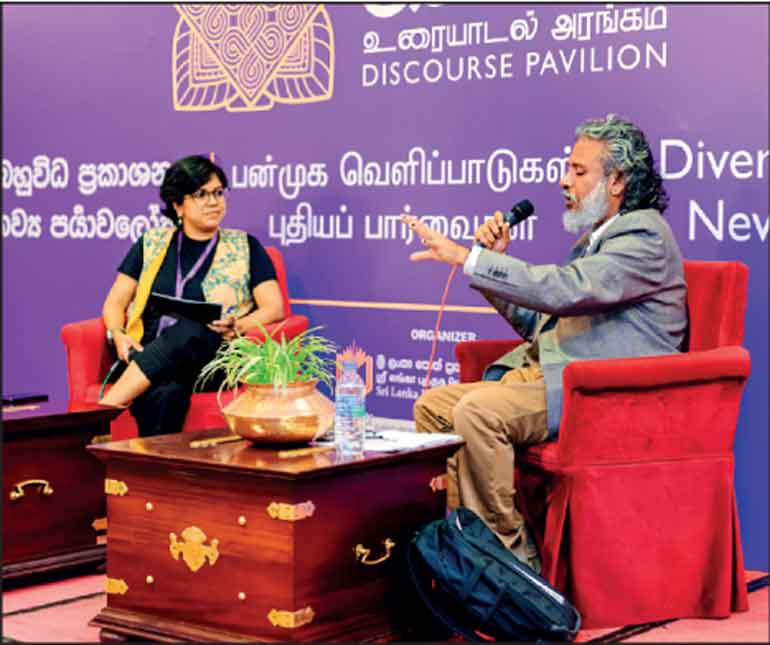
Booker Prize winner Shehan Karunatilaka, representing Education New Zealand, speaks at the Discourse Pavilion during the Colombo International Book Fair 2026 about his educational journey in New Zealand
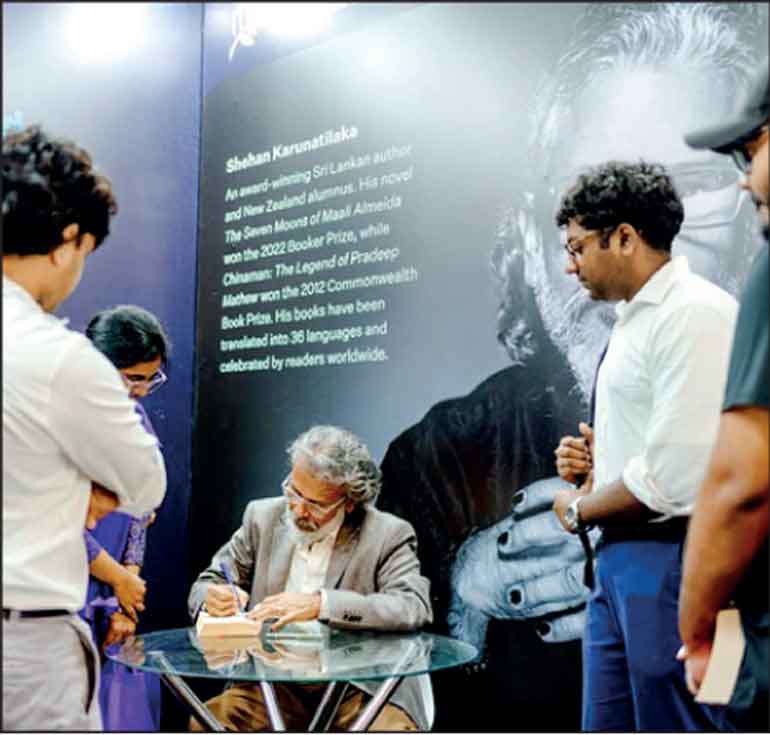
Author Shehan Karunatilaka (Massey University alumnus) signs books and interacts with readers, supported by Education New Zealand




