By Thaliba Cader
As the art market evolves and a new generation of collectors enters the conversation, Anoma’s Quest and Deliverance offer a compelling case for looking beyond aesthetic appeal towards the intellectual, cultural and enduring value of art.
Art is often acquired for what it brings into a room. A painting might complement an interior, introduce colour into an otherwise restrained space or simply offer the pleasure of living with something beautiful. These are perfectly legitimate reasons to buy art. Yet the relationship between an artwork and its owner can extend considerably further than its immediate visual appeal. The more interesting question is what makes a work worth keeping, returning to and eventually passing on. A collection, at its most considered, becomes an expression of intellectual curiosity and personal conviction. It may reflect an enduring interest in an artist, a historical period or a particular set of ideas. Its character emerges not only from the individual works, but also from the connections between them.
This distinction matters in a market where price, reputation and perceived investment potential can influence decisions as strongly as the work itself. Market recognition and artistic significance are not necessarily the same thing. Developing an informed understanding of what one collects requires a willingness to look beyond prevailing opinion and consider what an artwork represents.
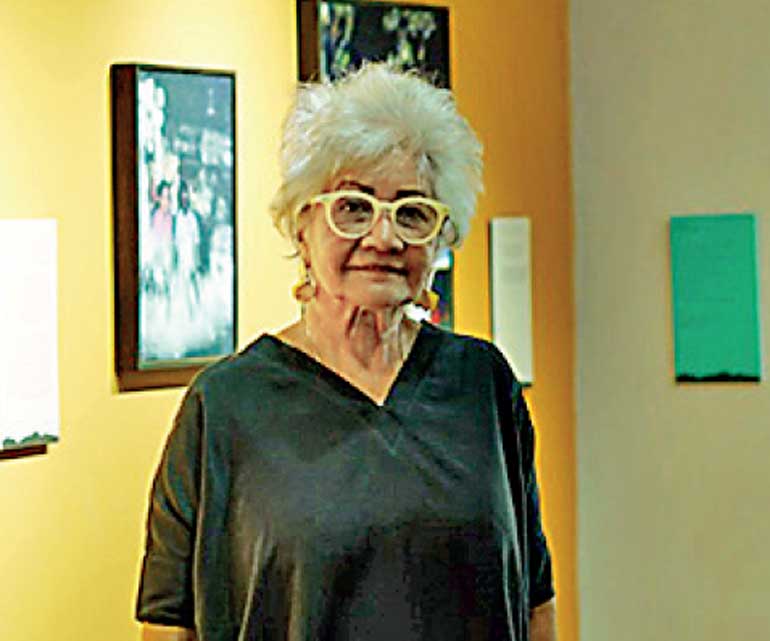
Anoma’s artistic practice offers an interesting perspective on this relationship. Her work engages with subjects that resist easy resolution: historical violence, collective memory, environmental destruction and the responsibilities that accompany human existence. These are not incidental themes attached to otherwise decorative objects. They are central to the ideas informing her practice. Having studied at Central Saint Martins, University of the Arts London, Anoma spent nearly three decades in the UK, initially working across art, design and academia. Since 1995, however, her practice has been devoted exclusively to painting and art installations. Her work has been presented at international platforms including the Venice Biennale at Palazzo Bembo in 2019 and Sotheby’s Hong Kong Gallery in 2016, with solo exhibitions in Sydney, Kuala Lumpur, New Delhi, the Maldives, Dubai and London. Her artistic explorations have also extended to questions of gender, identity and women’s experiences, with her two most recent exhibitions addressing these themes. Across her practice, she continues to explore the psychological and emotional dimensions of conflict, reconciliation, humanity and the natural world.
The difficult business of remembering
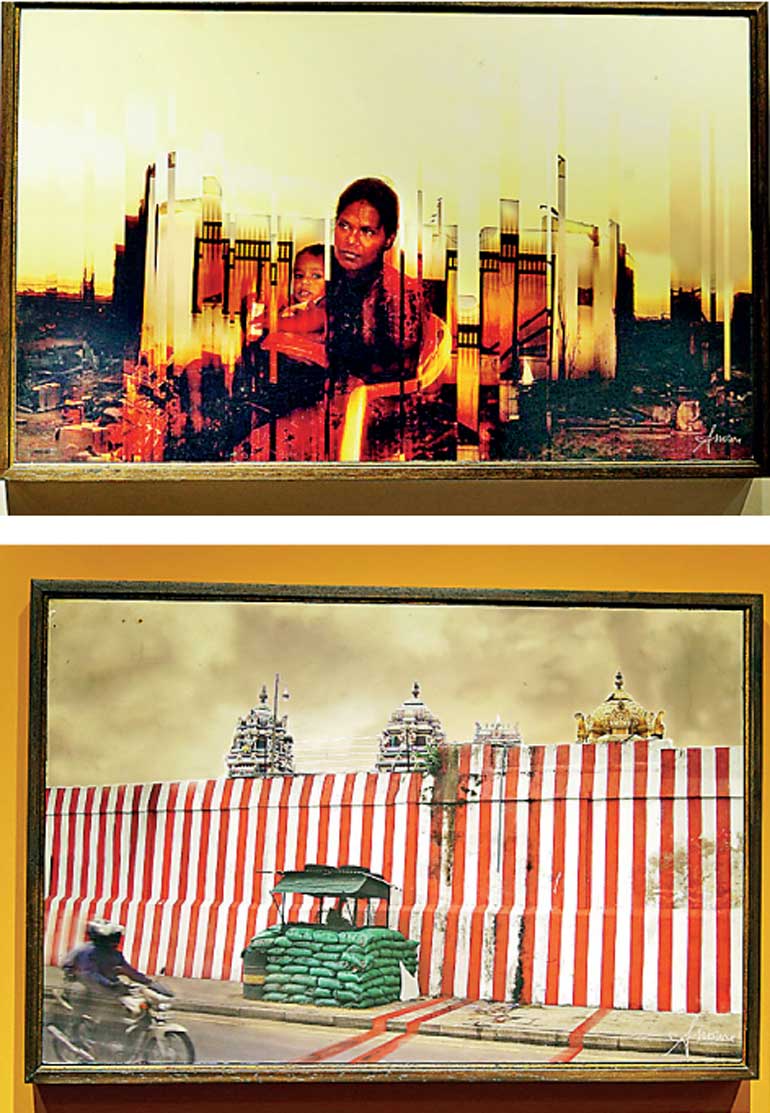
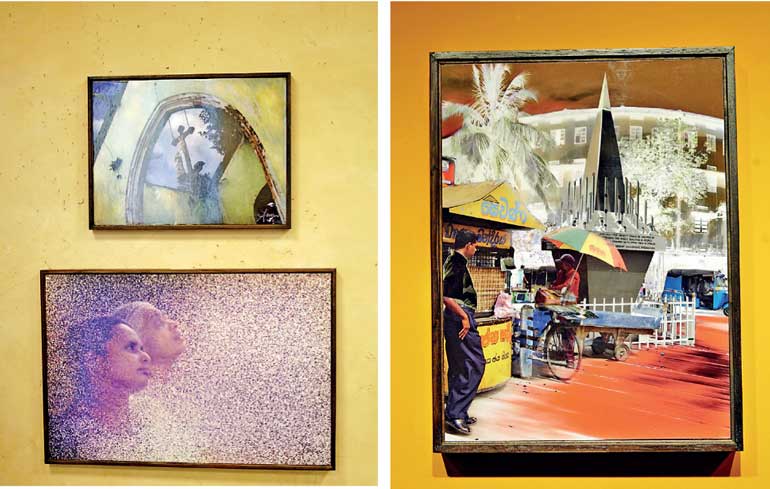
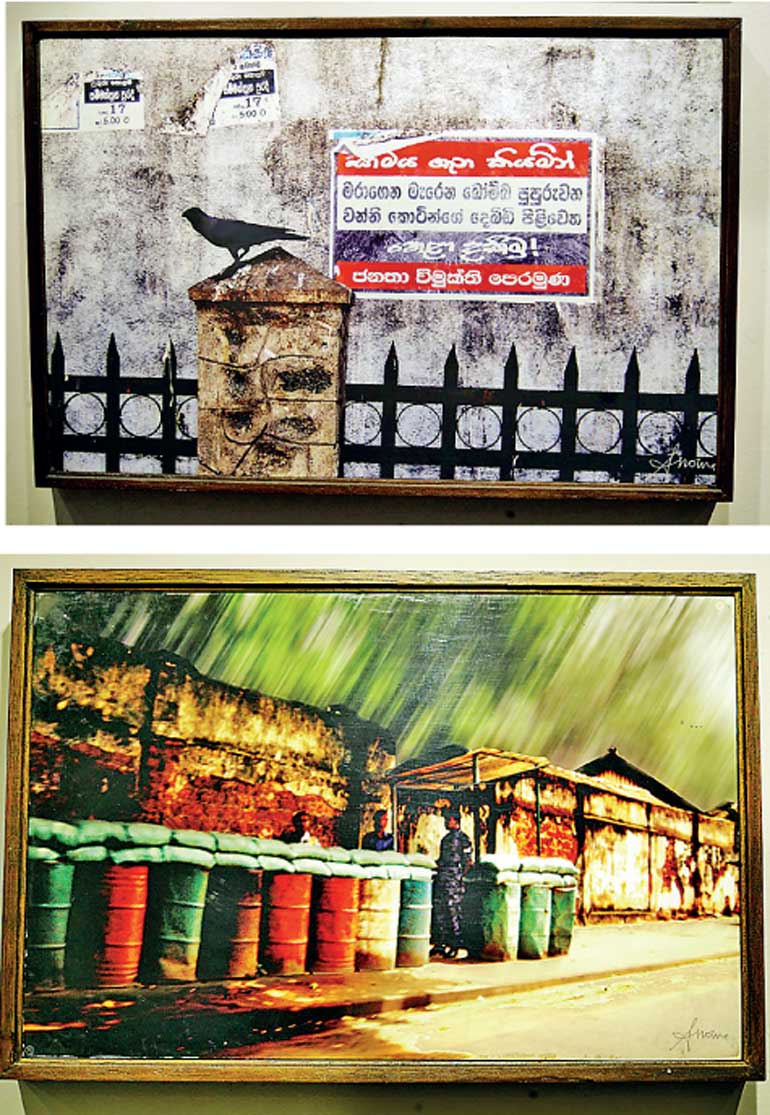
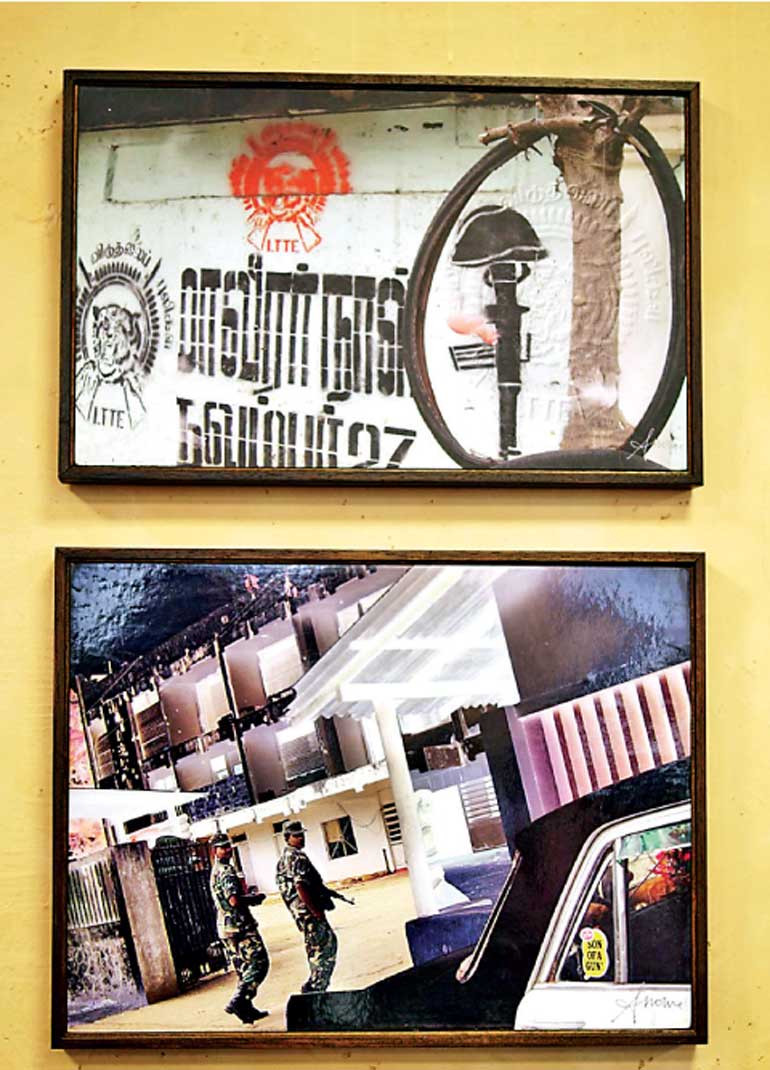
Quest began with a journey to Sri Lanka’s North in 2002, during the ceasefire. Developed over the following four years, it became an investigation into the ways conflict occupies physical landscapes and persists within collective memory.
Its geographical scope extends beyond the North. Images from Colombo and the South appear alongside those from war-affected regions, bringing different manifestations of the country’s experience into the same visual conversation. Through photography and digital manipulation, Anoma explores the possibilities and limitations of representation, and the extent to which an image can communicate experiences that resist straightforward documentation.
“We are brutalised by so much imagery,” Anoma has observed. It is a particularly pertinent observation in a society where images of violence have circulated for decades. Repetition can make suffering familiar without necessarily making it understood. The images in Quest interrupt that familiarity, asking viewers to pause and consider the emotional and historical implications of what they see. Yet tenderness is present within this difficult material. Anoma carried paper doves to the North, giving them to children to play with in a church and placing them in different locations, including cemeteries. In photographs of children playing among damaged buildings, these simple gestures introduce the possibility of innocence and play into a landscape marked by destruction.
The history of the Jaffna Public Library provides another point of reference. Burned in 1981, before the outbreak of the civil war, the library remains a powerful symbol of cultural loss. In one composition, its restored building appears in the distance while ruins in the foreground recall the destruction. Restoration and memory occupy the same frame. Rebuilding a structure, the image suggests, is not necessarily the same as repairing the history attached to it. The project was also a substantial collaborative undertaking, involving writers, researchers, video editors, actors, a film director, a composer and other contributors. Among those associated with the work were Dr. Paikiasothy Saravanamuttu of the Centre for Policy Alternatives and Stefan Mahrdt of Deutsche Bank. This interdisciplinary approach gave the project a wider intellectual context, extending its concerns beyond the artist’s individual perspective.
Kirby de Lanerolle described Quest as ‘an act of conscience as much as an exhibition’. The phrase captures its refusal to treat remembrance as a passive exercise. The civil war ended in 2009, but the questions surrounding disappearances, displacement, accountability and the fate of the missing have not disappeared with it. Art cannot settle these questions. It can, however, resist the temptation to consider them settled.
The limits of human dominion
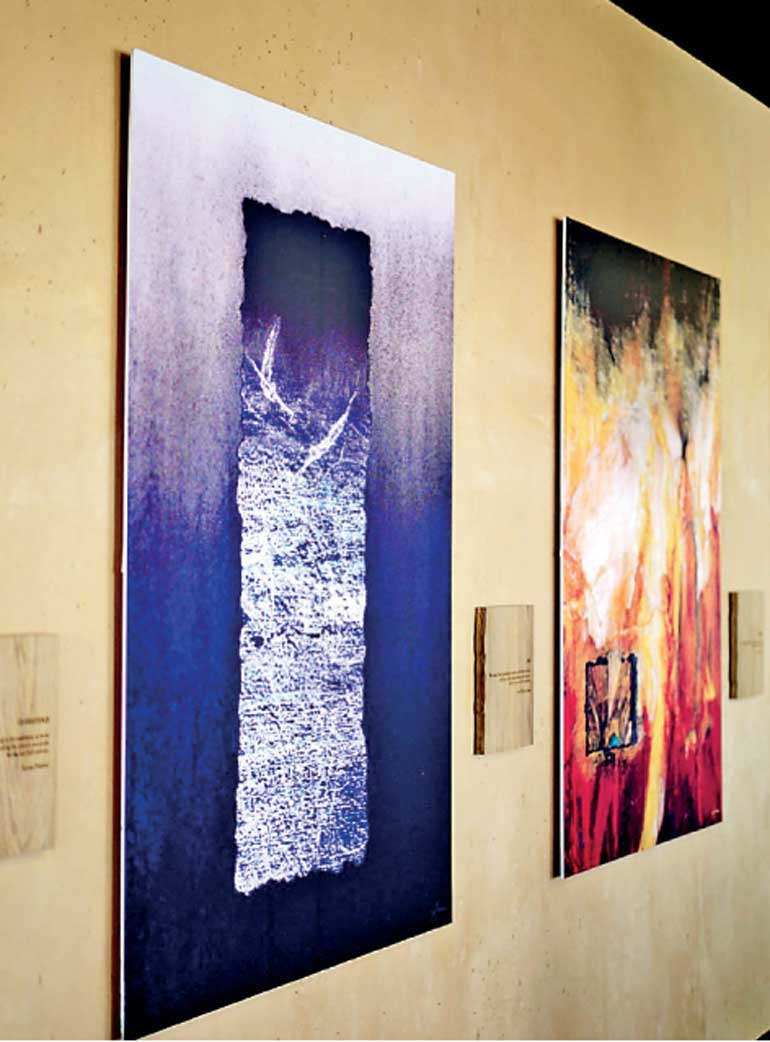
Where Quest examines the consequences of conflict, Deliverance turns towards the environmental consequences of human activity. Developed from 2012, the project reflects an interest that predates the present prominence of climate change in public debate. Anoma held her first solo exhibition addressing environmental destruction in Sydney in 2005.
In Deliverance, the natural world is not merely a backdrop against which human stories unfold. It is the condition on which those stories depend. Human figures appear small against expansive natural forms, challenging the assumption that humanity occupies a position of mastery over its environment.
In The Earth Is Our Raft, Anoma draws on environmentalist Vandana Shiva: “You are not Atlas carrying the world on your shoulder. It is good to remember that the planet is carrying you.” The quotation reverses the familiar image of humanity as the custodian of a fragile planet. The planet, rather, is the larger system that sustains human life. Another work, Coexistence, considers water as both a source of sustenance and a force capable of erosion. It also recalls the thinking of Anoma’s father, Ray Wijewardene, whose ideas explored the possibility of living in concurrence with nature rather than in opposition to it.
As with Quest, the project developed through conversations beyond the art world. Scientists, environmental specialists and development practitioners contributed to its research, while poet Ramya Chamalie Jirasinghe provided accompanying poetry. This interdisciplinary foundation gives the work intellectual breadth without reducing it to an illustrated lecture on environmental decline.
Curator Natasha Ginwala describes Anoma’s artistic oeuvre as ‘a lyrical study of principles of permanence and impermanence’, attentive to ‘expressions of brutality and renewal’, historical time and natural rhythms. The relationship between the two projects is evident. One considers what people do to one another; the other considers what they do to the world that sustains them. Both examine the consequences of human choices, but neither is ultimately an argument for despair. Beneath the difficult histories and unsettling images is an insistence on the possibility of peace, coexistence and renewal.
That sense of possibility is particularly striking when one considers when the projects were first conceived. Quest began more than two decades ago, while Deliverance took shape in 2012. Their questions have not receded with time. If anything, the intervening years have made them more urgent.
The intellectual life of collecting
The history of art collecting offers examples of individuals whose acquisitions became significant not merely because of their financial value, but because of the ideas and convictions that informed them.
Peggy Guggenheim remains one of the more compelling examples. Her collection was shaped by a commitment to modern art and an interest in artists whose reputations were still developing. Through her gallery, Art of This Century, she supported and exhibited artists associated with Surrealism and Abstract Expressionism, including Jackson Pollock. Her collection eventually became an important historical record of modern art. What makes her example relevant is the coherence of her collecting vision. She was not simply acquiring objects that had already achieved universal approval. She was making judgements about artistic movements, individual practices and the direction in which art was moving.
A collection need not be assembled on this scale to have a similar sense of purpose. It may reflect a collector’s enduring interest in a particular period, an artist’s development or a set of social, cultural and environmental concerns. Over time, the works become more than individual acquisitions. Together, they offer a picture of the questions, values and convictions that matter to the person who has brought them together.
There is no prescribed formula for collecting. Some may prefer abstraction or works that offer immediate visual pleasure; others are drawn to art that asks for a more sustained engagement. The significance of a work may emerge through an understanding of its historical context, the research informing its production or its relationship to the artist’s wider practice. For a collector, that evolving relationship can be as rewarding as the initial experience of acquiring the work.
A changing generation of collectors
The international art market is also undergoing a generational shift. The Art Basel and UBS Survey of Global Collecting 2026, produced by Arts Economics, offers an indication of where some of that change is coming from. Among the high-net-worth collectors surveyed across 10 markets, Gen Z recorded the highest average expenditure on fine art in 2025, at $ 347,460. Some 80% of Gen Z respondents also reported conducting independent research before buying.
These figures relate to wealthy collectors rather than the spending habits of an entire generation. Nevertheless, they challenge the assumption that younger people are peripheral to the future of art collecting. They also suggest that independent research and a desire to understand what one is buying are becoming increasingly important to some younger collectors. For artists whose work has a substantial intellectual foundation, this could create an important opportunity. An artwork encountered through a digital platform can become the starting point for a deeper investigation into its subject, provenance, process and place within the artist’s wider practice.
For Sri Lanka, where the development of a broader and more informed collecting culture remains an important opportunity, this generational shift is worth watching.
The value beyond the price
There is another dimension to the relationship between art and its audience that deserves attention. Research into the effects of visual art in healthcare environments has increasingly examined its contribution to wellbeing. A 2025 scoping review of studies across 20 locations found reported benefits among patients, healthcare staff and visitors, including improved wellbeing, positive distraction and better reported mental health outcomes.
In 2019, the World Health Organization also published a major review examining the role of the arts in promoting health and wellbeing, drawing on more than 900 publications. Its findings identified a range of potential benefits associated with both making and engaging with art. These findings should not be interpreted as a promise that owning a painting will prevent illness or extend an individual’s life. They do, however, provide a basis for taking seriously the contribution artistic engagement can make to everyday experience.
A work of art can offer pleasure, provoke thought, encourage reflection or provide a means of engaging with experiences beyond one’s own. Its value may be financial, but it can also be cultural, emotional and intellectual. This is sometimes described in collecting circles as a psychic dividend: the satisfaction and enrichment that accompany ownership beyond any financial return. Anoma’s Quest and Deliverance offer this possibility. Their importance rests not simply on the subjects they address, but on the effort to translate complex historical and environmental concerns into a distinctive visual language, and on the possibility that these works will continue to prompt reflection long after the first encounter.
An enduring relationship
In Search of Horizon brings these two substantial projects into a shared conversation. It offers an opportunity to encounter the ideas that have informed Anoma’s practice over time, while recognising that the works represent only part of a wider artistic undertaking. The distinction between purchasing art and collecting it is ultimately a distinction of relationship. An acquisition may begin with an image, but its significance can deepen through an understanding of the artist behind it, the questions that inform the work and the cultural circumstances from which it emerges.
The most enduring collections are not necessarily those that follow the market most successfully. They are often those that reveal something about the person who assembled them: the histories they value, the questions they pursue and the ideas they are prepared to live alongside. Anoma’s work does not promise easy answers or uncomplicated beauty. It asks for attention, patience and a willingness to look beyond what is immediately visible. Yet, despite confronting some of the most difficult questions of our time, Quest and Deliverance ultimately return to the possibility of repair: rebuilding relationships, reconsidering humanity’s place in the natural world and recognising that the future need not be a repetition of the past. More than two decades after the beginnings of Quest, and 14 years after Deliverance began to take shape, that proposition feels more urgent than ever.
In Search of Horizon: Conversation on art, society and our collective future
- Sunday, 29 November, 2026 | 10 a.m. to 3 p.m
In Search of Horizon is not an exhibition, but a private collection being made accessible to the general public for a limited period, courtesy of Sri Lanka Design Festival 2026. Previously presented to invited guests at a private viewing in August, the collection will be open to the public on Sunday, 29 November, at M2M, for just five hours, from 10 a.m. to 3 p.m
This offers a rare opportunity to encounter these works together, and it may be the only occasion on which the collection is shared in this way.
Anoma Wijewardene