Friday Nov 20, 2026
Friday Nov 20, 2026
Friday, 20 November 2026 00:25 - - {{hitsCtrl.values.hits}}
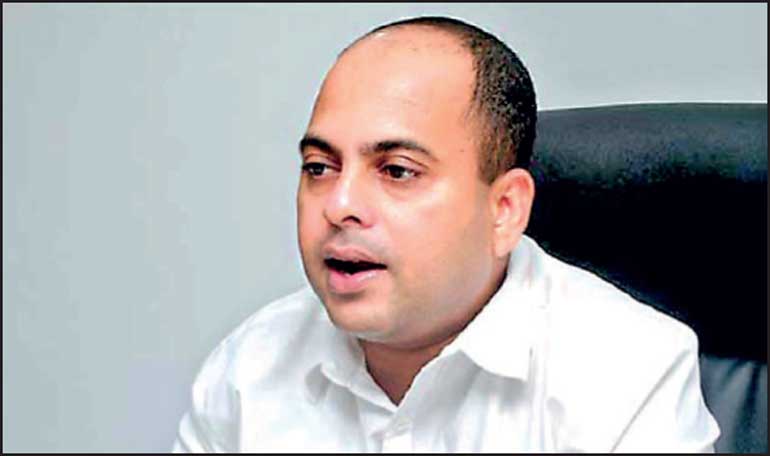
Sectoral Oversight Committee on Infrastructure and Strategic Development Chairman SJB MP S.M. Marikkar
The Board of Investment (BOI) is to take over financial screening of investors for State land from the Urban Development Authority (UDA) as it has failed to bring in any of the $ 500 million in foreign investment targeted for 2026, while a bitumen shortage caused by the West Asia conflict has capped road construction.
These were revealed during a session of the Parliamentary Sectoral Oversight Committee on Infrastructure and Strategic Development on Wednesday (18).
UDA Chairman M.G. Hemachandra said a Cabinet paper was moving forward to hand investor screening to the BOI. The UDA would then focus only on releasing land. “Previously, two places were checking the investor’s financial capability, both us and the BOI, so we submitted a Cabinet paper to hand that task to the BOI,” he said.
UDA officials admitted that none of the $ 500 million pledged for 2026 had materialised. They blamed the West Asia conflict for the cancellation of a planned investment forum in the Middle East.
Committee Chair SJB MP S.M. Marikkar pointed out that Port City had held its own investment forum in Dubai. He argued that forums held in Sri Lanka draw middlemen rather than genuine foreign capital. “Instead of attracting real investors, it looked like you were going to attract brokers, because investors do not come from inside Sri Lanka,” he said.
The UDA will also launch a public website listing available State land, zoning rules and master plan details, so that foreign investors can review opportunities before visiting Sri Lanka.
The conflict has also hit road construction. Road Development Authority (RDA) officials told the committee the agency could not reach full progress this year without bitumen. It is now aiming for 75% by year-end.
Sri Lanka had sourced bitumen from Iran, officials said, but no bitumen has arrived on regular vessels since the conflict began. The RDA has since approved bitumen from China, Thailand and European countries. Officials said its quality matches the Iranian product, but it costs more and carries higher transport charges. The price escalation has been approved for contractors. Officials said the RDA is also in talks on supply from Oman.
The RDA imports bitumen for its 10 plants and passes it on to contractors who cannot import their own. Officials put its immediate requirement at about 30,000 MT for RDA projects. With provincial road agencies included, the figure rises to about 50,000 MT. Main contractors holding Ceylon Petroleum Corporation licences have separately ordered about 20,000 MT.
“If we don’t get a solution within a month, we will have to discuss it on a Government-to-Government basis. That is the only solution,” a senior official told the committee.
Marikkar said the shortage threatened the Rs. 100 billion allocated for rural roads, which he described as the top priority. He said the Government needed a program to make full use of that money. He noted that road spending is projected at Rs. 487 billion in 2027.
He accepted that the conflict was beyond officials’ control, but said planning was also at fault. “It is true that there is a lack of planning. But if we have a plan, we can achieve more than this,” Marikkar said.
The urban development sector recorded 26% spending progress in the first 10 months of the year. The UDA itself was at 19% and forecasts just 35% by end-December. Officials blamed delays in planning projects introduced through the Budget Speech, such as the Life Cities program. They also cited slow progress on foreign-funded housing schemes financed by a bank loan and a Chinese grant, where some contracts had to be terminated and new ones signed. Contractors on the Chinese grant-funded projects have not been given price escalation, and officials said they had raised the matter with the Chinese Embassy.
The committee also directed the Ministry to wind up inactive State companies.



