Thursday Oct 22, 2026
Thursday Oct 22, 2026
Monday, 11 May 2026 00:21 - - {{hitsCtrl.values.hits}}
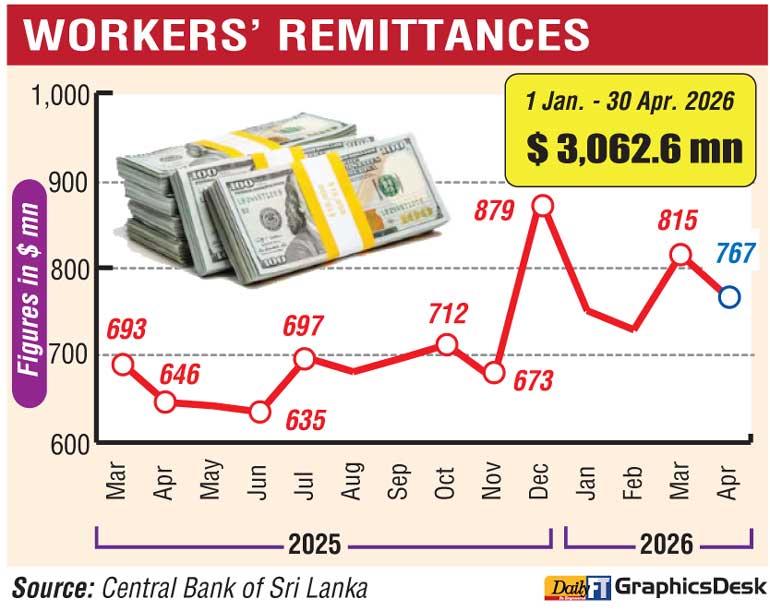
Workers’ remittances climbed to a record high in April, marking one of the strongest four-month performances in the country’s history, despite economic uncertainty stemming from the ongoing Middle East conflict, a region that hosts a large share of Sri Lankan migrant workers.
Latest data from the Central Bank of Sri Lanka (CBSL) showed that inflows rose 19% year-on-year (YoY) to $ 767.9 million. April marked the fourth consecutive month of exceptionally strong remittance inflows, highlighting the continued resilience of Sri Lankan migrant workers and the growing use of formal transfer channels.
The performance also surpassed the previous April high of $ 646.1 million recorded in 2025, making it one of the strongest monthly inflows on record.
Despite the annual growth, remittances in April 2026 declined 6.1% from March’s $ 814.7 million, reflecting seasonal variations in transfer patterns.
The $ 767.9 million inflow in April 2026 now ranks among the country’s strongest monthly performances, behind $ 879.09 million in December 2025, $ 812.73 million in December 2020, and $ 751.13 million in January 2026.
Cumulative remittances for the first four months of 2026 also rose to over $ 3.06 billion, registering a robust 24.5% YoY increase and marking the strongest January-April performance in Sri Lanka’s history.
With export earnings and tourism facing external pressures, remittances have once again reinforced their position as Sri Lanka’s single largest source of foreign exchange, providing critical support to external reserves and broader macroeconomic stability.
The strong start to the year follows a historic performance in 2025, when full-year remittances climbed to $ 8.07 billion, a 23% increase from a year earlier and the highest annual inflow ever recorded.
The total exceeded the previous all-time high of $ 7.24 billion in 2016 by about 12%, firmly cementing remittances as Sri Lanka’s largest and most reliable source of foreign exchange during its ongoing post-crisis recovery.
CBSL data show that the rebound has been both sharp and sustained since the collapse in inflows during the 2022 economic crisis, when remittances fell 31% to a 12-year low of $ 3.78 billion amid acute foreign exchange shortages and the proliferation of informal transfer channels.
The turnaround began in 2023, when inflows surged 57% to $ 5.96 billion, marking the strongest post-crisis recovery on record.
Momentum continued in 2024, with remittances rising a further 10.1% YoY to $ 6.57 billion, supported by a wave of outbound labour migration as thousands of Sri Lankans sought overseas employment in the aftermath of the economic collapse.
Although overseas departures eased slightly in 2025, inflows continued to rise, pointing to higher average transfers per worker.
Historically, Sri Lanka’s workers’ remittances averaged around $ 7 billion a year between 2014 and 2018, or roughly $ 600 million a month, reinforcing their longstanding role as a stabilising pillar of the economy.




