Friday Nov 27, 2026
Friday, 27 November 2026 00:28 - - {{hitsCtrl.values.hits}}

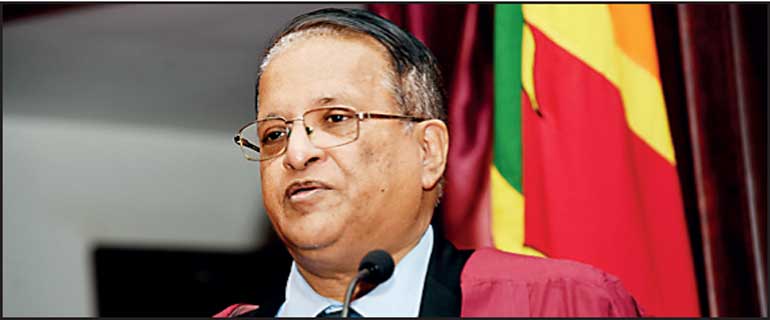
World Bank Lead Economist
Dr. Harsha Aturupane
– Pic by Shehan Gunasekara
Sri Lanka’s economists understand growth, markets and the role of the State better than ever, but the public they must persuade still backs a market-stifling model, and closing that gap is now the profession’s main task, World Bank Lead Economist Dr. Harsha Aturupane said.
The distinction matters because in a democracy, economic policy can only go as far as voters will allow. Economists can diagnose problems and design solutions, but reforms that lack public consent tend to be diluted, delayed or reversed at the next election.
Sri Lanka’s recovery since the 2022 crisis rests on an IMF-backed program of higher taxes, cost-reflective energy pricing, State-owned enterprise restructuring and an independent Central Bank, and every one of these measures is politically contested.
Dr. Aturupane’s argument moves the binding constraint on growth from technical knowledge to public persuasion. That makes the durability of reform as much a question of whether economists can win the public argument as of whether their prescriptions are right.
Delivering the keynote address at the Sri Lanka Economic Association (SLEA) Annual International Conference last Saturday, Dr. Aturupane told the gathering that this gap explains why the country remains stuck.
“Our country, I often think, is the last country fighting the Cold War, the economics of the Cold War, on the losing side,” he said.
He said the gap has not always run this way. In the early 1970s, which he called the worst period in Sri Lanka’s economic history up to then for stifling markets, people queued for hours for a quarter pound of bread and went home hungry. Many economists of that era, academics among them, strongly backed those policies. It was the public that broke with them.
“1977 is when our population rejected that economic model and brought in a model more concerned with what we know of the dynamism of markets and the importance of a liberalised economy,” Dr. Aturupane said.
That position has now reversed. He said economists in academia, policymaking, the private sector and research have a good grasp of growth and of the roles of the State and markets. The public, however, still works with a model in which markets are to be stifled, for reasons he described as emotional or imaginary.
He said recent history shows the problem is not a lack of economic knowledge. From 2008, economists warned against borrowing on private international markets at very high interest rates to fund activities that did not earn enough foreign exchange to repay the loans. The Central Bank and academics also warned the Government that it could not control the inflation rate, the interest rate and the exchange rate at the same time. Governments went ahead regardless.
“We would encounter economic disaster, and we did. It was just a case of when, not if,” Dr. Aturupane said.
He added that the 2019 tax cuts and the deficit financing that followed were wrongly presented as Keynesian demand stimulus. That tool is meant for an economy in recession that is producing below its capacity. It does not expand the capacity of a developing economy.
The blind spot in public debate, he argued, is State failure. Markets can produce very unequal outcomes, and the case for State intervention in the interest of social justice is deeply rooted in the Sri Lankan psyche and drives voter behaviour.
The costs of State failure are far less understood: short-sighted policymaking, administrative and enforcement costs, loss-making State-owned enterprises funded by taxpayers, power imbalances between the State and the population, and rent-seeking, ‘popularly known as corruption’. He urged university economists to give it more emphasis in their courses.
“State failure is more dangerous and more damaging than market failure. The State can drive an entire population into poverty. The State is much more powerful than any one agency in the market,” he said.
His example was 2022, when the exchange rate collapsed from Rs. 201 to Rs. 360.
Dr. Aturupane said the same history shows what market-friendly institutions can achieve. The 1833 Colebrooke-Cameron report drew on the classical economics of Adam Smith, Jeremy Bentham and David Ricardo, and it laid the framework for the plantation economy. He said international data sets show Sri Lanka had the highest per capita income in Asia, above Japan’s, from about the 1830s to about the 1920s. Market-stifling policies later cost the country its competitiveness, and market-oriented economies overtook it.
The cost is still visible. Sri Lanka scores well below what its per capita income would predict on the 2025 Knowledge Economy Index, which rests on human capital, information and communications technology, innovation, financial foundations and the quality of institutions. It also underperforms on the gross enrolment rate in tertiary education and on innovation and technology indices.
Dr. Aturupane also took on the term ‘neoliberalism’, which he said is a political label rather than a school of economic thought. He pointed to the liberalisation wave led by J.R. Jayewardene in 1977, Deng Xiaoping in China, Margaret Thatcher in Britain from 1979 and Ronald Reagan in the US from 1980. He said the globalisation that followed generated wealth on a scale never seen before in human history.
“When people argue against neoliberalism, I take the position that the empirical evidence is fully in favour of a democratic political system and a modern market economy. I hope the economics profession can take this message out in a persuasive way,” he said.