Sunday Sep 13, 2026
Sunday Sep 13, 2026
Tuesday, 9 June 2026 02:49 - - {{hitsCtrl.values.hits}}
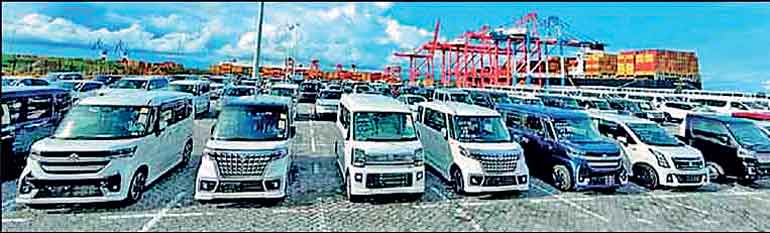
Sri Lanka Customs said vehicle imports have remained resilient despite the temporary surcharge imposed on imports earlier this year, with revenue from the sector continuing to account for around one-third of total Customs collections.
Speaking to the media, Sri Lanka Customs Spokesperson and Additional Director General Chandana Punchihewa said the anticipated slowdown in vehicle imports had not materialised, despite reports of unsold inventories in the market.
According to Customs data, vehicle-related taxes contributed Rs. 91 billion out of a total revenue of Rs. 235 billion in January, Rs. 75 billion out of Rs. 215 billion in February, Rs. 77 billion out of Rs. 231.9 billion in March, and Rs. 84 billion out of Rs. 242.9 billion in April. As at 28 May, Customs had collected Rs. 212 billion in total revenue, of which Rs. 76 billion came from vehicle imports.
Punchihewa said vehicle imports continue to generate around 30% of Customs revenue, broadly in line with last year’s contribution of between 30% and 35%.
He noted that while there had been a slight reduction in import volumes following the surcharge, the decline had not translated into lower revenue collections.
Punchihewa also attributed part of the revenue strength to the depreciation of the rupee against the US dollar, noting that higher exchange rates increase the rupee value of Customs duties and taxes collected on imported vehicles.
“Despite the surcharge, no reduction has been reported as previously expected,” he said.
The Government imposed a 50% surcharge on Customs Import Duty applicable to vehicle imports in May as part of measures aimed at managing foreign exchange outflows and moderating import demand.
CBSL net dollar sales rise to $ 211 m in May
Amid pressure on the rupee from the global supply shock caused by the Middle East war, the Central Bank of Sri Lanka (CBSL) emerged as a net seller of foreign exchange for a second consecutive month in May.
Official data showed net dollar sales of $ 211.3 million as the rupee came under significant depreciation pressure and touched a four-year low.
The CBSL purchased $ 12 million and sold $ 223.3 million during the month, marking a departure from its recent role as a net buyer of foreign exchange aimed at rebuilding reserves under Sri Lanka’s International Monetary Fund (IMF)-supported economic program.
Despite the May outflow, the CBSL remained a net purchaser of $ 485.9 million during the first five months of 2026. In 2025, the CBSL was a net purchaser of $ 2 billion.
The CBSL first turned into a net seller of dollars in April, recording net sales of $ 13 million. That marked the first month of net foreign exchange sales since June 2024, after an extended period of reserve accumulation.
However, despite net dollar sales in both April and May, Sri Lanka’s gross official reserves increased by 1.7% to $ 6.87 billion at end-May from $ 6.76 billion a month earlier, indicating continued support from foreign inflows and other reserve-building measures.
To defend the currency, the CBSL would have to tighten the monetary policy rate, effectively raising interest rates, and choke credit-led demand. Or, it would have to allow the rupee to depreciate. Selling dollars from reserves to protect the domestic currency risks depleting reserves and pushing the economy towards a Balance of Payments crisis.




