Saturday Apr 25, 2026
Saturday Apr 25, 2026
Saturday, 25 April 2026 01:47 - - {{hitsCtrl.values.hits}}
By Charumini de Silva
|
Country Director |
Unpaid care work remains one of the most overlooked yet critical barriers to gender equality and inclusive growth in Sri Lanka and across South Asia, a senior International Labour Organisation (ILO) official said, urging governments and partners to accelerate investment and policy reform in the care economy.
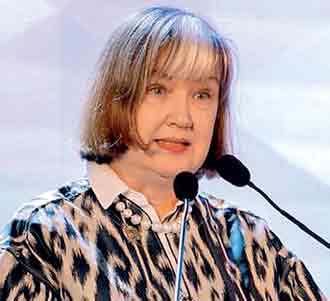
Addressing the South-4-Care Learning Hub in Colombo, ILO Country Director Joni Simpson stressed that care work, while foundational to societies and economies, continues to be “unseen, undervalued, and underinvested.”
She noted that unpaid care work is carried out largely by women, limiting their opportunities and reinforcing structural inequalities.
“They shoulder the majority of unpaid care responsibilities, often at the expense of other activities, including participation in paid employment,” Simpson said.
At the same time, many households lack access to affordable, accessible, and quality care services, including support for persons with disabilities, further constraining women’s ability to engage in the labour market. “This is not only a gender issue—it’s a matter of social justice,” she stressed.
Highlighting Sri Lanka’s shifting demographics, Simpson pointed to rapidly rising demand for care services driven by ageing, migration, and changing family structures.
“About 18% of the population is aged 60 and above, up from 12% a decade ago, the share of children has declined to around 21% and the median age has risen to approximately 35 years,” she said, warning that these trends are placing increasing pressure on healthcare, pensions, and social services, while also constraining economic growth through a shrinking labour force.
“Care systems remain fragmented and under-resourced, relying heavily on unpaid and informal work,” she said.
She disclosed that across South Asia, millions of women remain outside the workforce largely due to care responsibilities, while those engaged in paid care work, especially in domestic and community settings, often face low wages, limited legal protection, and lack of recognition and formalisation.
“This is not only a matter of equality, it is a constraint on productivity, resilience, and inclusive growth,” Simpson said.
The Country Director also commended Sri Lanka for its recent ratification of ILO Convention 190, adopted in Geneva, describing it as a “significant milestone” in strengthening safe and dignified workplaces, including within the care sector.
Echoing global policy consensus, Simpson stressed that investment in the care economy should be seen not as a cost but as a driver of growth.
“Investing in care is not a cost, it’s a catalyst,” she said, referencing the ILO’s framework for transforming care systems.
Central to this approach is the “5Rs framework” which includes; recognise unpaid care work, reduce the burden through services and infrastructure, redistribute responsibilities, reward care workers, and represent them in decision-making. “This provides a clear roadmap to build more equitable and inclusive care systems,” she said.
The ILO is supporting Sri Lanka’s efforts to develop a national plan on social care, working with multiple Ministries including Labour, Women and Child Affairs, And Rural Development.
Simpson noted that effective reform requires broad partnerships across the Government, development partners, private sector, workers and employers, and communities and academia. “No single actor can do this alone,” she said.
The South-4-Care initiative, launched in 2025, is designed as a platform for knowledge exchange and collaboration across countries including Sri Lanka, India, Pakistan, Nepal, and Afghanistan. Over the four-day Learning Hub, participants will explore policy innovations, financing models, social protection systems, and gender-responsive care strategies.
“As we begin this Learning Hub, let us commit to taking action to build inclusive care systems that work for everyone in South Asia,” she added.
Simpson highlighted the importance of translating dialogue into action, including through shared knowledge platforms that document practical solutions and best practices from the Global South.
She also pointed to emerging models within the social and solidarity economy, such as cooperatives and community-based care systems, which demonstrate how care can be delivered in ways that are efficient, inclusive, and grounded in dignity.
“Advancing decent work in the care economy is about more than responding to current needs—it’s about shaping the future of work, advancing gender equality and social justice, and building resilient societies,” she said.
Pic by Lasantha Kumara