Tuesday Sep 15, 2026
Tuesday Sep 15, 2026
Friday, 16 January 2026 00:23 - - {{hitsCtrl.values.hits}}
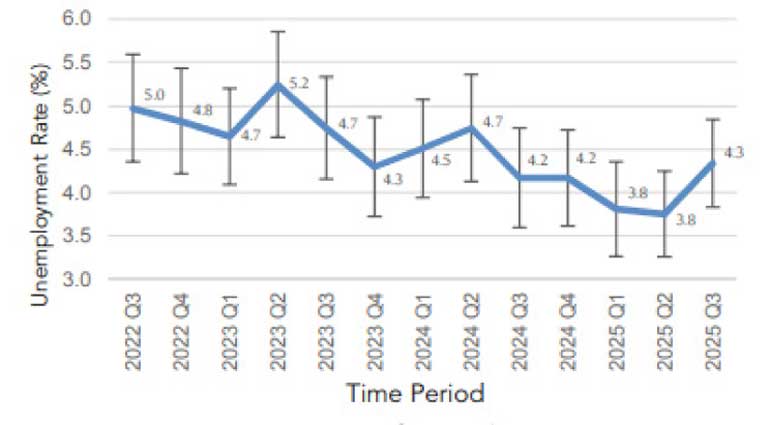
Sri Lanka’s unemployment rate increased to 4.3% in the third quarter of 2025, the highest since the third quarter of 2024, reversing the steady improvement seen earlier in the year, according to the Department of Census and Statistics’ Labour Force Survey.
The rise in unemployment occurred because labour force entry, especially by women, outpaced job creation, with employment declining slightly quarter-on-quarter (QoQ).
The unemployment rate had remained at 3.8% in both 1Q and 2Q 2025 before edging up in the July-September period, alongside a rise in the number of unemployed persons to 367,282. The increase marks the first quarterly deterioration since early 2024, though unemployment remains below the 4.4% recorded in 2024 and well below the peaks seen during the crisis years.
The uptick in unemployment occurred even as labour force participation improved. The labour force participation rate rose to 49.9% in 3Q, from 49.3% in 2Q 2025 and 49.7% in 1Q 2025. Female participation increased to 33.9% from 31.7% in the previous quarter, while male participation declined to 68.6% from 69.5%, suggesting that new entrants to the labour market outpaced job creation.
Total employment slipped to 8.10 million in 3Q, down from 8.17 million in 2Q 2025 and 8.14 million in 1Q. This followed two consecutive quarters of employment growth at the start of the year. The contraction was driven largely by agriculture, where employment fell sharply QoQ, while industry and services continued to record modest gains compared with a year earlier. Services remained the dominant employer, accounting for 49.8% of total employment, up from 49% in 2Q but broadly in line with recent quarters.
Youth unemployment remained persistently high despite overall labour market stability. The unemployment rate for those aged 15-24 stood at 19.2% in 3Q, higher than the national average and only marginally lower than levels recorded in 2024. Unemployment among those aged 25-29 rose to 13.3%, while remaining low at 1.7% for those over 30, a pattern broadly unchanged from previous quarters.
By education level, unemployment among those with G.C.E. A/L qualifications and above increased to 7% in 3Q, up from 5.9% in 2Q 2025, with female unemployment consistently higher than male unemployment across all education categories.
The data suggest that while headline indicators have stabilised compared with earlier years, QoQ movements continue to reflect weak labour absorption, particularly for young and educated entrants.




