Tuesday Oct 06, 2026
Tuesday Oct 06, 2026
Tuesday, 6 October 2026 04:22 - - {{hitsCtrl.values.hits}}
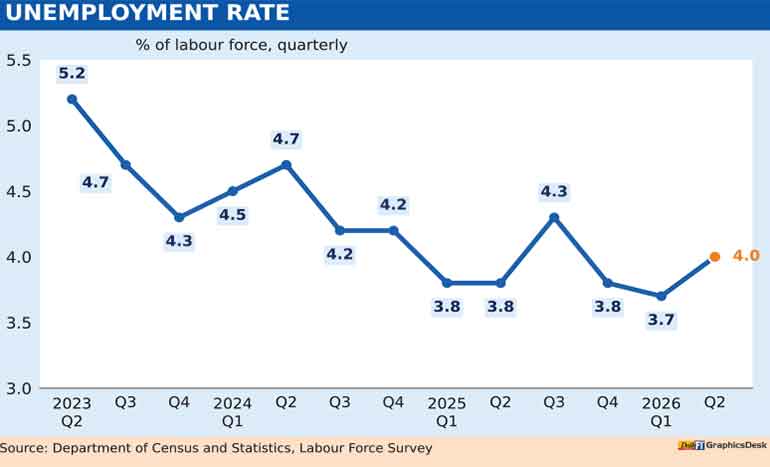
Sri Lanka’s unemployment rate rose to 4% in the second quarter of 2026 from 3.8% a year earlier, as more people entered the labour force than the economy absorbed, even though employment grew and industry hired strongly, official data showed.
The rate was also up from 3.7% in the first quarter, the Department of Census and Statistics (DCS) said in its quarterly Labour Force Survey. It remains below the 4.3% recorded in the third quarter of 2025. The number of unemployed was estimated at 340,240.
The rise came alongside job growth. Employment increased by 73,578, or 0.9%, year-on-year (YoY) to 8.25 million, and by 143,348, or 1.8%, from the first quarter. The labour force participation rate, the share of people aged 15 and over who are working or looking for work, rose to 50% from 49.3% a year earlier, above the annual rates recorded in each year from 2021 to 2025. The labour force stood at 8.59 million.
Industry drove the hiring. Employment in the sector, which covers manufacturing, construction, mining, and utilities, rose 9.3% YoY to 2.25 million, lifting its share of total employment to 27.3%, the highest in the DCS series published since 2020. Services employment grew 1.4% to 4.06 million, while agriculture shed 173,568 jobs, a decline of 8.2%, to 1.93 million.
Women accounted for all of the net increase in employment. Female employment rose by 127,991, or 4.7%, to 2.85 million, while male employment fell by 54,414, or 1%, to 5.39 million. Female participation rose to 32.7% from 31.7%. Even so, the female unemployment rate held at 6.1%, against 2.8% for men, and women made up 72.8% of the 8.58 million people outside the labour force.
The YoY rise in the headline rate was driven by men, whose unemployment rate rose to 2.8% from 2.6%, as male participation climbed to 70.3% from 69.5%.
Young people continued to bear the brunt. Unemployment among 15- to 24-year-olds stood at 17.8%, and those aged under 30 accounted for 72% of the unemployed. The sharpest deterioration was among 25- to 29-year-olds, whose unemployment rate rose to 12.1% from 9.3% a year earlier. Among women in that age group, the rate was 19.7%.
By contrast, unemployment among 20- to 24- year-olds eased to 17% from 19.6% a year earlier, though it was up from 15.8% in the first quarter.
Education offered little protection. The unemployment rate among those with G.C.E. Advanced Level (A/L) qualifications or higher rose to 6.7% from 5.9% a year earlier, and this group made up 165,361, or 49%, of the unemployed. For women with A/L or higher qualifications, the rate was 9.6%. The DCS said unemployment was consistently more acute among educated women than educated men.
Data on hours worked point to some slack among the employed. The share of employed people who worked 40 hours or more a week fell to 61.8% from 63.3% a year earlier and 68.5% in the first quarter. The share who had a job but did not work during the reference week rose to 5.4% from 3.7%.
Private sector employees made up the largest group of workers at 3.82 million, followed by 2.63 million own account workers. The public sector employed 1.13 million, or 13.7% of the workforce.
The survey, based on a quarterly sample of 6,250 housing units, covered April to June. The DCS cautioned that sampling error should be considered when interpreting changes in the unemployment rate. The 2025 estimates were reweighted using Census of Population and Housing 2024 data.



